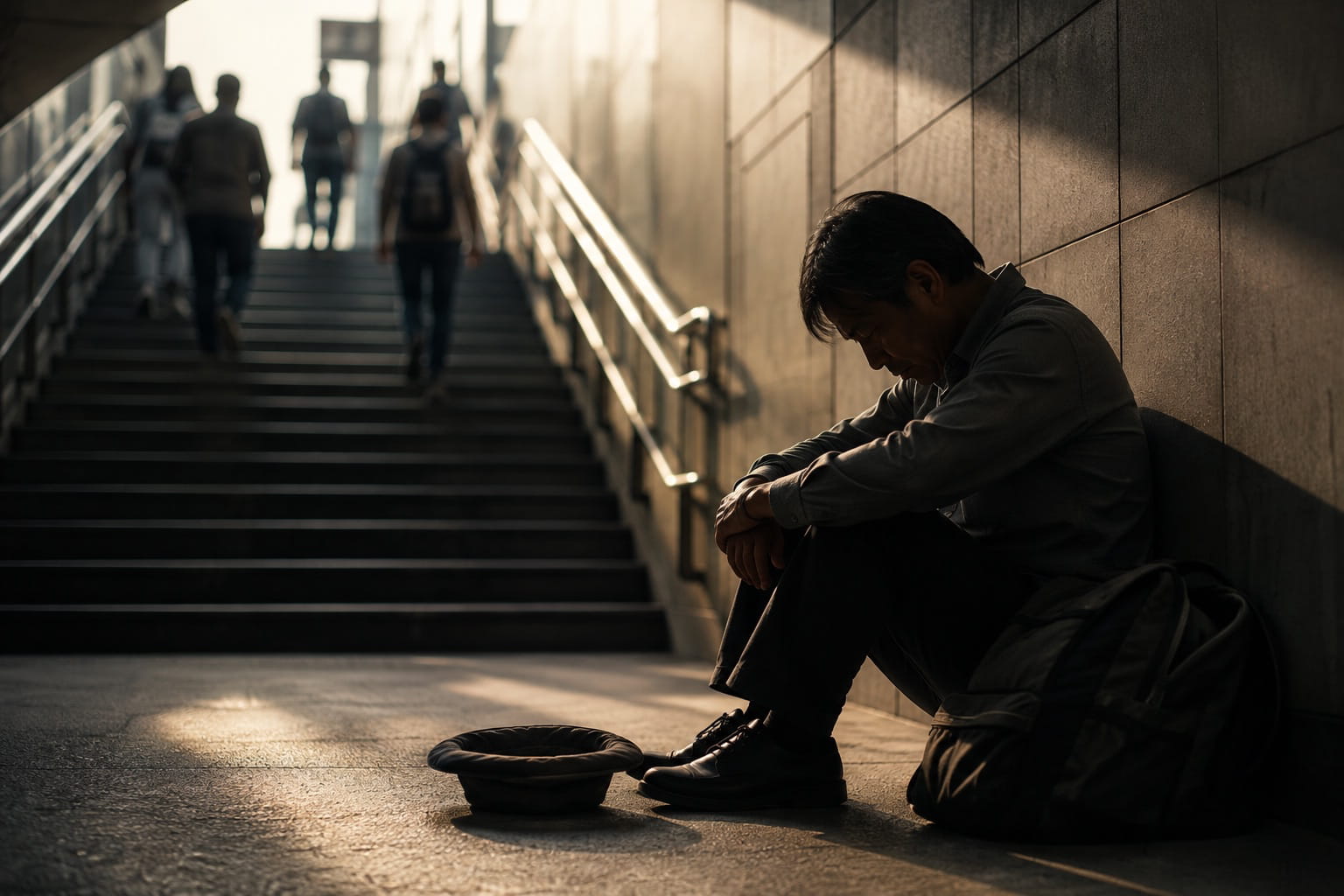
I was walking through a connecting train station, hurrying down the stairs to catch my train, when something at the corner of my eye caused me to pause. Seated quietly beside the staircase, almost hidden from the stream of commuters, was a man with a standard-sized backpack resting beside him. Clipped to it was a sheet of white paper that read:
"I'm from Laguna. My wallet and phone got snatched. I only need enough money for the bus and jeepney fare to go home."
As I continued walking, I found myself wondering about him. Curiosity made me glance back. He looked well-groomed. His shoes were clean. His posture was upright, yet his eyes remained fixed on the ground, as though trying to disappear into the crowd.
Without fully understanding why, my feet carried me back up the stairs. I walked toward him, placed in his hand what I believed would be enough for the fare he had written about, nodded quietly, and hurried away without waiting for a conversation.
On the train, however, I was still thinking about the encounter. Was his story true? Had he genuinely been robbed, or had I simply become another passerby persuaded by a familiar act? I realized I would probably never know. then another thought emerged.
For a brief moment, I imagined what it would feel like to lose every form of control over one's circumstances. How quickly an ordinary day could become one of complete helplessness. It reminded me that every person, regardless of status or success, lives closer to vulnerability than we often admit.
Money is a form of power.
Time is another.
Health is another.
Even the simple ability to choose where we go, what we do, and how we solve our problems is a privilege we seldom recognize until it vanish. As I replayed the image of the man sitting beside the stairs, I wondered who he had been before that moment. He could be someone respected in his workplace, or maybe a father, a husband, a son, or a friend. Perhaps he had always been capable of taking care of himself. I did not know.
What struck me most was not his request for help, but the dignity with which he carried himself. There was a trace of pride that had not vanished, only been temporarily humbled by circumstances beyond his control. His situation had taken away his power, but not necessarily his humanity.
That realization led me to ask a question that extended far beyond the stranger I met that day: What remains of a person when all the symbols of power are stripped away? If our money, our titles, our possessions, our achievements, and every visible marker of success were suddenly removed, what would remain for the world to see?
Would our character become clearer?
Would we still recognize ourselves?
More importantly, would society still recognize our worth?
Too often, we unconsciously measure people by what they possess instead of by who they are. We offer admiration to those with influence and overlook those whose circumstances have rendered them powerless. Yet vulnerability has a way of revealing a truth that success often conceals: every human life possesses inherent dignity, regardless of status or circumstance.
This is why kindness is never really about determining whether another person deserves our help. Nor is it about calculating whether they will repay us. Kindness first reveals something about the one who chooses to give.
Whether the man was telling the truth is a question I may never answer. But I have come to realize that the greater truth did not belong to him alone. It belonged equally to me. That encounter raised a different question:
When faced with another person's vulnerability, will I respond with suspicion, or with compassion?
Life does not place strangers in our path so that we can solve their problems… they appear simply to reveal our own hearts.
Image
About the Author
The Wanderer travels not to escape life, but to understand it.
Every road, every stranger, every quiet conversation becomes an invitation to look beyond landscapes and into the human heart. These reflections are not merely about places visited, but about the unseen journeys we all take through hope, loss, kindness, purpose, and belonging.
The World Through a Wanderer's Eyes is a collection of stories that remind us that the longest journeys are often the ones that lead us back to ourselves.