


Super Apps, Battlefield Metrics, and the New Regional Champions
Southeast Asia stands at the intersection of digital transformation and economic ambition. With a combined population nearing 700 million and a median age under 30, ASEAN is one of the world’s youngest and most connected regions. Over 460 million citizens are now online, and nearly all of them access the internet through smartphones. This mobile-first generation is driving a digital economy projected to reach $300 billion by 2025, turning the region into the most dynamic digital frontier outside China and India.
Unlike in the West, where legacy systems and credit-heavy infrastructures dominate, Southeast Asia’s growth is fueled by inclusivity, creativity, and necessity. Platforms here thrive not by imitation but by innovation—fusing technology with cultural intuition and regional pragmatism.
1. ASEAN’s Platform Landscape: Key Numbers and Dynamics
According to the 2023 Google-Temasek-Bain report, ASEAN’s digital economy reached $218 billion in 2024, growing at an annual rate of 27 percent, far outpacing the global average of 15 percent. The region’s unique advantage lies in its mobile-first ecosystem, with 90 percent of internet users relying on smartphones as their gateway to work, finance, entertainment, and education.
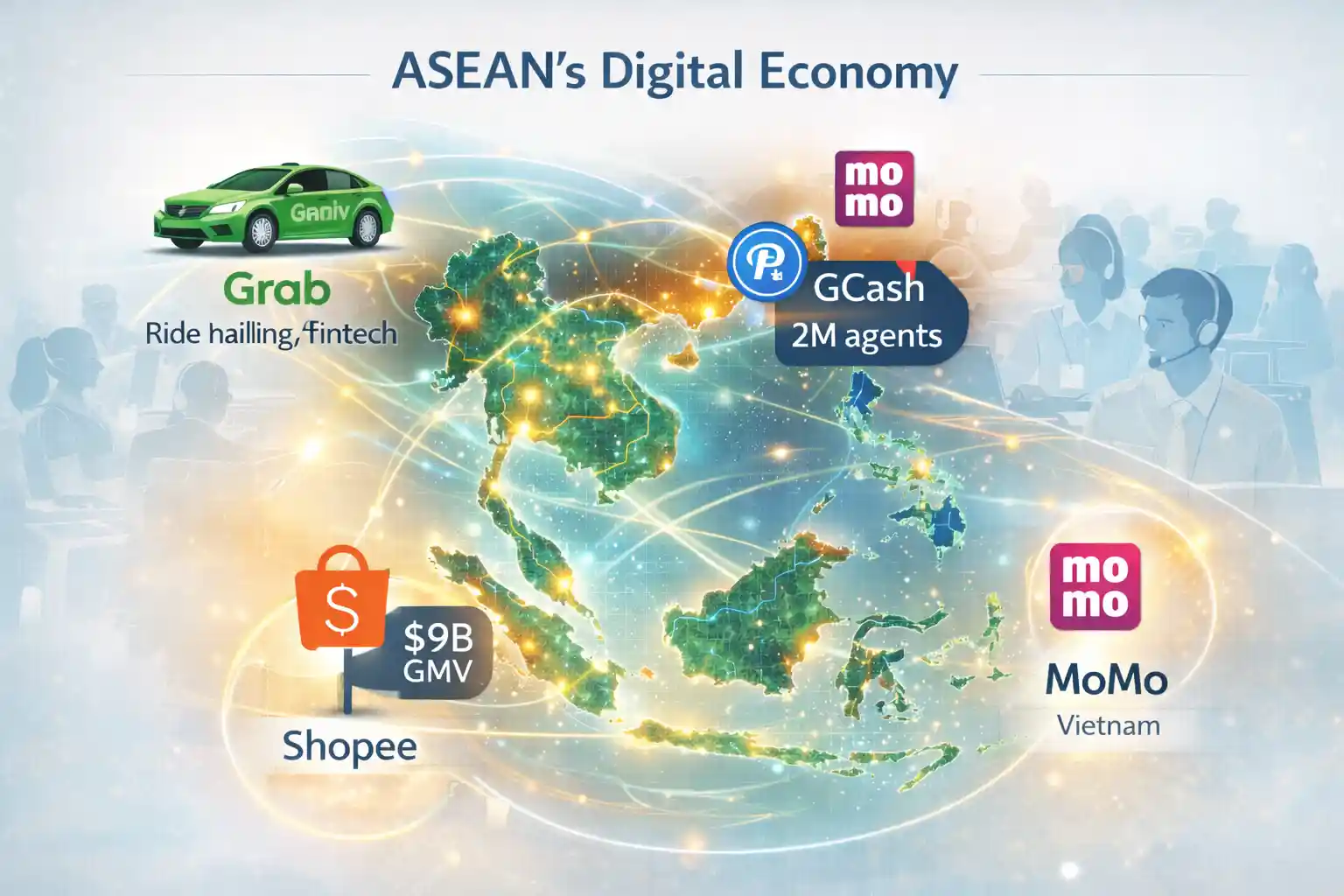
This mobile dominance has transformed ASEAN into a proving ground for “platform stacking”—the integration of multiple services within a single ecosystem. From ride-hailing to e-payments, food delivery, and even insurance, these platforms act as self-contained economies, each supported by vast networks of BPO operations and AI-driven customer engagement hubs.
| Model | Leader | Revenue Tactics | BPO Impact |
| Super Apps | Grab (Singapore) | Ride-hailing to fintech to ads ($2.3B revenue) | 10K+ support agents in Manila and Kuala Lumpur |
| E-Commerce | Shopee (Singapore) | 0% fees to seller loans and ads ($9B GMV in Indonesia) | AI chatbots handle 60% of queries |
| Fintech | OVO (Indonesia) | QR payments to credit scoring to BNPL | Fraud teams doubled in Vietnam |
| Content Platforms | Vie (Hong Kong) | Ad-supported streaming and premium subscriptions | Thai and Korean localization hubs |
| BPO-as-a-Service | FirstSource (Philippines) | AI-human hybrid customer support | 30% of global BPO workforce located in ASEAN |
Key Insight: The most successful ASEAN platforms combine services under one brand. GoTo in Indonesia, created from the merger of Gojek and Tokopedia, illustrates how local ecosystems can compete with global players by integrating payments, logistics, and retail services into a single network.
2. Country Spotlights and Regional Leaders
Indonesia – ASEAN’s Digital Epicenter
Indonesia accounts for nearly forty percent of the region’s digital economy. With more than 170 million online consumers, it is a living laboratory for scalable innovation. GoTo’s offline-to-online model blends transportation, groceries, and digital payments. The expansion of this system created around 5,000 new BPO jobs in Surabaya that operate around the clock.
Philippines – The Human Cloud of ASEAN
The Philippines continues to lead the BPO industry while evolving into a fintech hub. GCash, valued at two billion dollars, applies a strategy called sachet monetization, offering small-scale investment and insurance products priced at as little as fifty pesos. This approach has trained half a million Filipino agents who specialize in financial dispute resolution, customer support, and fraud prevention.
Vietnam – The Fastest-Growing Challenger
Vietnam’s transformation is fast and disciplined. MoMo, the country’s leading e-wallet, has reshaped everyday payments while competing intensely with ShopeePay through cashback promotions. The rapid rise of digital payments also triggered a threefold increase in scam-related calls, prompting the introduction of artificial intelligence voice filters to strengthen user protection. Vietnam’s growing technology workforce is positioning the country as ASEAN’s next digital workshop.
Image

3. The BPO Backbone Powering ASEAN’s Growth
Behind every digital success story is a strong support network. The business process outsourcing sector remains the foundation that allows digital platforms to grow quickly while staying personal and accessible across languages and time zones.
Manila leads in training data annotation and customer experience management for super apps. Kuala Lumpur focuses on Sharia-compliant fintech services for regional markets. Ho Chi Minh City has become a center for artificial intelligence moderation and Vietnamese language automation tools.
The evolution from voice-based outsourcing to integrated human and AI support represents a new chapter in ASEAN’s digital history. It reflects a shift from simple labor to high-value digital collaboration that reinforces trust and quality at scale.
4. Regional Challenges and Opportunities
Despite its progress, ASEAN continues to face structural barriers to full monetization. Limited credit card penetration forces companies to create alternative payment solutions.
-
Telco billing accounts for about thirty percent of Shopee transactions.
-
Cash-on-delivery remains the preferred method for sixty-five percent of Filipino consumers.
On the policy side, Indonesia’s Negative Investment List restricts foreign ownership in certain technology sectors, encouraging joint ventures with local firms. In Thailand, the Personal Data Protection Act has increased compliance costs by forty percent, reflecting a growing focus on data privacy and user protection.
These hurdles have not slowed growth but instead pushed regional firms to innovate responsibly. The tightening of data laws is leading to stronger user confidence, which strengthens the foundation for sustainable digital participation.
5. The Next Wave of ASEAN Innovation
The future of ASEAN’s digital landscape will be shaped by inclusion, sustainability, and cross-border collaboration. The most successful companies will focus not only on growth but on purpose-driven expansion.
-
Green Mobility: Grab is rolling out its electric vehicle fleet with a goal of five thousand charging stations by 2026.
-
Rural Digitalization: Lazada is transforming small local shops in the Philippines into digital sari-sari stores that serve as village commerce hubs.
-
Cross-Border SaaS: Malaysian HR platform BrioHR is entering the Indonesian market, showing that ASEAN can become an exporter of digital business services rather than only a consumer of them.
This next phase marks ASEAN’s transition from a fast-growing region into a global innovation contributor. The ideas and platforms developed here are beginning to influence digital practices beyond Asia.
Conclusion: The Human Code Behind the Algorithms
The power of ASEAN’s digital economy is rooted in people. Code and capital drive efficiency, but empathy and cultural understanding drive loyalty. Platforms that succeed in Southeast Asia build more than apps. They build trust through accessibility, respect, and genuine service to communities.
Actionable Takeaway: In ASEAN, long-term success belongs to platforms that connect payments, logistics, and trust into one seamless experience. Growth will favor those that understand local needs and create value that feels personal and inclusive.
Image
Disclaimer:
This guide is for informational purposes only. It does not promote or sell any investment. All insights are based on independent research supported by AI-assisted analysis referencing verified data from the IMF, World Bank, ASEAN Secretariat, and official Philippine government publications.
Citation:
-
GMV Data: Momentum Works “SEA E-Commerce 2024”
-
BPO Statistics: IT-BPM Association Philippines
-
Regulatory Insights: ASEAN Secretariat Briefings