The Longevity Framework Series: Okinawa Longevity Model | Nicoya Longevity Model | Icaria Longevity Model | Sardinia Longevity Model | Loma Linda Longevity Model
Introduction: From Observation to Structure
In the southernmost reaches of Japan lies Okinawa, a subtropical archipelago long recognized for its extraordinary longevity. This region has been extensively studied for its unusually high concentration of centenarians who maintain independence, mobility, and social engagement well into advanced age.
Reaching one hundred, in this context, is not the most remarkable outcome. What distinguishes Okinawa is how individuals arrive there - with independence intact, social bonds preserved, and a sense of purpose that continues to evolve rather than diminish. Older adults remain visible within daily life, actively participating in community, culture, and contribution.
In a rapidly ageing world, Okinawa offers more than a demographic anomaly. It presents a structured model of longevity, where health emerges from the sustained alignment of purpose, social connection, and daily living.
Scientific Positioning
Okinawa is among the most extensively studied longevity regions, frequently identified within the group of populations known as “Blue Zones.” Longitudinal research, including the Okinawa Centenarian Study, documented lower prevalence of cardiovascular disease, certain cancers, and dementia compared to Western populations (Willcox et al., 2007).
These outcomes are not attributable to advanced medical systems alone. Rather, they reflect the interaction of lifestyle, environmental conditions, and deeply embedded cultural practices. More recent research has continued to show that diet, social integration, and psychological purpose are associated with improved long-term health outcomes and reduced risk of cognitive decline (Livingston et al., 2020; World Health Organization, 2023).
Taken together, the evidence indicates that longevity in Okinawa is best understood not as an isolated phenomenon, but as the product of an integrated system of living.
Image

Core Thesis: Longevity as Cultural and Structural Alignment
Longevity in Okinawa is not merely biological. It is structural, cultural, and psychological. It emerges from a system in which daily practices, social relationships, and personal meaning operate in alignment across the lifespan.
This perspective reframes longevity from a set of behaviors into a system of continuity. Rather than focusing on individual habits, the Okinawan model demonstrates how those habits are embedded within a cultural structure that sustains them over time. Health, in this context, is not actively pursued as a separate goal; it is an outcome of how life is organized.
Social Structure: Lifelong Bonds as Living Infrastructure
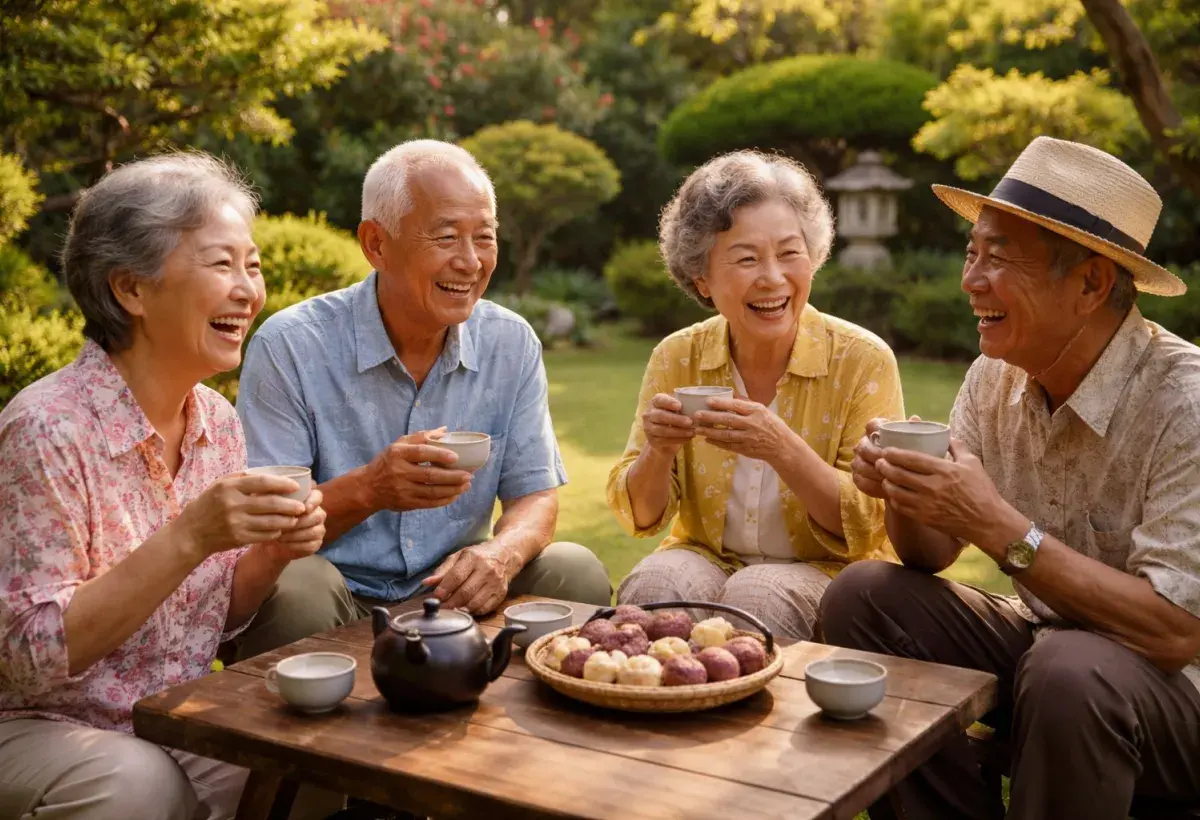
One of Okinawa’s most distinctive features is the moai, a lifelong social network that provides emotional, financial, and practical support. These groups are not temporary affiliations but enduring structures that accompany individuals across decades.
Social connection in Okinawa is continuous and normalized within daily life. Individuals remain embedded within supportive networks that reinforce belonging, identity, and mutual responsibility. This sustained integration reduces the fragmentation often associated with ageing in more individualistic societies.
Empirical research has consistently shown that strong social relationships are associated with increased survival and reduced health risks (Holt-Lunstad et al., 2015; World Health Organization, 2023), while social isolation has been identified as a significant risk factor for cognitive decline (Livingston et al., 2020). The Okinawan model illustrates that connection is not incidental; it is structurally embedded.
Lifestyle and Environment: Moderation as Cultural Regulation
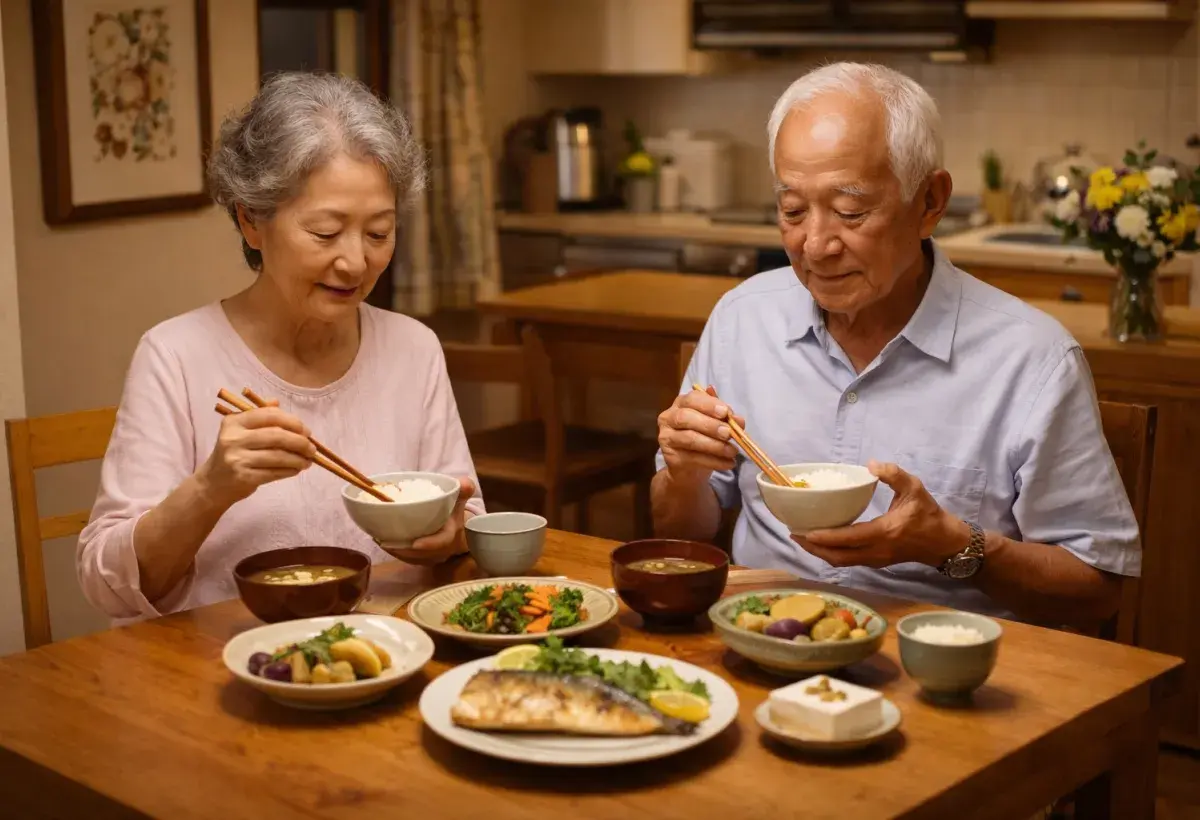
Daily life in Okinawa reflects a pattern of moderation, balance, and natural movement. The cultural practice of Hara Hachi Bu - eating until approximately 80% full, supports caloric balance without deprivation, reinforcing long-term metabolic stability.
Traditional dietary patterns are largely plant-forward, consisting of sweet potatoes, vegetables, tofu, seaweed, and legumes. Caloric moderation has been associated with improved metabolic regulation and reduced oxidative stress (Fontana & Partridge, 2015), while plant-based diets have been linked to lower cardiovascular risk and reduced incidence of chronic disease (Estruch et al., 2018; Livingston et al., 2020).
Physical activity is not structured as exercise but embedded within daily routines such as walking, gardening, and household tasks. Health, in Okinawa, is integrated into everyday life rather than externally imposed.
Image
Purpose and Psychological Continuity: Ikigai Across the Lifespan
A defining element of Okinawan longevity is ikigai, often translated as a reason for being. Unlike fixed notions of purpose, ikigai evolves across the lifespan, adapting to changing roles and capacities.
Younger individuals may find meaning in work or craft, while older adults transition toward mentorship, cultural preservation, and community participation. Purpose does not diminish with age; it transforms.
Research showed that a strong sense of purpose is associated with reduced mortality and improved cognitive outcomes (Sutin et al., 2021; Alimujiang et al., 2019). This aligns with the definition of healthy ageing advanced by the World Health Organization, which emphasizes the capacity to maintain the ability to do what one values (World Health Organization, 2020).
In Okinawa, purpose is not abstract. It is sustained through participation, reinforcing both psychological resilience and continuity of identity.
The Biological Interface: Why the System Holds
The Okinawan system operates as a biologically protective environment in which multiple mechanisms converge. Caloric moderation supports metabolic efficiency and reduces oxidative stress (Fontana & Partridge, 2015), while plant-forward diets contribute to cardiovascular and cognitive health (Estruch et al., 2018; Livingston et al., 2020).
Strong social ties enhance survival and reduce mortality risk (Holt-Lunstad et al., 2015; World Health Organization, 2023), and psychological purpose contributes to long-term resilience (Sutin et al., 2021). These factors reinforce one another within a coherent system.
Biological outcomes, in this context, reflect the cumulative effect of sustained behavioral and social alignment. Biology follows structure.
System Vulnerability: Cultural Shifts and Health Outcomes
Despite its historical resilience, Okinawa is undergoing change. Post-war influences, economic development, and globalization have altered dietary patterns and daily routines. The increasing consumption of processed foods and declining physical activity have contributed to rising obesity rates among younger generations (Japan Ministry of Health, 2022).
These shifts underscore a critical insight: longevity is not genetically fixed. It is culturally sustained. As cultural patterns change, the systems that once protected health may gradually weaken, altering long-term outcomes.
Image
Policy and Global Relevance
The Okinawan model aligns closely with global ageing frameworks advanced by the World Health Organization and the United Nations. Healthy ageing is defined as the preservation of functional ability and the capacity to live with autonomy and purpose (World Health Organization, 2020).
Similarly, the Madrid International Plan of Action on Ageing and its subsequent reviews emphasize the continued participation and contribution of older persons across society (United Nations, 2002; United Nations Economic Commission for Europe, 2022).
Okinawa demonstrates that these outcomes are not aspirational but achievable when supported by structured social and cultural systems.
Conclusion: Longevity as Cultural Continuity
Okinawa does not offer a formula. It reveals a structure where connection is continuous, food nourishes without excess, movement is integrated into daily life, and purpose evolves across the lifespan.
These are not isolated behaviors but components of a coherent system that protects health by preserving the architecture of daily living. Longevity, in this context, is cultivated through the sustained alignment of culture, lifestyle, and meaning.
The relevance of the Okinawa model extends beyond its geographic boundaries. Its principles are not confined to place, but to the structure of how life is organized. In practical terms, this includes the cultivation of enduring social relationships, the practice of moderation in consumption, the integration of natural movement into daily routines, and the maintenance of a sense of purpose that evolves with life stages. When these elements are sustained over time, the conditions that support healthy ageing begin to emerge.
What Okinawa demonstrates is not a lifestyle to replicate, but a system to understand. The translation of these principles into modern contexts does not require imitation, but alignment. Longevity, therefore, becomes not an outcome to be pursued, but a consequence of how life is consistently lived.
And in a world searching for sustainable pathways to ageing, Okinawa offers an enduring proposition: the future of longevity will not be defined by how long we live, but by how meaningfully we remain connected, engaged, and aligned with the conditions that sustain life.
Image

Suggested Citation
Lendez, M. (2026). Okinawa Longevity Model: Purpose, belonging, and the structure of healthy ageing. Developed within the Ikigai-Bayanihan Purpose-Driven Retirement Framework.
About the Author: Written by Dr. Mariza Lendez, the developer of the Ikigai-Bayanihan Purpose-Driven Retirement Framework, a model that redefines aging through purpose, dignity, and community-centered living.
Explore the Ikigai-Bayanihan Retirement Model presented by Chikicha Co-founder:
https://www.chikicha.com/chikicha-co-founder-present-ikigai-bayanihan-retirement-model-iafor-egen-2026
The Longevity Framework Series
👉 Okinawa Longevity Model
👉 Nicoya Longevity Model
👉 Icaria Longevity Model
👉 Sardinia Longevity Model
👉 Loma Linda Longevity Model
REFERENCES
Okinawa Longevity Research
Willcox, B. J., Willcox, D. C., Todoriki, H., & Suzuki, M. (2007).
Caloric restriction, the traditional Okinawan diet, and healthy aging.
Annals of the New York Academy of Sciences.
https://nyaspubs.onlinelibrary.wiley.com/doi/10.1196/annals.1396.037
Diet & Caloric Moderation
Fontana, L., & Partridge, L. (2015).
Promoting health and longevity through diet: From model organisms to humans.
Cell.
https://www.cell.com/fulltext/S0092-8674(15)00246-4
Estruch, R., et al. (2018).
Mediterranean diet and cardiovascular prevention.
New England Journal of Medicine.
https://www.nejm.org/doi/full/10.1056/NEJMoa1800389
Social Connection (Moai / Community)
Holt-Lunstad, J., et al. (2015).
Loneliness and social isolation as risk factors for mortality.
Perspectives on Psychological Science.
https://journals.sagepub.com/doi/10.1177/1745691614568352
Livingston, G., et al. (2020).
Dementia prevention, intervention, and care.
The Lancet.
https://www.thelancet.com/article/S0140-6736(20)30367-6/fulltext
Purpose (Ikigai / Meaning in Life)
Sutin, A. R., Stephan, Y., & Terracciano, A. (2021).
Psychological well-being and risk of dementia.
JAMA Network Open.
https://jamanetwork.com/journals/jamanetworkopen/fullarticle/2784169
Alimujiang, A., et al. (2019).
Association between life purpose and mortality.
JAMA Network Open.
https://jamanetwork.com/journals/jamanetworkopen/fullarticle/2734064
Global Healthy Ageing Frameworks
World Health Organization (2020).
Decade of Healthy Ageing: Baseline Report
https://www.who.int/publications/i/item/9789240017900
World Health Organization (2023).
World report on social determinants of health equity
https://www.who.int/publications/i/item/9789240080973
United Nations (2002).
Madrid International Plan of Action on Ageing (MIPAA)
United Nations Economic Commission for Europe (2022).
Rome Ministerial Declaration (MIPAA+20)
https://unece.org/population/publications/2022-rome-ministerial-declaration
Blue Zone Context
Dan Buettner (2012).
The Blue Zones (2nd ed.)
National Geographic