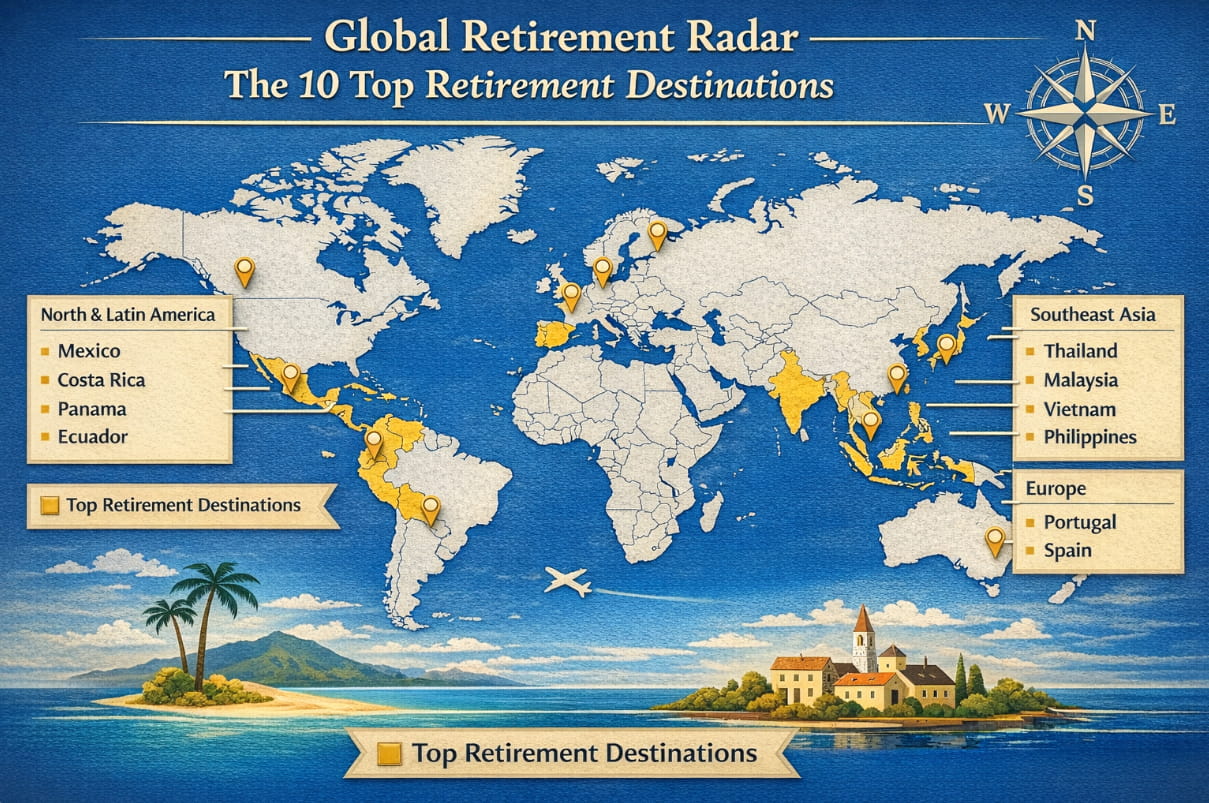
The Global Retirement Radar: Mexico | Thailand | Malaysia | Costa Rica | Portugal | Panama | Ecuador | Philippines | Vietnam | Spain
The Global Retirement Radar: A World Map for Aging with Purpose
For generations, retirement was imagined as a quiet ending, a slowing of pace after decades of work. Today, that idea is evolving. Across the world, retirees are increasingly viewing this stage of life as a new chapter rather than a conclusion. Many seek environments where healthcare is accessible, living costs remain manageable, and community life continues to provide meaning and connection.
The Global Retirement Radar was created to explore that question:
“Where can people age not only comfortably, but with dignity, purpose, and belonging?”
This series looks beyond the typical “retire cheap” lists. Instead, it examines retirement through three essential lenses:
Dignity - access to healthcare, safety, and respect for older adults.
Purpose - opportunities for engagement, learning, and contribution.
Reality - practical factors such as visas, living costs, infrastructure, and policy.
From Mediterranean villages to tropical coastlines and mountain cities, the following ten countries offer diverse possibilities for retirement.
The 10 Countries on the Global Retirement Radar
Mexico
Close to the United States yet rich in its own culture, Mexico offers a balance of affordability, vibrant communities, and accessible healthcare. Cities such as Mérida, San Miguel de Allende, and Puerto Vallarta host well-established expatriate networks that make adaptation easier for foreign retirees. Mexico’s proximity to North America and relatively low cost of living have made it one of the most popular retirement destinations in the Western Hemisphere.
Thailand
Thailand’s blend of cultural warmth, tropical landscapes, and world-class private healthcare continues to attract retirees from Europe, Australia, and North America. Cities such as Chiang Mai and coastal towns like Hua Hin offer affordable living with vibrant expatriate communities. While visa requirements and bureaucracy require careful planning, many retirees find Thailand’s lifestyle deeply rewarding.
Malaysia
Malaysia combines modern infrastructure with cultural diversity and relatively affordable living. The Malaysia My Second Home program has long attracted foreign residents seeking tropical comfort with English-language accessibility. Cities such as Kuala Lumpur, Penang, and Ipoh offer strong healthcare systems and growing senior living developments.
Image

Costa Rica
Known for its Pura Vida philosophy, Costa Rica emphasizes community, nature, and longevity. The Nicoya Peninsula is recognized as one of the world’s Blue Zones, where healthy lifestyles and strong social connections contribute to long life expectancy. Affordable healthcare and residency options continue to attract retirees seeking a balance between nature and community life.
Portugal
Portugal remains one of Europe’s most attractive retirement destinations. Mild climates, walkable cities, and high-quality healthcare combine with the D7 visa program to create accessible residency pathways. Regions such as the Algarve, Porto, and Lisbon’s coastal towns provide retirees with culture, safety, and European mobility.
Panama
Panama’s Pensionado visa is often regarded as one of the most retiree-friendly residency programs in the world. Affordable living, strong expatriate communities, and the use of the U.S. dollar simplify financial planning for many retirees. Mountain towns like Boquete and coastal communities such as Coronado have become popular retirement hubs.
Ecuador
Ecuador offers retirees one of the most affordable lifestyles in Latin America. Cities such as Cuenca provide colonial charm, mild climates, and accessible healthcare. The country’s Pensionado visa and constitutional protections for older adults further strengthen its appeal to retirees seeking both affordability and stability.
Philippines
In the Philippines, retirement often comes with a sense of belonging. Cultural traditions emphasize respect for elders, and English fluency makes integration easier for foreign residents. The Special Resident Retiree’s Visa (SRRV) allows retirees to obtain long-term residency, while cities such as Cebu, Davao, and Dumaguete provide growing expatriate communities.
Vietnam
Vietnam offers retirees one of the most affordable lifestyles in Southeast Asia. While the country does not currently provide a dedicated retirement visa, many expatriates establish long-term residence through business or investment pathways. Cities such as Da Nang and Ho Chi Minh City combine modern infrastructure with vibrant cultural life.
Spain
Spain brings together Mediterranean climate, cultural heritage, and one of Europe’s strongest healthcare systems. The Non-Lucrative Visa provides a pathway for retirees who can demonstrate sufficient passive income. Regions such as Valencia, Alicante, and the Costa del Sol remain among Europe’s most popular retirement destinations.
Image

A Changing Global Landscape of Aging
Population aging is reshaping societies around the world. By 2030, one in every six people worldwide will be aged 60 and over. This is not a distant projection, this is our present, which will nearly double globally by 2050, according to the World Health Organization.
This shift is encouraging countries to rethink healthcare systems, retirement policies, and housing options for older adults. For retirees themselves, it also opens new possibilities. The world is becoming more interconnected, allowing individuals to explore environments where their savings stretch further and their quality of life improves.
Choosing Where to Age
Relocating abroad for retirement is not a decision to make lightly. Beyond climate and cost, retirees should consider: healthcare accessibility, visa stability and residency pathways, cost of living and housing markets, language and cultural integration, and long-term care options.
Visiting potential destinations, renting before purchasing property, and consulting with legal or financial advisors can help retirees make informed decisions.
Aging with Freedom, Dignity, and Connection
Retirement abroad is not about escaping life it is about redesigning it. For many, it offers a chance to remain active, explore new cultures, and build communities that support both independence and belonging.
The countries highlighted in the Global Retirement Radar represent different paths toward the same goal: living the later chapters of life with health, curiosity, and purpose. Because retirement is not simply the end of a career. It is the beginning of a new geography of living.
Image

The Global Retirement Radar Index
Comparing the 10 Retirement Destinations
To help retirees interpret the information across countries, the Global Retirement Radar Index evaluates each destination using five practical criteria commonly used in international retirement studies. These indicators reflect the realities retirees face when relocating abroad.
Cost of Living: Relative affordability compared to the United States or Western Europe.
Healthcare Access: Availability and quality of medical services for older adults.
Visa Accessibility: Ease of obtaining long-term residency or retirement visas.
Community Integration: Presence of expat networks, social engagement opportunities, and cultural openness.
Long-Term Aging Support: Availability of eldercare services and infrastructure for aging populations.
Scores reflect general conditions based on global reports, demographic data, and retiree experiences.
Global Retirement Radar Scorecard
|
Country |
Cost of Living |
Healthcare |
Visa Accessibility |
Community Integration |
Long-Term Aging Support |
| Mexico | High | Good | Moderate | Strong | Moderate |
| Thailand | Very High | Very Good | Moderate | Strong | Moderate |
| Malaysia | High | Very Good | Moderate | Strong | Moderate |
| Costa Rica | High | Good | Good | Strong | Moderate |
| Portugal | Moderate | Excellent | Good | Strong | Moderate |
| Panama | High | Good | Excellent | Strong | Moderate |
| Ecuador | Very High | Good | Excellent | Strong | Moderate |
| Philippines | Very High | Moderate | Excellent | Very Strong | Developing |
| Vietnam | Very High | Moderate | Limited | Strong | Developing |
| Spain | Moderate | Excellent | Moderate | Strong | Strong |
What the Index Reveals
Looking across the radar, several patterns emerge. Latin America leads in affordability Countries such as Ecuador, Mexico, Panama, and Costa Rica consistently attract retirees seeking lower living costs while maintaining access to healthcare and social communities.
Southeast Asia offers exceptional value
Thailand, Malaysia, Vietnam, and the Philippines provide some of the lowest living costs globally, along with warm climates and vibrant social environments.
Europe offers stability and healthcare strength
Countries such as Portugal and Spain provide strong healthcare systems, infrastructure, and safety, though often at higher living costs than developing regions.
A New Geography of Retirement
The rise of international retirement migration reflects broader demographic trends. According to the World Health Organization, the global population aged 60 and older will exceed 2 billion by 2050. At the same time, improvements in transportation, healthcare, and digital connectivity allow retirees to consider living beyond their home countries. The result is a new geography of retirement, where people choose destinations that better align with their financial resources, lifestyle preferences, and health needs.
A Strategic View of Retirement Abroad Is No Longer a Destination - It Is a Design
Across the world, retirement is undergoing a quiet transformation. For much of the twentieth century, retirement was framed as withdrawal from working life a period defined by rest and financial security. Today, demographic change, longer life expectancy, and global mobility are reshaping that narrative. People are living longer, healthier lives.
Many will spend twenty to thirty years in retirement. That reality turns retirement from a passive stage into an active life design challenge. From an aging policy and retirement consulting perspective, successful international retirement decisions usually involve three key strategies:
Healthcare accessibility
Retirees should prioritize proximity to reliable hospitals and specialists. A beautiful destination loses its appeal quickly if medical care is unreliable or difficult to reach.
Social integration
Community matters, loneliness is one of the greatest risk in later life. countries with strong social networks and expat communities often offer better adjustment. Longevity studies consistently show that strong social connections are among the most important determinants of well-being in later life.
Long-term sustainability
Retirement migration must account not only for lifestyle preferences but also for aging needs that may emerge decades later. The retirement location that works at age 60 should still be viable at age 80.
The countries featured in the Global Retirement Radar each illustrate different approaches to these realities. Some offer strong healthcare system, others provide affordability or community networks. A few combine all three. What matters most is not simply finding a place that is cheaper or warmer. The true goal is finding an environment where older adults can continue to grow, contribute, and belong.
For retirees willing to explore the world with thoughtful planning and cultural openness, retirement abroad can become far more than a financial decision. It becomes a second geography of life. A place where experience is valued, curiosity remains alive, and the later chapters of life continue to unfold with dignity and purpose.
Author: Dr. Mariza Lendez, DBA - Founder of Global Retirement Radar and developer of the Ikigai–Bayanihan Purpose-Driven Retirement Framework, a research-based model addressing the social, economic, and community dimensions of global population aging.
Explore the Ikigai-Bayanihan Retirement Model presented by Chikicha Co-founder:
https://www.chikicha.com/chikicha-co-founder-present-ikigai-bayanihan-retirement-model-iafor-egen-2026
The world is no longer just a place we travel.
For many retirees, it has become the place where the next chapter of life begins.
Image

Explore Each Country in the Global Retirement Radar
Research Sources and Data Transparency
The Global Retirement Radar is an independent editorial series that examines retirement destinations using publicly available data, international research reports, and policy publications. The analysis combines demographic studies, healthcare indicators, visa policies, cost-of-living comparisons, and firsthand retiree experiences. Key reference sources include:
-
World Health Organization - Global Health Observatory data on life expectancy, healthcare access, and aging populations.
-
World Bank - Economic indicators, demographic trends, and aging population projections.
-
Organisation for Economic Co-operation and Development - Comparative healthcare performance and retirement policy research.
-
United Nations Department of Economic and Social Affairs - Global aging statistics and population forecasts.
-
Eurostat - European demographic and health system data.
-
Asian Development Bank - Southeast Asian demographic and economic development reports.
-
National statistical agencies and ministries of health from the countries discussed in the series.
-
International cost-of-living databases and comparative economic indicators.
Editorial Independence
The Global Retirement Radar is produced as an independent editorial project. The analysis is not sponsored by governments, immigration agencies, real estate developers, or retirement programs. Countries are included based on publicly available data, global retirement trends, and the growing interest among retirees seeking international living options.
The goal of the series is to help readers make informed decisions by presenting both opportunities and challenges associated with retiring abroad.
Image