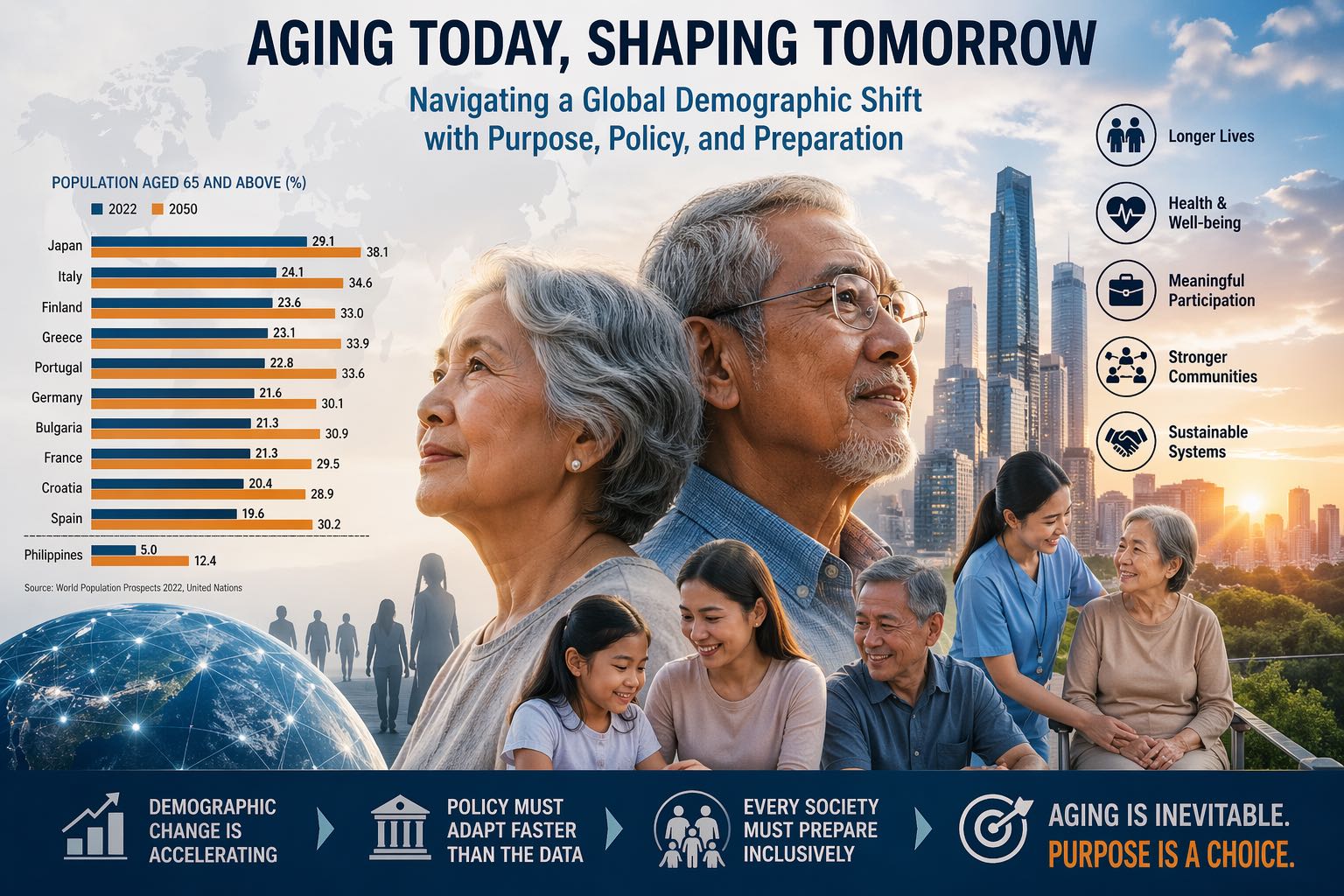
A structural turning point that is reshaping the global economy, straining labor markets, pensions, and healthcare systems.
Aging is a defining demographic phenomenon of the 21st century, generating structural pressures on labor markets, fiscal systems, and health infrastructures. These conditions underscore the need to reconsider retirement and care models, including purpose-centered frameworks such as Ikigai.
The Limits of Traditional Retirement Models
Historically, retirement was framed as the cessation of work and reliance on pensions or family support systems designed for shorter lifespans and smaller elderly populations. Shaped by twentieth-century industrial labor systems and government-led pension schemes, these models have become increasingly inadequate amid longer life expectancy, shifting family dynamics, and rapid socioeconomic change. The traditional focus on economic provision alone fails to address broader dimensions of aging, including health, purpose, social engagement, and dignity.
Uneven Transitions: Regional Realities of Aging
The Asia-Pacific region is undergoing the most rapid demographic transition globally, while Europe faces advanced aging pressures that strain pension systems, labor markets, and intergenerational support structures (Eurostat, 2021; Eurostat, 2023). The Philippines exemplifies a compressed transition toward an aging society within a narrow policy window, underscoring the urgency for anticipatory, community-based, and culturally grounded approaches to aging.
These regional and national trajectories reveal a common condition: aging is a global inevitability, yet lived experience and policy readiness remain deeply unequal. The convergence of economic, social, and health pressures calls for integrated frameworks that reimagine aging in terms of dignity and purpose.
Image
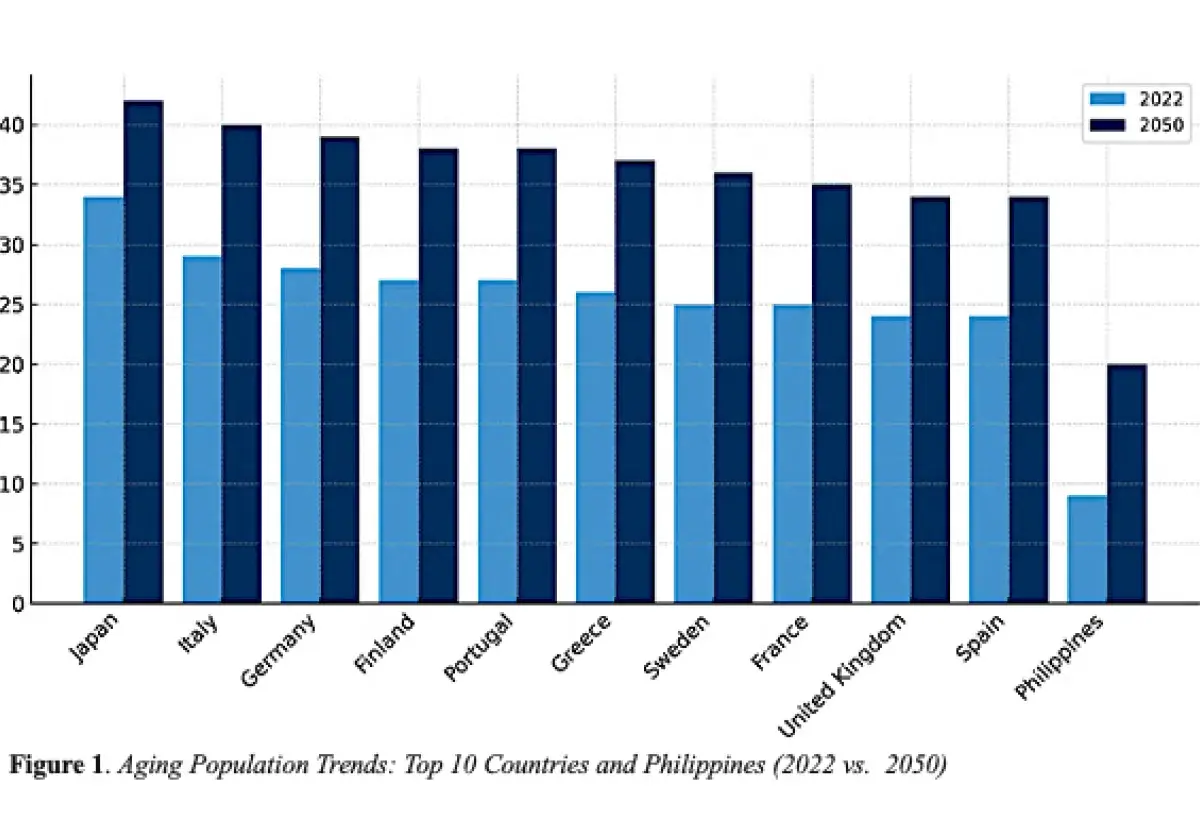
Mapping the Shift: Global Aging in Comparative Perspective
Figure 1 illustrates the relative position of the Philippines alongside the world’s ten most aged countries, highlighting substantial cross-variation in population aging. While countries such as Japan and several European states have already entered advanced or super-aged stages, the Philippines remains demographically younger but exhibits clear indicators of accelerated aging. This contrast underscores the uneven pace of demographic transition across countries and signals a narrowing window for policy preparation in societies aging rapidly without the institutional depth of high-income economies.
The Policy Gap: When Demographics Outpace Institutions
The challenges associated with population aging extend beyond demographic change to systemic policy constraints. Declining fertility, shrinking labor markets, rising old-age dependency ratios, and escalating long-term care costs have prompted governments to pursue pension reforms, retirement-age adjustments, and policies aimed at extending labor participation among older adults. Across many economies, however, implementation has lagged behind policy intent, creating a persistent gap between demographic realities and institutional preparedness (European Commission, 2022; World Bank, 2022).
Economic and Fiscal Pressures of Longevity
Evidence from both advanced and developing regions illustrates the depth of this implementation gap. In the European Union, the working-age population is projected to decline by 57.4 million by 2100, while the old-age dependency ratio is expected to increase from 33% in 2022 to approximately 56% by mid-century, intensifying pressures on pension, healthcare, and social care systems (European Commission, 2022). Similarly, in developing regions, structural vulnerabilities including high levels of informal employment, inadequate pension coverage, and rising health expenditures continue to threaten fiscal sustainability in the absence of accelerated reforms (World Bank, 2022). Together, these trends highlight the growing mismatch between the pace of demographic change and policy systems designed for shorter life expectancies.
Asia as the Epicenter of Accelerated Aging
Asia remains the fastest-aging region in the world (United Nations Economic and Social Commission for Asia and the Pacific [ESCAP], 2022). Several East Asian societies have already entered advanced stages of population aging. Japan, classified as a super-aged society, has approximately 29.1% of its population aged 65 and above (Statistics Bureau of Japan, 2024). South Korea’s population aged 65 and above is projected to reach about 25% by 2030 (Statistics Korea, 2023), while in Singapore, citizens aged 65 and above accounted for approximately 19.9% of the population in June 2024 and are expected to surpass the low-to-mid 20s by 2030 (Department of Statistics Singapore, 2024). In parallel, middle-income ASEAN countries such as Thailand, Malaysia, and Vietnam are experiencing compressed aging, transitioning to older age structures within two to three decades rather than the extended demographic timelines historically observed in many Western countries (ASEANstats, 2023; U.S. Census Bureau, 2022).
Conclusion: From Demographic Pressure to Purpose-Driven Aging
The present global condition is defined by a dual and accelerating demographic shift: population aging on one side and declining fertility on the other. Together, these forces are reshaping the very foundations of economic and social systems, not gradually, but with increasing abruptness. International bodies such as the United Nations, through frameworks like the Madrid International Plan of Action on Ageing, and institutions like the World Health Organization, have been actively calling for a transition toward healthy aging, integrated care systems, and age-inclusive societies. The direction is clear: aging must no longer be treated as a peripheral social issue but as a central structural force requiring coordinated, multi-sectoral response. Without such alignment, the imbalance between a shrinking workforce and a growing elderly population risks undermining productivity, fiscal stability, and social cohesion.
At the national level, responses remain uneven, though some countries have begun to act with urgency. Japan has pioneered policies extending working life, investing in robotics and long-term care systems, while Singapore has advanced preventive health, lifelong employability, and community-based aging models. Parts of Europe are undertaking pension reforms and labor market adjustments, and the United States has initiated measures to extend workforce participation and address healthcare costs. Yet globally, the pace of reform still lags behind the speed of demographic change. The emerging trajectory suggests a future where economic resilience, social stability, and even national competitiveness will increasingly depend on how effectively societies adapt to this new demographic reality. What is unfolding is not a distant scenario, but a defining transformation of our time, one that will determine whether aging becomes a burden or an opportunity for reinvention.
Image

Suggested Citation
Lendez, M. (2026). The Global Aging Condition. Chikicha.
About the Author: Written by Dr. Mariza Lendez, the developer of Ikigai-Bayanihan Framework, a model that redefines aging through purpose, dignity, and community-centered living.
Explore the Ikigai-Bayanihan Retirement Model presented by Chikicha Co-founder:
https://www.chikicha.com/chikicha-co-founder-present-ikigai-bayanihan-retirement-model-iafor-egen-2026
References
ASEANstats. (2023). ASEAN Statistical Yearbook 2023. ASEAN Secretariat / ASEANstats.
Department of Statistics Singapore. (2024). Population in Brief 2024. Government of
Singapore
European Commission. (2024). Ageing Europe: 2024 interim report.https://ec.europa.eu/eurostat
European Commission. (2022). The 2021 ageing report: Economic and budgetary projections for the EU Member States (2019–2070). https://economy-finance.ec.europa.eu/publications/2021-ageing-report-economic-and-budgetary-projections-eu-member-states-2019-2070_en
Eurostat. (2021). Ageing Europe: Looking at the lives of older people in the EU. https://ec.europa.eu/eurostat/web/products-statistical-books/-/ks-02-20-655
Statistics Bureau of Japan. (2024). Statistical handbook of Japan 2024. https://www.stat.go.jp/english/data/handbook/index.html
Statistics Bureau of Japan. (2024). Annual Report on the Ageing Society 2024 (Summary). Cabinet Office, Government of Japan
Statistics Korea. (2023). Population Projections and Summary Indicators (Korea) 1960-2072 [Data set]. KOSTAT.
United Nations, Economic and Social Commission for Asia and the Pacific. (2022). *Asia-Pacific report on population ageing 2022: Trends, policies and good practices regarding older persons and population ageing (ST/ESCAP/3041).https://www.unescap.org/sites/default/d8files/knowledge-products/AP-Ageing-2022-report.pdf
United Nations Economic Commission for Europe. (2024). MIPAA+20: Regional review and appraisal of the Madrid International Plan of Action on Ageing.https://unece.org/population/ageing/MIPAA20
U.S. Census Bureau. (2022). International Database: Ageing in Asia – Trends and Projections. U.S. Government Publishing.
U.S. Census Bureau. (2022). International data base (IDB). https://www.census.gov/data-tools/demo/idb/
World Bank. (2021). Silver tsunamipan: East Asia’s aging crisis.https://www.worldbank.org
World Health Organization. (2022). Global report on aging and health. World Health Organization.https://www.who.int
World Health Organization [WHO]. (2020). Decade of healthy ageing: Baseline report. Geneva, Switzerland: World Health Organization.
Retrieved from https://www.who.int/publications/i/item/9789240017900