What Really Happens to Your Skin After 40: Part 1 | Part 2 | Part 3 | Part 4 | Part 5 | Part 6 | Part 7
Article 6 of 7 in the “Aging Skin After 40” Series
Beyond the Phrase: What “Beauty Sleep” Actually Means
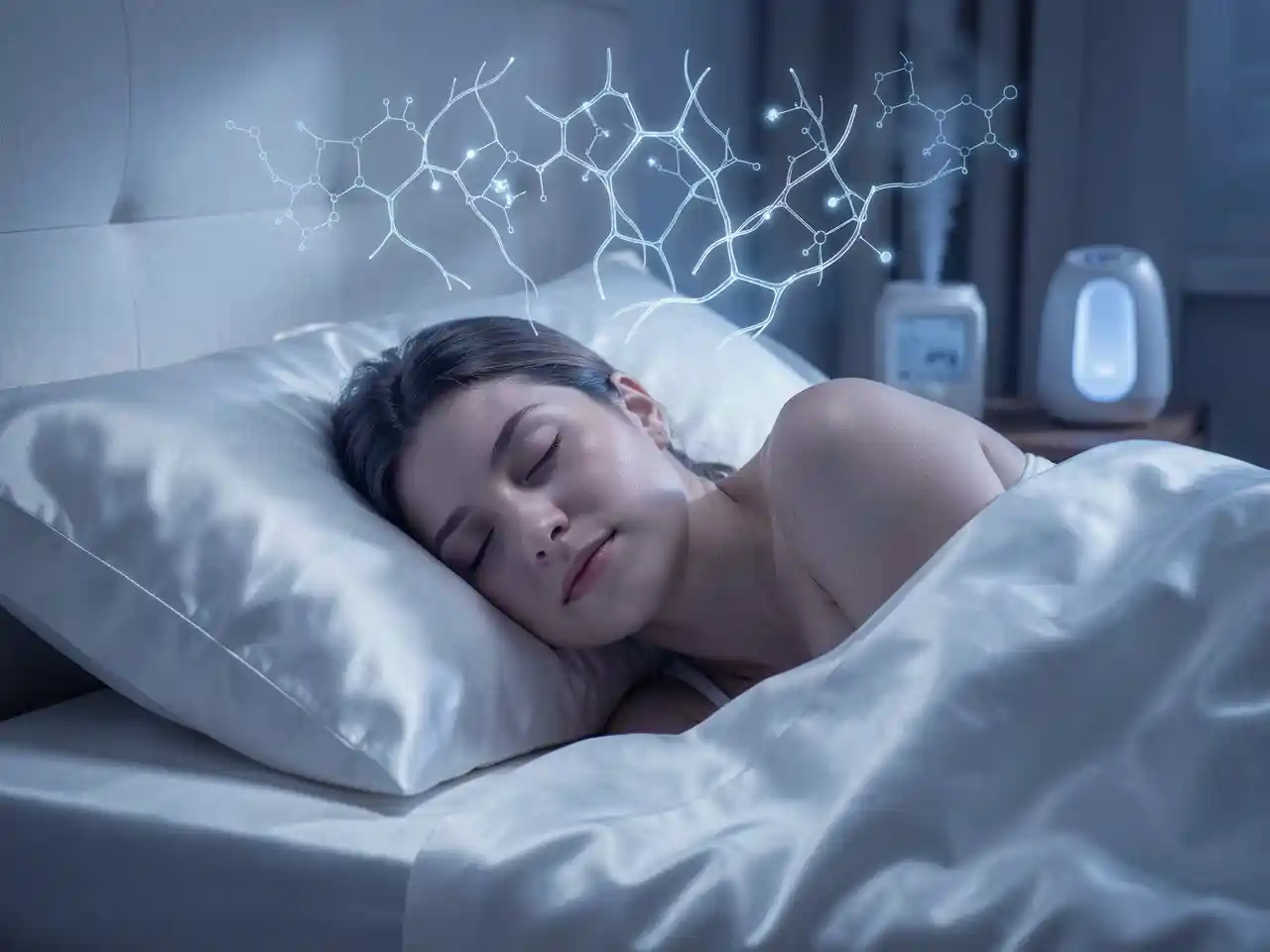
“Beauty sleep” has long been treated as a cultural expression something intuitive, yet rarely examined with scientific precision. Recent advances in sleep and skin biology, however, have clarified that sleep is not merely restorative, but actively regenerative. During the night, the body enters a coordinated state of repair governed by circadian rhythms, where cellular renewal, antioxidant defense, and tissue recovery are significantly enhanced (Hardeland et al., 2011; Oyetakin-White et al., 2015; Lan et al., 2023).
As sleep deepens, skin physiology shifts in measurable ways. Cutaneous blood flow increases, metabolic waste is cleared more efficiently, and cellular turnover accelerates. These processes create an internal environment where structural repair, particularly collagen synthesis, can occur with greater efficiency. Over time, the consistency and quality of sleep begin to shape not only how the skin appears, but how it ages at a structural level.
The Biological Foundation of Nighttime Skin Repair
Central to this regenerative process is melatonin, a hormone released in response to darkness and tightly regulated by the circadian system. Beyond its role in sleep initiation, melatonin functions as a potent antioxidant and cellular protector. It mitigates oxidative stress, supports mitochondrial integrity, and contributes to the regulation of skin homeostasis (Hardeland et al., 2011; Slominski et al., 2018; Kim et al., 2022).
During uninterrupted sleep cycles, fibroblast activity increases, supporting the production of collagen and elastin. While popular narratives often point to a fixed “2AM repair window,” current evidence suggests that regenerative activity is distributed across deep sleep stages aligned with circadian timing, rather than confined to a specific hour (Oyetakin-White et al., 2015; Lan et al., 2023). When sleep is fragmented or delayed, these cycles are disrupted, reducing the skin’s capacity to repair daily damage and maintain structural resilience.
Image

Sleep Quality and the Structural Aging of Skin
Sleep quality exerts a direct influence on visible and structural skin aging. Clinical evidence has shown that poor sleep is associated with increased signs of intrinsic aging, including fine lines, uneven pigmentation, and reduced elasticity (Oyetakin-White et al., 2015). These findings highlight that the skin reflects not only environmental exposure, but also the efficiency of internal recovery processes.
This relationship is mediated in part by hormonal balance. Growth hormone, released during deep sleep, supports tissue repair and collagen synthesis, while elevated cortisol common in sleep deprivation accelerates collagen breakdown. Contemporary research continues to reinforce that sleep plays a critical role in systemic recovery, including immune and inflammatory regulation, both of which influence skin integrity (Leproult & Van Cauter, 2010; Besedovsky et al., 2021). Over time, disrupted sleep shifts the body from a regenerative state toward a degradative one.Mechanical Factors: What Happens Between Skin and Surface
Beyond internal physiology, the physical interface between the skin and its environment during sleep also contributes to aging patterns. Repeated compression of the face against surfaces can lead to the formation of sleep lines creases that, over time, may become permanent as skin elasticity declines (Kahn et al., 2019; Lee et al., 2022).
Materials with lower friction, such as silk or satin, may reduce shear stress applied to the skin compared to more textured fabrics. While the magnitude of this effect varies and is not always quantified precisely, dermatological research supports the broader principle that minimizing mechanical stress can help preserve skin structure over time (Lee et al., 2022). These changes are subtle but cumulative, shaped by nightly repetition rather than immediate outcomes.
Sleep Position, Breathing, and Subtle Structural Influence
Sleep posture introduces another layer of mechanical influence. Side sleeping increases localized pressure on facial tissues, which may contribute over time to asymmetry and deepening of expression lines. While it is neither necessary nor realistic to eliminate this position entirely, varying sleep posture can help reduce prolonged stress on specific areas of the face (Kahn et al., 2019; Lee et al., 2022).
Breathing patterns during sleep also play a role in facial physiology. Nasal breathing supports more efficient oxygen exchange and reduces dryness associated with mouth breathing. Clinical research has linked chronic mouth breathing to structural and functional changes in craniofacial development, which may influence facial tone and contour over time (Zhao et al., 2019; Hsu et al., 2021). These mechanisms are gradual, yet they underscore how repeated habits contribute to long-term structural outcomes.
Image

The Sleep Environment and Skin Hydration
The surrounding sleep environment directly affects skin hydration and barrier function. Low humidity increases transepidermal water loss (TEWL), leading to dryness, reduced elasticity, and a compromised skin barrier (Denda et al., 2010; Filaggrin et al., 2021). Over time, this can accentuate the appearance of fine lines and dullness.
Maintaining a balanced environment like moderate humidity, minimal light exposure, and stable temperature supports the skin’s ability to retain moisture and recover overnight. While individual tools such as humidifiers may vary in effectiveness, the underlying principle is well established: environmental conditions influence skin physiology, particularly during prolonged periods of rest when repair processes are active.
Rethinking “Beauty Sleep” as a System
Sleep is often reduced to duration, yet it functions as an integrated biological system where timing, quality, environment, and behavior converge. Optimizing sleep for skin health requires alignment with circadian rhythms, protection of deep sleep cycles, and reduction of disruptive stimuli.
Consistent sleep timing reinforces hormonal regulation, allowing melatonin and growth hormone to function predictably. Limiting artificial light exposure before bed supports natural melatonin release, while uninterrupted sleep preserves the integrity of regenerative cycles. Over time, these patterns establish a stable internal environment where repair processes can occur efficiently and repeatedly.
Conclusion
The concept of beauty sleep is not a myth, but a reflection of the body’s intrinsic capacity for nighttime repair. During sleep, the skin is actively engaged in processes that restore structure, regulate damage, and prepare for the demands of the following day.
What determines the outcome is not a single intervention, but the consistency of conditions that support these processes. When sleep is aligned with biological rhythms and supported by a stable environment, the skin responds with improved resilience, smoother texture, and stronger structural integrity over time.
Aging, in this sense, is not defined solely by years, but by how effectively the body is allowed to repair itself, night after night.
Image

Suggested Citation
Lendez, M. (2026). Beauty Sleep Redefined: How Your 2AM Melatonin Surge Rebuilds Collagen and Smooths Wrinkles. (Chikicha Series). Chikicha.
Dr. Mariza Lendez is the developer of the Ikigai-Bayanihan Purpose-Driven Retirement
About the Author
Written by Dr. Mariza Lendez, the developer of the Ikigai-Bayanihan Purpose-Driven Retirement Framework, a model that redefines aging through purpose, dignity, and community-centered living.
Aging Skin After 40 Series
👉 The Science of Aging, Elasticity Loss, and Wrinkles
👉 Top 10 Botanical Extracts That Firm and Repair Aging Skin: 2024 Science-Backed Guide
👉 The Gut-Skin Axis: How Probiotics Are Clinically Proven to Reduce Wrinkles from Within
👉 The Collagen Diet: 12 Science-Backed Foods to Rebuild Aging Skin from Within
👉 Acid Mantle Repair: The Hidden Key to Plumper, Wrinkle-Resistant Skin
👉 Beauty Sleep Redefined: How Your 2AM Melatonin Surge Rebuilds Collagen and Smooths Wrinkles
👉 Facial Yoga and Gua Sha: 2024 Science on Non-Invasive Lifting and Collagen Boosting
Disclaimer
Chikicha does not sell or promote any of the products mentioned in this article. The content is intended solely for educational and informational purposes.
The author, Mariza Lendez, is not a medical practitioner. This article does not provide medical advice, diagnosis, or treatment. Readers are encouraged to consult a qualified healthcare professional.
REFERENCES
Circadian Rhythm & Skin Repair
Hardeland, R., Cardinali, D. P., Srinivasan, V., & Spence, D. W. (2011). Melatonin and human skin aging. Neuroendocrinology Letters, 32(5), 587–593.
Oyetakin-White, P., Suggs, A., Koo, B., et al. (2015). Does poor sleep quality affect skin aging? Clinical and Experimental Dermatology, 40(1), 17–22.
https://doi.org/10.1111/ced.12455
Lan, C. C., et al. (2023). Circadian rhythm and skin regeneration. Cells, 12(3).
https://doi.org/10.3390/cells12030456
Melatonin & Skin Biology
Slominski, A. T., Zmijewski, M. A., & Paus, R. (2018). Melatonin and skin biology. Journal of Pineal Research, 65(1).
https://doi.org/10.1111/jpi.12526
Kim, T. K., et al. (2022). Melatonin in skin physiology and pathology. International Journal of Molecular Sciences, 23(8).
https://doi.org/10.3390/ijms23084321
Sleep, Hormones & Repair
Leproult, R., & Van Cauter, E. (2010). Role of sleep and sleep loss in hormonal release and metabolism. Endocrine Reviews, 31(5), 865–899.
https://doi.org/10.1210/er.2009-0024
Besedovsky, L., Lange, T., & Born, J. (2021). Sleep and immune function. Physiological Reviews, 101(3), 1325–1367.
https://doi.org/10.1152/physrev.00009.2020
Humidity & Skin Barrier
Denda, M., Tsuchiya, T., Hosoi, J., & Koyama, J. (2010). Effects of environmental humidity on skin barrier function. Journal of Investigative Dermatology, 130(3), 775–780.
https://doi.org/10.1038/jid.2009.384
Filaggrin, A., et al. (2021). Skin barrier function and its importance in maintaining hydration and preventing aging. International Journal of Molecular Sciences, 22(8).
https://doi.org/10.3390/ijms22084330
Mechanical Stress & Skin Aging (Sleep Lines)
Kahn, D. M., Shaw, R. B., et al. (2019). Aging of the facial skeleton and soft tissues: Implications for wrinkle formation. Aesthetic Surgery Journal.
https://doi.org/10.1093/asj/sjy234
Lee, H. J., et al. (2022). Mechanical stress and skin aging pathways. Journal of Dermatological Science.
https://doi.org/10.1016/j.jdermsci.2022.01.003
Breathing & Facial Structure
Zhao, Z., et al. (2019). Mouth breathing and craniofacial development. Journal of Oral Rehabilitation.
https://doi.org/10.1111/joor.12798
Hsu, C. Y., et al. (2021). Airway and craniofacial development: Clinical implications. Journal of Clinical Medicine, 10(9).