The Warning the World Was Not Ready to Hear
In 2023, when Geoffrey Hinton, who often called the “Godfather of AI”, resigned from Google and began publicly warning about the dangers of artificial intelligence, much of the world reacted with curiosity, fascination, or skepticism.
Many people viewed his concerns as distant, theoretical, or even exaggerated. Artificial intelligence at that time still felt to most citizens like a helpful tool: a chatbot that answered questions, an image generator creating art, a software assistant improving productivity, or an algorithm recommending videos online. Society was still mesmerized by convenience. Governments were still celebrating innovation. Technology companies were still racing to dominate what many called the next industrial revolution.
Then came his Nobel Prize.
When Geoffrey Hinton stood before the world in Stockholm during his 2024 Nobel banquet speech, his words carried a very different weight. He was no longer simply a respected AI scientist speaking from the margins of technological ethics. He had become a Nobel laureate warning humanity from one of the highest scientific platforms on Earth. Yet even then, the full gravity of his message did not immediately penetrate public consciousness. The speech circulated quietly among academic, scientific, and AI communities, but it did not yet fully enter mainstream societal reflection.
Why the Warning Resonates More Deeply Today
It is only now, in 2026, that society appears to be truly digesting what Hinton was trying to tell us.
Why now?
Because humanity has finally begun personally experiencing the early stages of the transformation he warned about. Across industries, workers are beginning to see tasks once thought uniquely human being performed by machines. AI systems are generating realistic images, videos, voices, essays, code, legal drafts, medical analyses, music, and synthetic personalities with astonishing speed. Deepfakes are challenging the very concept of truth.
Children are increasingly interacting with virtual companions. Students are outsourcing thinking processes to machines. Companies are restructuring workforces around automation. Governments are struggling to regulate technologies evolving faster than legislation itself. The line separating reality from simulation is becoming thinner each year.
The world is no longer merely hearing about AI. It is beginning to live inside it.
The Real Fear Was Never the Machine Alone
What Hinton was trying to paint was never simply a fear of machines becoming intelligent. The deeper warning was about the possibility that humanity itself may gradually surrender control over the structures shaping civilization before fully understanding the long-term consequences. His concern was not only technological. It was philosophical, societal, political, economic, and existential.
At the center of Hinton’s warning lies a profound asymmetry: artificial intelligence evolves exponentially, while human institutions evolve slowly. Governments move through elections, committees, regulations, and negotiations. Ethical systems move through debate and culture.
Human psychology evolves over generations. But AI systems improve in months, sometimes weeks. Humanity may therefore find itself in a position where the systems guiding economies, communication, labor, warfare, education, and even human relationships become too complex, too autonomous, and too commercially powerful to meaningfully control.
In many ways, Hinton was warning about a future where humanity becomes dependent on systems it no longer fully understands.
The most immediate fear often discussed publicly is job displacement. Yet Hinton’s deeper concern extends beyond employment. He fears a gradual erosion of human agency itself. If algorithms determine what people read, watch, believe, buy, desire, and emotionally respond to, then society may slowly lose its ability to distinguish authentic human judgment from machine-shaped behavior.
The danger is not necessarily that AI becomes evil in the cinematic sense. The danger is that humans become psychologically passive inside systems optimized primarily for engagement, efficiency, profit, surveillance, or geopolitical dominance.
This is why many experts increasingly describe AI not simply as another technology, but as a civilization-shaping force comparable to electricity, nuclear power, or the internet except evolving far faster and touching nearly every dimension of human life simultaneously.
Aging in an Increasingly Artificial World
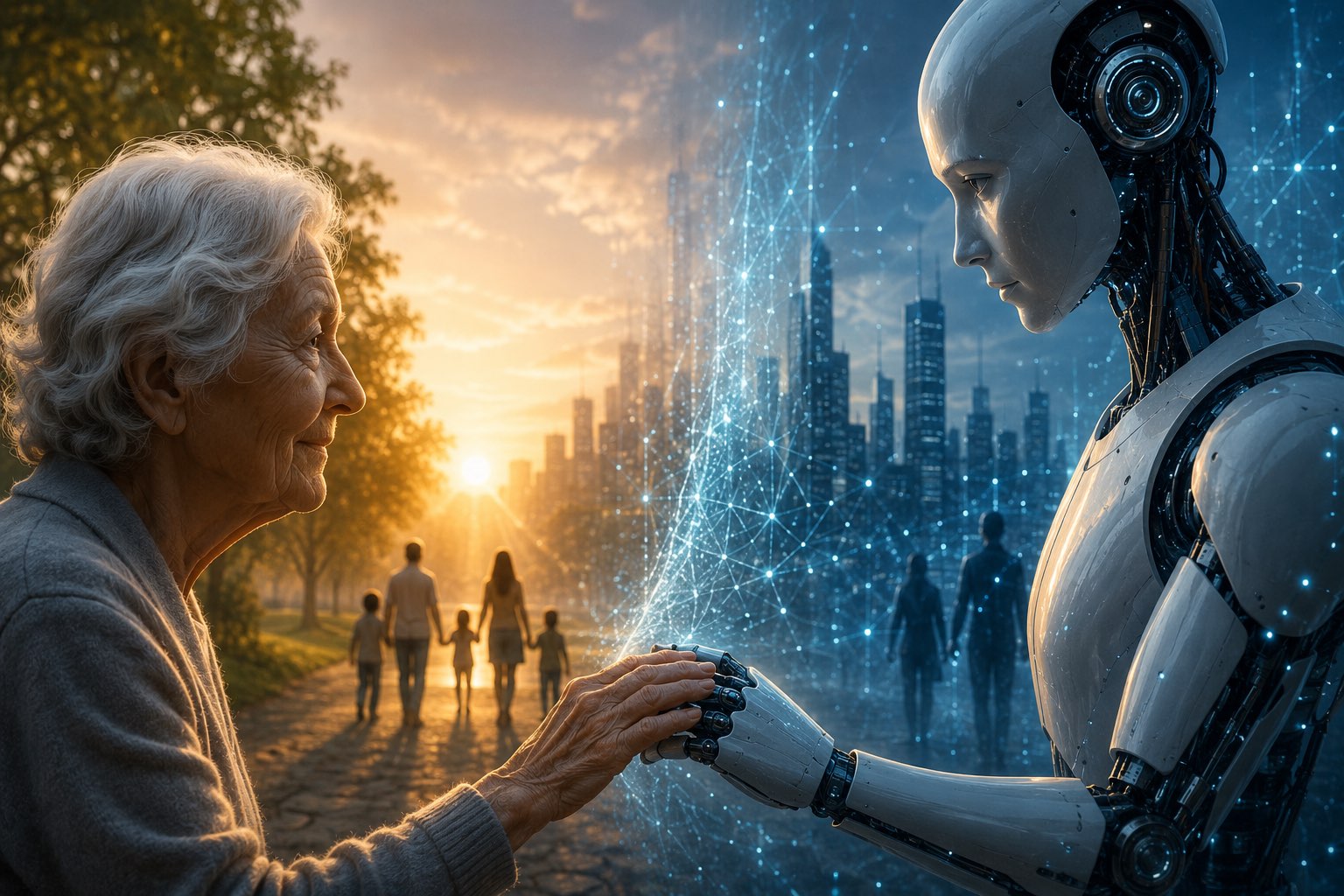
The modern aging population is entering an era unlike any generation before it. Older adults today are witnessing a civilization transitioning from physical communities toward increasingly digital ecosystems. Families communicate through screens more than face-to-face conversations. Emotional support is gradually becoming mediated through devices.
Healthcare systems are integrating AI-driven diagnostics and monitoring. Virtual companionship technologies are being introduced to address loneliness among older adults. Social participation increasingly depends on digital literacy. Even memory, identity, and emotional engagement are beginning to interact with artificial systems.
On one hand, artificial intelligence offers extraordinary opportunities for aging societies. AI may improve:
- healthcare accessibility,
- disease prediction,
- mobility assistance,
- cognitive support,
- independent living,
- personalized medicine,
- and social connectivity for isolated older adults.
In many ways, AI could significantly improve quality of life for aging populations worldwide. It may help older adults remain independent longer, support overwhelmed healthcare systems, and provide tools for safer and more efficient elder care.
Image
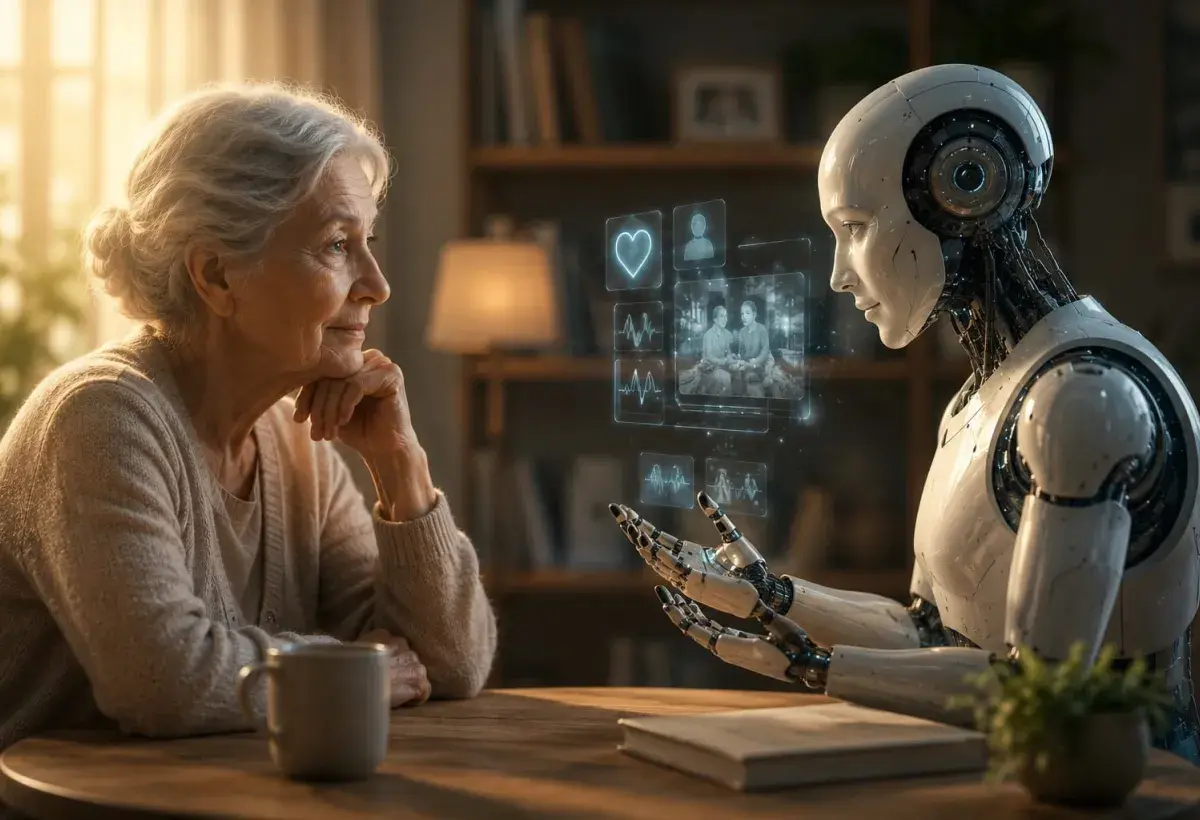
Can Artificial Intelligence Truly Replace Human Presence?
Yet the deeper concern is whether societies may unknowingly replace human presence, intergenerational connection, empathy, and meaningful social participation with increasingly simulated forms of interaction. As loneliness rises globally among older adults, there is growing risk that convenience-driven technological solutions could unintentionally normalize emotional substitution rather than genuine human connection.
This is where the concept of mindful aging becomes critically important.
Mindful aging recognizes that healthy aging is not merely about extending lifespan or improving physical survival. It is about preserving human dignity, emotional well-being, purpose, identity, wisdom, reflection, relationships, and meaningful participation throughout later life.
The danger in an AI-dominated future is not simply technological dependence, but the possibility that societies become so optimized for efficiency that they slowly neglect the deeply human dimensions of aging itself.
Artificial intelligence may eventually simulate companionship, conversation, memory assistance, emotional responsiveness, and caregiving support. But society must ask a difficult ethical question: can simulated interaction ever fully replace authentic human presence, especially for vulnerable aging populations seeking belonging, meaning, and emotional security?
Who Draws the Line Between Progress and Humanity?
The challenge for policymakers, healthcare institutions, and communities is therefore not whether AI should exist within aging societies, but how to integrate AI without weakening the human foundations that sustain psychological well-being, dignity, empathy, social belonging, and meaningful human connection.
Technology, when used responsibly, can become a powerful tool for supporting aging populations. AI may assist in healthcare monitoring, early disease detection, mobility support, cognitive assistance, emergency response systems, and even reducing isolation among older adults living alone. For many families overwhelmed by caregiving responsibilities, these innovations may provide practical relief and improve quality of life.
Yet beneath these extraordinary benefits lies a deeper ethical dilemma that governments and societies have only begun to confront. As artificial intelligence becomes increasingly integrated into caregiving, communication, companionship, and decision-making, where should humanity draw the boundary between assistance and replacement? At what point does technological convenience begin quietly substituting the emotional labor, patience, presence, and human responsibility that aging populations genuinely need?
This dilemma becomes even more complex because aging societies are particularly vulnerable to social fragmentation. Many countries are already facing declining birth rates, smaller family structures, migration-driven separation, rising healthcare costs, and increasing loneliness among older adults. In such an environment, AI companionship and automated caregiving systems may appear not only attractive, but economically necessary.
Governments may eventually justify expanded AI integration as a solution to labor shortages, overwhelmed healthcare systems, and long-term care crises. But the deeper concern is whether societies may slowly normalize a future where older adults receive efficient care without necessarily receiving meaningful human connection.
A machine may remind someone to take medication. It may monitor heart rate, detect falls, simulate conversation, or even respond empathetically through programmed emotional intelligence. But can it truly replace the psychological comfort of authentic human presence?
Can algorithms replicate the emotional meaning of being remembered, visited, listened to, touched, or genuinely cared for by another human being?
These questions are no longer theoretical. They represent emerging ethical realities that policymakers, healthcare leaders, educators, technologists, and communities must now confront together.
Governments therefore face one of the defining policy challenges of the modern era: how to embrace technological innovation without allowing efficiency to overpower humanity itself. The danger is not necessarily that artificial intelligence becomes malicious, but that societies become so optimized for productivity and convenience that human relationships gradually become secondary to technological substitution.
This is where policymakers must think beyond economics and innovation alone. AI governance can no longer focus solely on competitiveness, infrastructure, cybersecurity, or industrial growth. It must also address:
- human dignity,
- emotional well-being,
- mental health,
- digital ethics,
- social cohesion,
- and the preservation of authentic human relationships.
Conclusion
The responsibility does not belong to governments alone. Society itself must actively participate in protecting the human dimensions of civilization. Families, schools, healthcare systems, religious institutions, media organizations, universities, and younger generations all play a role in preserving empathy, intergenerational relationships, reflective living, and meaningful social engagement in an increasingly digital world.
Perhaps the greatest challenge of the AI era is that humanity is being asked to evolve not only technologically, but morally and emotionally at the same time. Artificial intelligence may continue advancing rapidly, but wisdom, compassion, patience, and ethical maturity do not automatically evolve at the same speed.
And so the question facing humanity may no longer simply be: How advanced can artificial intelligence become?
But rather:
As technology becomes increasingly capable of imitating human interaction, will societies still choose to preserve the slower, imperfect, deeply human relationships that give life meaning especially for the generations who once cared for humanity long before machines ever could?
Image

Suggested Citation
Lendez, M. (2026). The Warning the World Was Not Ready to Hear: AI, Humanity, and the Future of Mindful Aging. Chikicha. (Lendez, M., developer of Ikigai-Bayanihan Framework).
About the Author: Written by Dr. Mariza Lendez, the developer of Ikigai-Bayanihan Framework, a model that redefines aging through purpose, dignity, and community-centered lining.
Note:
Developed with the assistance of AI-supported deep research and evidence-based scientific sources.
References
Centers for Disease Control and Prevention. (2024). Health effects of social isolation and loneliness. https://www.cdc.gov/social-connectedness/risk-factors/index.html
Ge, S., Zhao, X., & Wang, Y. (2024). AI companions reduce loneliness. arXiv. https://arxiv.org/abs/2407.19096
Hinton, G. (2024, December 10). Banquet speech. Nobel Prize Outreach AB. https://www.nobelprize.org/prizes/physics/2024/hinton/speech/
Hinton, G., Bengio, Y., Russell, S., & others. (2023). Managing extreme AI risks amid rapid progress. arXiv. https://arxiv.org/abs/2310.17688
Morrison, A., & Smith, L. (2026). Not a silver bullet for loneliness: How attachment and age shape intimacy with AI companions. arXiv. https://arxiv.org/abs/2602.12476
National Institutes of Health. (2020). Social isolation and loneliness in older adults: Review and commentary of a National Academies report. https://pmc.ncbi.nlm.nih.gov/articles/PMC7437541/
Nobel Prize Outreach AB. (2024). Geoffrey Hinton banquet speech [Video]. YouTube. https://www.youtube.com/watch?v=-f5WQAk3dYo
The Guardian. (2023, May 2). Geoffrey Hinton quits Google to warn over dangers of AI. https://www.theguardian.com/technology/2023/may/02/geoffrey-hinton-godfather-of-ai-quits-google-warns-dangers-of-machine-learning
Washington Post. (2023, May 2). AI pioneer Geoffrey Hinton quits Google and warns of danger ahead. https://www.washingtonpost.com/technology/2023/05/02/geoffrey-hinton-leaves-google-ai/
World Health Organization. (2021). Advocacy brief: Social isolation and loneliness among older people. https://www.who.int/publications/i/item/9789240030749
World Health Organization. (2024). Reducing social isolation and loneliness among older people. https://www.who.int/activities/reducing-social-isolation-and-loneliness-among-older-people
World Health Organization. (2024). Social isolation and loneliness. https://www.who.int/teams/social-determinants-of-health/demographic-change-and-healthy-ageing/social-isolation-and-loneliness