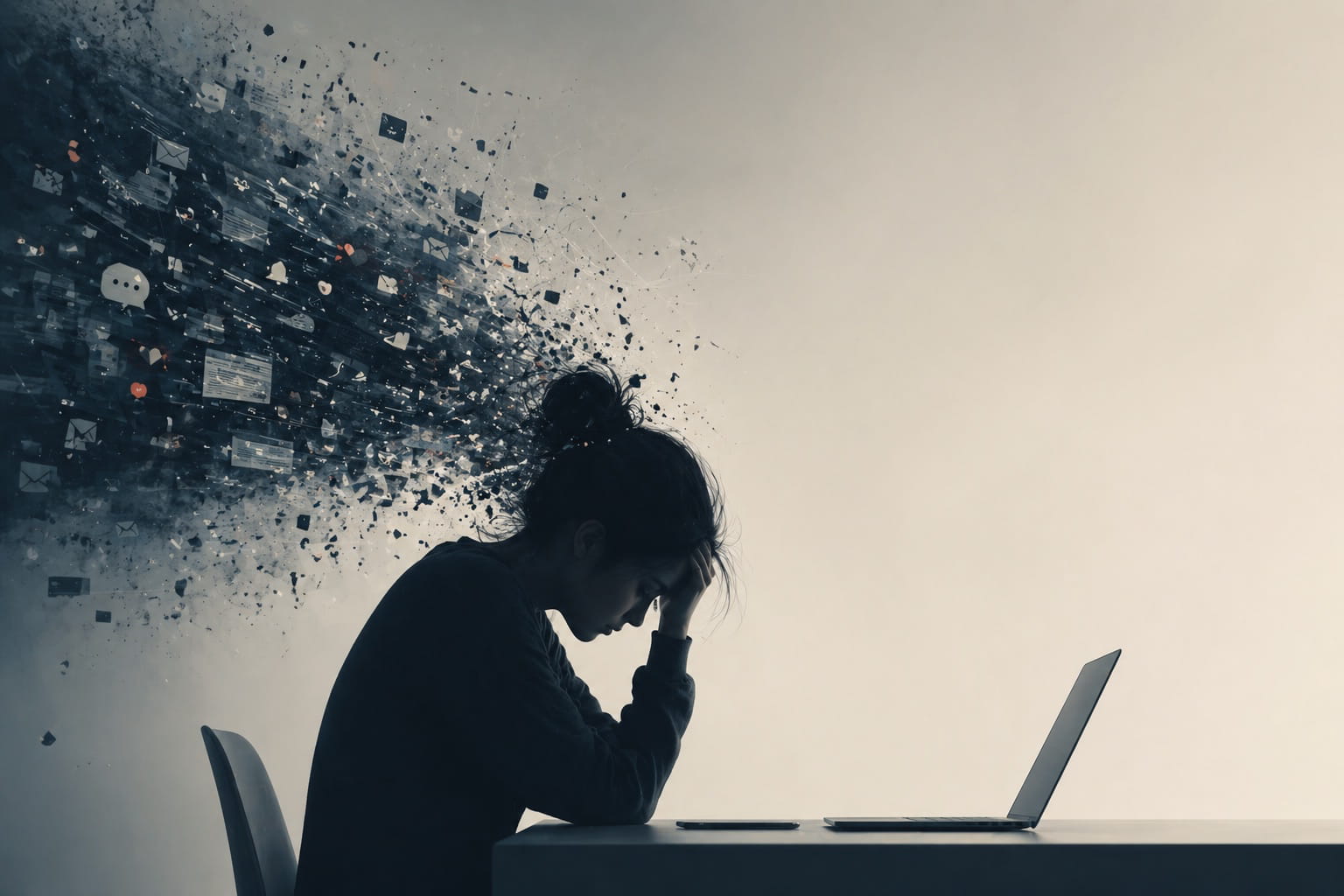
A Structural Analysis of Mental Load, Digital Overstimulation, and the Stress Cycle
Anxiety is often framed as a personal condition, something internal, something to be managed through discipline or mindset. However, current evidence does not support this limited view.
Leading authorities and peer-reviewed research consistently show that anxiety is shaped by interacting systems, not isolated behavior. It emerges from the combined weight of environmental demand, digital exposure, and biological strain.
Overthinking, in this context, is not simply excessive thought, it is a cognitive response to unresolved processing under continuous input. This reframing shifts the responsibility from the individual alone to the structure in which the individual operates (World Health Organization [WHO], 2023).
Mental Load: The Expansion of Cognitive Demand
Mental load has evolved beyond traditional definitions of responsibility or task management. It now represents a continuous occupation of the mind, driven by the need to process, decide, anticipate, and respond without pause.
The World Health Organization (2023) emphasized that anxiety arises from a complex interaction of biological, psychological, and social determinants, underscoring that it is a response to layered pressures rather than a single cause. In practical terms, individuals today navigate constant micro-decisions, anticipate outcomes, and sustain both social and professional presence simultaneously. Supporting this, research indexed by the National Institutes of Health (2023) confirmed that continuous connectivity and multitasking increase stress and contribute to emotional exhaustion.
The mind, therefore, is not just active as it is persistently engaged without a defined endpoint.
Digital Overstimulation: The Continuous Input Environment
The modern digital environment introduces a level of stimulation that is both constant and unregulated. Information is no longer encountered periodically; it is delivered in an uninterrupted stream that demands attention and response.
The American Psychological Association (2022) reported that a significant majority of individuals experience stress linked to continuous exposure to news and media. This finding suggests that digital exposure is not passive, as it actively contributes to psychological strain. Supporting this, research in Frontiers in Public Health (2024) demonstrated that increased screen time and social media use are directly associated with higher anxiety levels, particularly when sleep is reduced.The structure of digital platforms, designed for sustained engagement, ensures that input continues even when cognitive capacity has been exceeded.
The Stress Cycle: Interruption Without Resolution
From a physiological perspective, stress follows a structured cycle that includes activation, response, resolution, and recovery. Under normal conditions, this cycle allows the body to return to baseline after a stressor is addressed. However, current evidence indicates that this cycle is increasingly interrupted before completion.
Studies published in Biomedical and Pharmacology Journal (2025) showed that digital overuse, combined with chronic psychological stress, disrupts the body’s stress-response system, particularly the hypothalamic–pituitary–adrenal (HPA) axis. This disruption impairs full physiological recovery, leading to sustained activation rather than proper regulation. Concurrently, sleep, identified as a critical recovery mechanism, is often compromised, further limiting the body’s capacity to reset (Frontiers in Public Health, 2024). This results in a prolonged state of physiological activation that lacks proper resolution
Image

Overthinking: The Cognitive Expression of Incomplete Processing
Overthinking is commonly interpreted as a tendency toward excessive or unproductive thought. However, current research suggests a more precise understanding. It is the manifestation of cognitive processes that have not reached completion, largely due to continuous interruption and renewed input.
Studies indexed by the National Institutes of Health (2025) indicated that social media environments intensify rumination and repetitive negative thought patterns. Additional findings from Computers in Human Behavior Reports (2025) demonstrated that information overload and fear of missing out create a self-reinforcing feedback loop, wherein anxiety drives continued information consumption.
This cycle prevents cognitive closure, keeping the mind in a state of ongoing analysis and evaluation. Overthinking, therefore, is not simply excessive as it is sustained by the environment in which thinking occurs.
System Capacity and the Growing Gap
While the drivers of anxiety continue to expand, the systems designed to address it have not kept pace, that only a fraction of individuals with anxiety disorders receive adequate treatment (WHO, 2023). This gap highlights a structural imbalance between demand and support.
As cognitive and emotional pressures increase, the availability of effective intervention remains limited. This imbalance allows anxiety to persist not only at the individual level but across populations. It also reinforces the normalization of anxiety as part of everyday functioning rather than a condition requiring systemic response.
Conclusion
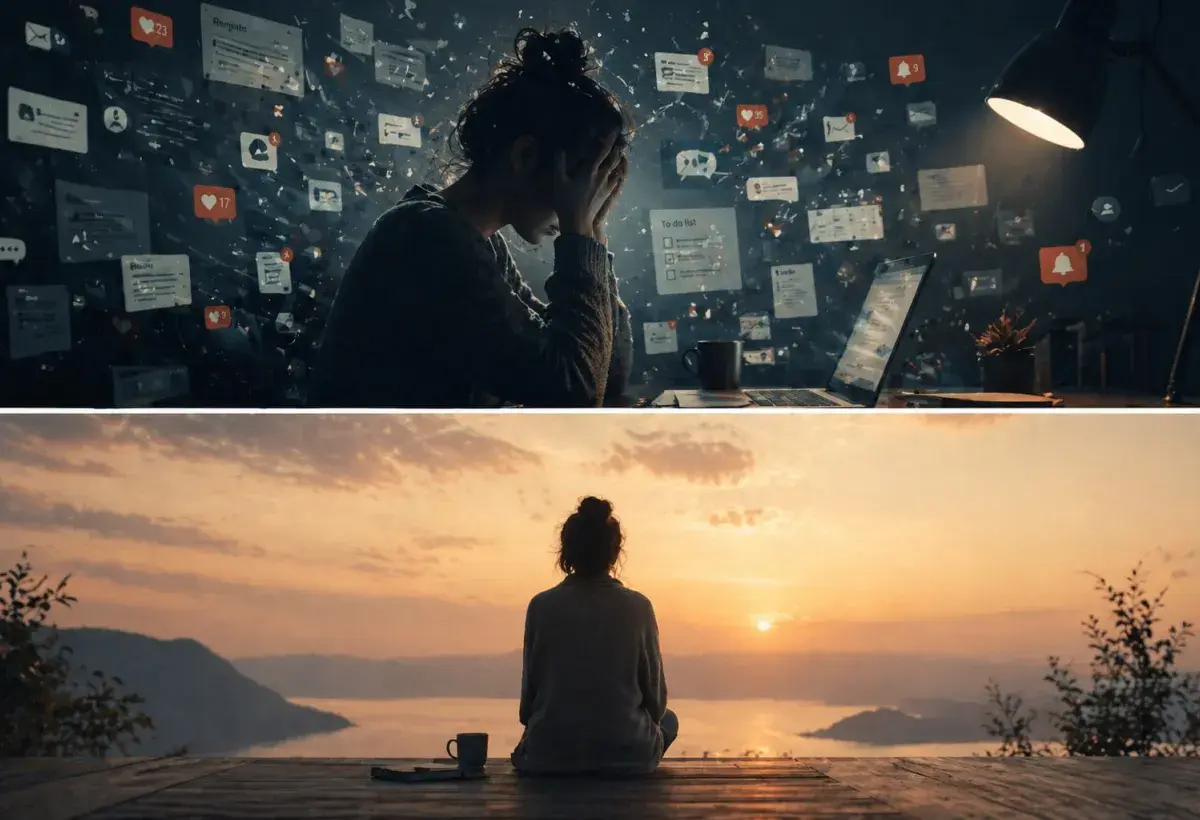
Anxiety and overthinking, when examined through current evidence, are not isolated or purely internal experiences. They are the result of continuous cognitive demand, sustained digital input, and disrupted recovery mechanisms operating simultaneously. The interaction of these factors creates an environment in which the mind remains active without completion and the body remains engaged without rest.
This is not a temporary condition but an emerging baseline shaped by modern systems.
What remains uncertain is how society will respond. Whether individuals and institutions will establish boundaries, redesign environments, or continue adapting to increasing levels of stimulation is not yet determined. What is clear, based on current evidence, is that without intervention, the trajectory does not move toward resolution, it moves toward persistence (WHO, 2023; Frontiers in Public Health, 2024).
And yet, beyond the data, there is something personal that is difficult to ignore. I find myself slowly recognizing these patterns. The shortened patience, the constant urge to check, to scan, to move from one input to another without pause. It does not feel like engagement anymore; It feels like acceleration but without direction. At times, it carries an intensity as confirmed by APA, 2022, as if the mind is approaching a threshold it was never meant to sustain.
This moment of awareness, however brief, interrupts the pattern. In that moment, a fundamental question emerges; What am I actually looking for? The repetition of the behavior does not always lead to an answer. Instead, it reveals the possibility that the act of searching has become detached from any clear object. The movement continues, but the purpose becomes less defined (NIH, 2025).
This is where the concern deepens. If the behavior persists without examination, it risks becoming automatic or the word we call “auto pilot", integrated into daily life without reflection. The data already suggests that these patterns are reinforcing themselves (Computers in Human Behavior Reports, 2025). My personal observation suggests something equally important: that recognition is still possible.
Whether that recognition leads to change remains open. But the question itself, What am I looking for? may be one of the few interruptions left within a system designed to continue.
Image
Suggested Citation
Lendez, M. (2026). The New Baseline: Anxiety, Overthinking, and the Architecture of Modern Life. Chikicha. (Lendez, M. developer of Ikigai-Bayanihan Framework).
About the Author
Written by Dr. Mariza Lendez, the developer of Ikigai-Bayanihan Framework, a model that redefines aging through purpose, dignity, and community-centered living.
References
American Psychological Association. (2022). Stress in America™ 2022: Strain, stress, and media overload.
https://www.apa.org/monitor/2022/11/strain-media-overload
Biomedical and Pharmacology Journal. (2025). Viral infections, psychological stress, and digital overuse: A critical triad in post-pandemic mental health.
https://biomedpharmajournal.org/vol18no2/viral-infections-psychological-stress-and-digital-overuse-a-critical-triad-in-post-pandemic-mental-health/
Computers in Human Behavior Reports. (2025). Cyberchondria, information overload, and anxiety: A behavioral loop analysis.
https://www.sciencedirect.com/science/article/pii/S2543925125000191
Frontiers in Public Health. (2024). Screen time, sleep, and anxiety relationships in modern populations.
https://www.frontiersin.org/articles/10.3389/fpubh.2026.1766808/full
National Institutes of Health. (2023). Digital stress and its impact on mental health: A growing concern.
https://pmc.ncbi.nlm.nih.gov/articles/PMC10561583/
National Institutes of Health. (2025). Social media use and its association with rumination and anxiety.
https://pmc.ncbi.nlm.nih.gov/articles/PMC12401342/
World Health Organization. (2023). Anxiety disorders.
https://www.who.int/news-room/fact-sheets/detail/anxiety-disorders