This article clarifies the gap between appearance-based health perceptions and evidence-based medical understanding and offers a structured approach to evaluating health information in digital environments.
Introduction
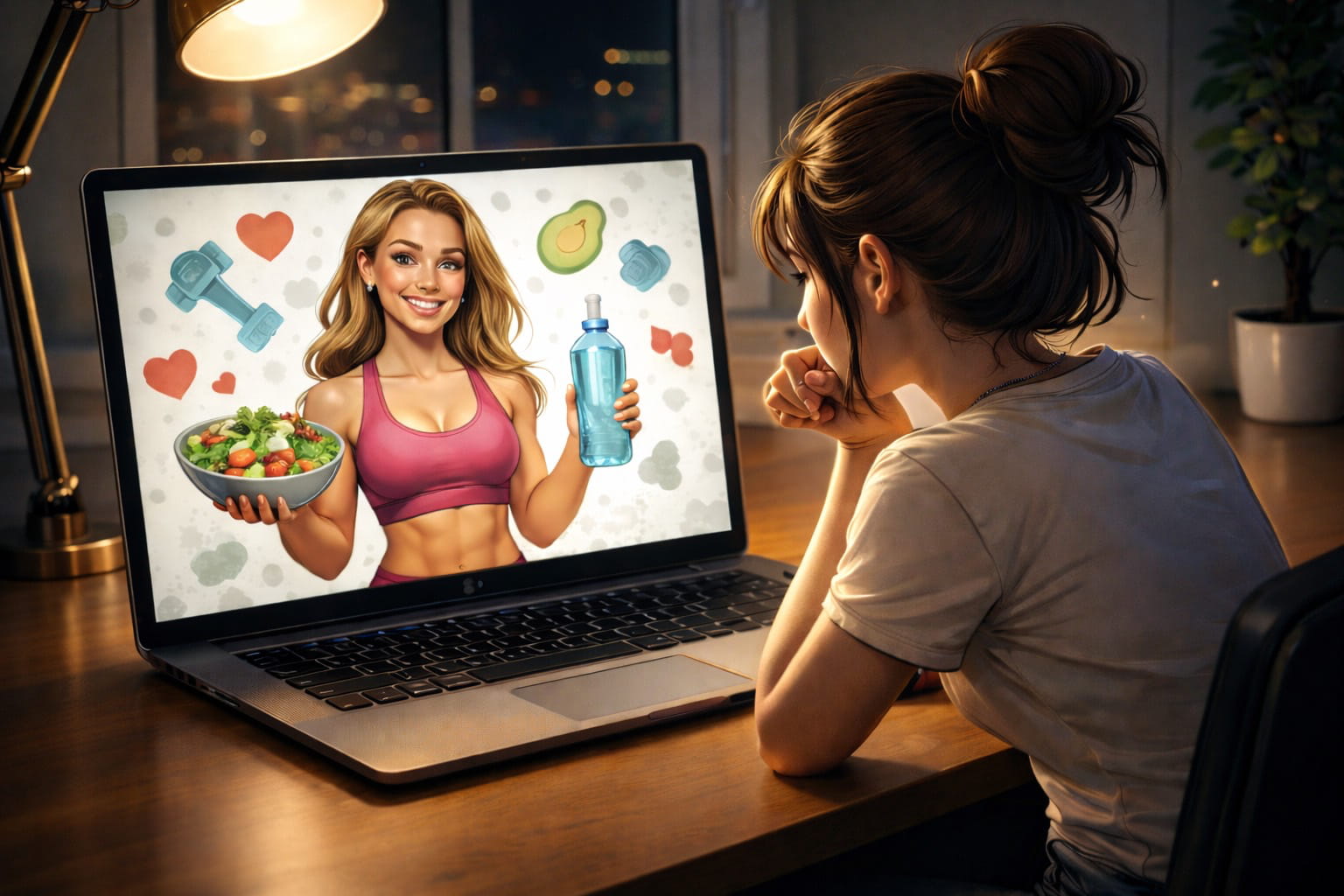
Digital platforms have reshaped how health is understood, often presenting it as something visible, measurable, and quickly achievable. Across widely used platforms such as Instagram, TikTok, and YouTube, health is frequently portrayed through physical appearance, curated routines, and simplified lifestyle practices.
While accessible, these representations do not reflect how health is defined in evidence-based medicine. Clinical understanding is grounded in physiological function, risk factors, and long-term outcomes, elements that are not always visible or immediately apparent. As a result, health is increasingly interpreted through visual indicators rather than clinical parameters, raising concerns about the accuracy, applicability, and safety of practices derived from non-clinical sources.
This article clarifies the gap between appearance-based health perceptions and evidence-based medical understanding and offers a structured approach to evaluating health information in digital environments.
The current information landscape further complicates this distinction. The World Health Organization defines the present condition as an infodemic, where an overabundance of mixed-quality information makes it difficult to identify reliable guidance (World Health Organization, 2020). In this environment, health claims are often presented without methodological context, outcomes are highlighted without appropriate comparison, and interventions are generalized beyond their intended populations.
Repeated exposure to such content increases familiarity, which may be misinterpreted as credibility. However, familiarity does not constitute validation. The absence of standardized evidence introduces risk into decision-making, particularly when information is accepted without critical evaluation. Exposure to repeated health-related content has also been shown to influence perception and behavior, reinforcing the need for structured interpretation rather than passive consumption (Su et al., 2022).
Image

What Evidence Actually Supports
Despite the variability of health claims in digital environments, guidance from established health authorities remains consistent. The World Health Organization identifies core determinants of health outcomes that are supported by long-term evidence:
- balanced nutrition based on whole foods
- regular physical activity appropriate to age and condition
- adequate sleep and recovery
- avoidance of harmful substances
- timely access to qualified healthcare
These principles are central to reducing the burden of noncommunicable diseases and supporting long-term health (World Health Organization, 2023).
Notably, these recommendations are foundational rather than trend-driven. They do not rely on rapid transformation, single interventions, or universal solutions. Instead, they reflect sustained, evidence-based practices that apply across populations.
Evaluating Common Health Claims
- Detoxification Practices: Claims promoting detoxification through juices, supplements, or restrictive regimens are not supported by major health authorities. The body maintains its own detoxification processes through the liver and kidneys.
Conclusion: Not supported as a necessary or evidence-based intervention.
- Generalized Supplementation: Routine supplementation without clinically identified deficiencies does not replace dietary adequacy. In some cases, it may introduce risks due to excessive intake or interaction with medications.
Conclusion: Appropriate only when clinically indicated.
- Intermittent Fasting: Intermittent fasting has demonstrated benefits in specific metabolic contexts. However, its suitability varies depending on individual health status, age, and existing conditions.
Conclusion: Evidence exists, but application must be individualized.
- “Clean Eating” Concepts: While whole-food dietary patterns are supported, the concept of “clean eating” lacks a standardized clinical definition and may lead to unnecessary restriction.
Conclusion: Beneficial when aligned with balanced nutrition; otherwise, undefined.
- Appearance as a Health Indicator: Visible attributes such as body composition or skin condition do not reliably reflect internal health status. Clinical evaluation requires objective measures.
Conclusion: Not a valid standalone indicator of health.
Image

Why These Practices Are Widely Adopted
The persistence of non-validated health practices is not accidental. It reflects predictable patterns in how individuals process information.
Visual presentation plays a central role. Observable outcomes are often perceived as evidence, even when they lack clinical validation. At the same time, simplified messages such as single routines or universal solutions, reduce complexity and create a sense of control.
Social reinforcement further strengthens these patterns. Repeated exposure across networks increases perceived credibility, regardless of source accuracy. Health-related misinformation circulating on digital platforms has been shown to influence decision-making and public behavior, reinforcing the need for critical evaluation of information sources (Chou et al., 2020).
These dynamics are behavioral, not evidentiary. They explain adoption, but they do not justify it.
Implications for Aging Populations
The impact of misinformation is amplified in aging populations, where health management becomes more complex. The World Health Organization identifies multimorbidity, the presence of multiple conditions, as a central challenge requiring coordinated and individualized care (World Health Organization, 2016).
Generalized advice derived from non-clinical sources is not designed for such complexity. Practices that appear beneficial in one context may be inappropriate or ineffective in another.
This underscores the importance of evaluating health information within the context of individual conditions rather than adopting generalized trends.
Image

A Structured Approach to Evaluating Health Information
Effective decision-making requires a disciplined approach to evaluating health information:
- Source validation: Is the information supported by recognized health authorities or peer-reviewed evidence?
- Context relevance: Is the guidance appropriate for the individual’s age, condition, and medical history?
- Outcome clarity: Are the claimed benefits measurable and clinically meaningful?
- Risk awareness: Are potential risks, interactions, or limitations clearly identified?
This approach shifts decision-making from passive consumption to active evaluation.
Conclusion
The contemporary health environment is defined not by lack of information, but by excess of interpretation.
What is widely shared is not always reliable.
What appears convincing is not always evidence-based.
The World Health Organization emphasizes that improved outcomes depend on adherence to validated practices and timely, appropriate intervention (World Health Organization, 2023).
Health decisions should therefore be guided by evidence, context, and professional evaluation, not by visibility, repetition, or perceived consensus.
In an environment shaped by influence, the ability to distinguish evidence from assertion is not optional. It is essential.
Disclaimer
The author is not a licensed medical practitioner. This article is intended for educational purposes only and does not provide medical advice, diagnosis, or treatment. Any health concerns should be evaluated by a qualified healthcare professional.
Image

Suggested Citation
Lendez, M. (2026). The Illusion of Health Online: Why What Looks Heatlhy Is Not Always True. Chikicha.
About the Author
Written by Dr. Mariza Lendez, the developer of Ikigai-Bayanihan Retirement Framework, a model redefines aging through purpose, dignity, and community-centered living.
References
Chou, W.-Y. S., Oh, A., & Klein, W. M. P. (2020).
Addressing health-related misinformation on social media. JAMA, 324(23), 2417–2418.
Su, Z., McDonnell, D., Wen, J., Kozak, M., Abbas, J., Segalo, S., Li, X., Ahmad, J., Cheshmehzangi, A., Cai, Y., Yang, L., & Xiang, Y.-T. (2022).
Mental health consequences of COVID-19 media coverage: The need for effective crisis communication practices. Globalization and Health, 18, 4.
World Health Organization. (2016).
Multimorbidity: Technical series on safer primary care.
World Health Organization. (2020).
Managing the COVID-19 infodemic: Promoting healthy behaviours and mitigating the harm from misinformation and disinformation.
World Health Organization. (2023).
Noncommunicable diseases: Key facts.