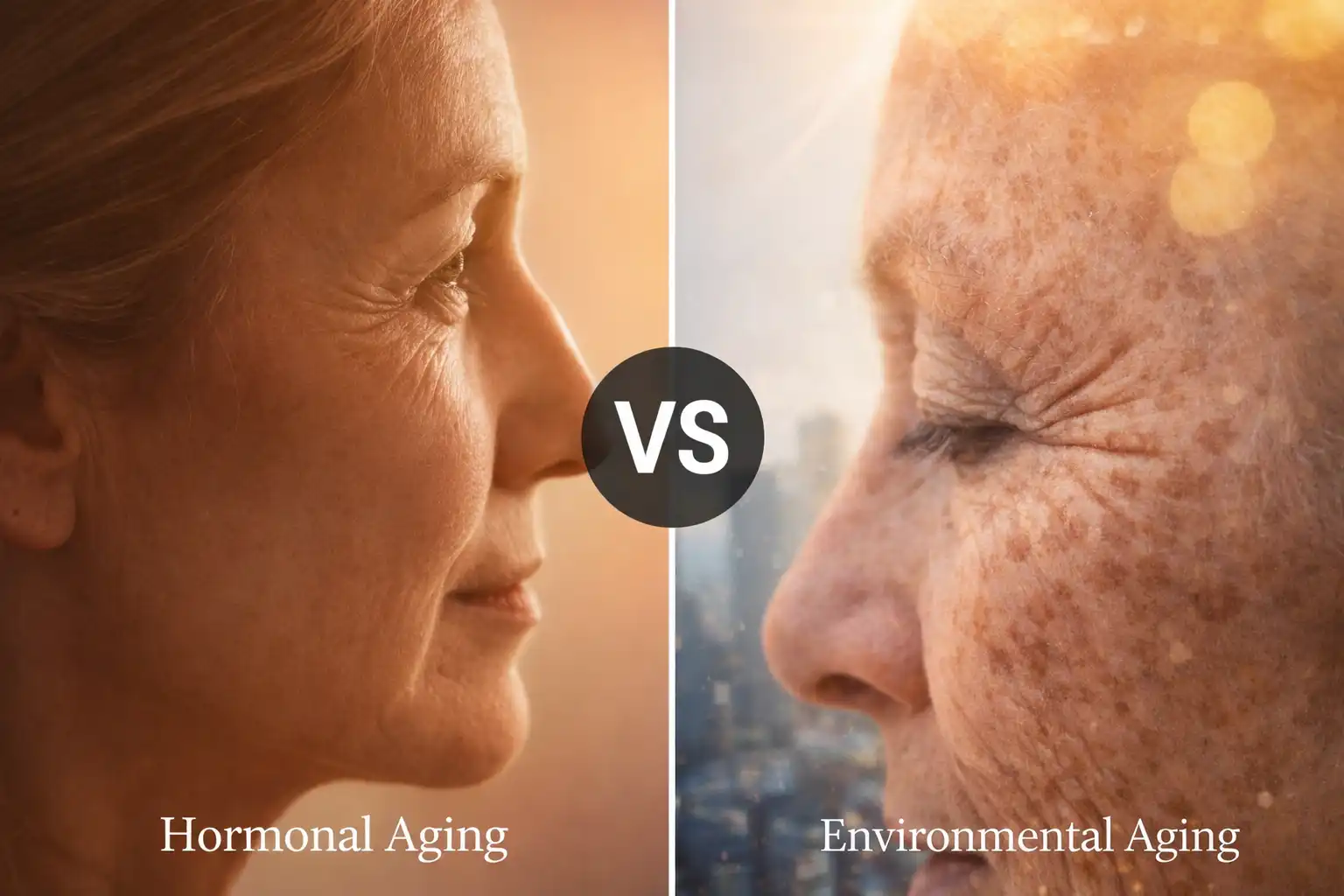
Hormonal Aging vs Environmental Aging: What’s Really Making You Look Older?
Aging is often treated as a single, inevitable process. But in reality, it is shaped by two powerful forces working at the same time one from within, and one from the world around you.
-
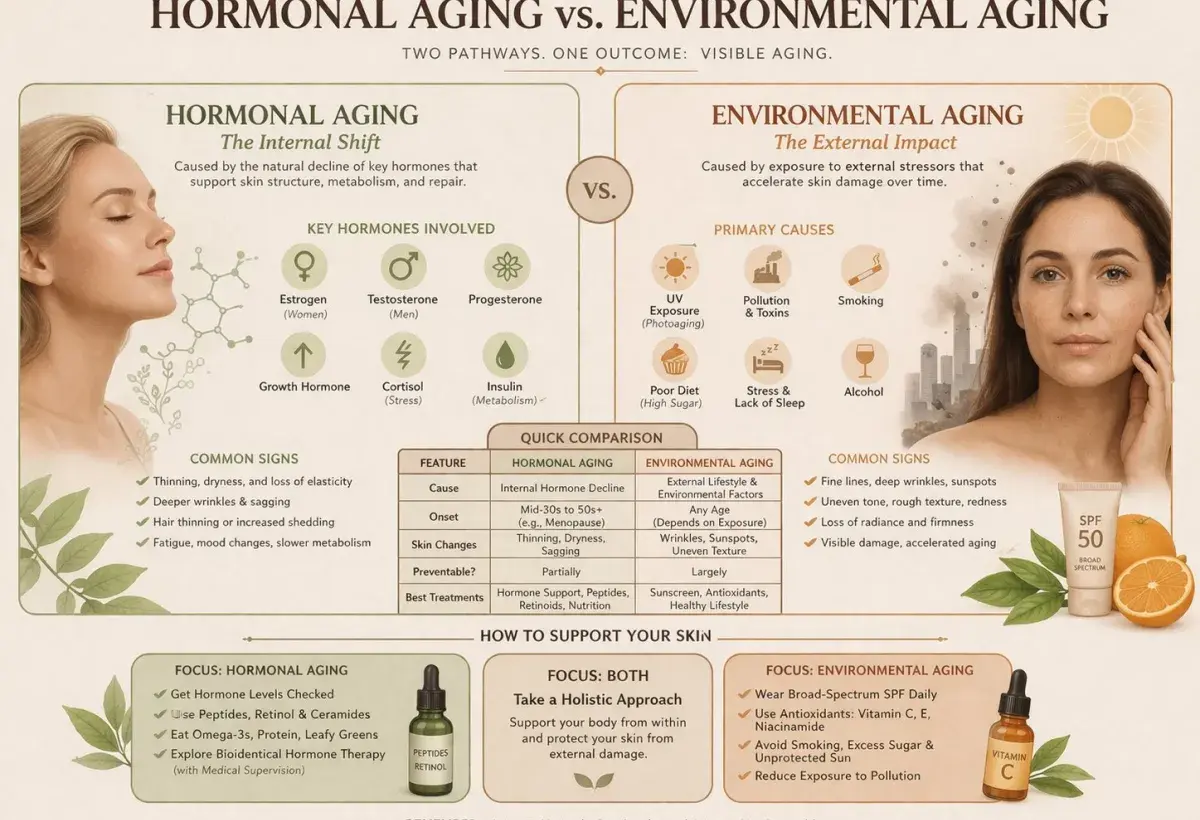
Hormonal aging reflects what is happening internally: the gradual decline of key biological signals that regulate skin structure, metabolism, and repair.
-
Environmental aging, on the other hand, reflects accumulated exposure sunlight, pollution, stress, and daily habits that quietly accelerate visible damage.
Most people experience both. But understanding which one is driving your changes more strongly allows you to respond with precision, rather than guesswork.
Understanding Hormonal Aging: The Internal Shift
Hormonal aging is not just about getting older it is about losing biological signals that maintain structure and function.
Beginning as early as the mid-30s and accelerating through perimenopause and menopause, levels of estrogen, progesterone, testosterone, and growth hormone begin to decline. These hormones are not only reproductive, they are deeply involved in skin thickness, hydration, elasticity, and repair.
What Happens to the Skin
Research has consistently shown that estrogen plays a central role in maintaining skin integrity. As levels decline:
- Collagen production decreases, leading to thinning and loss of firmness
- Skin hydration drops, as natural oil and water retention decline
- Elastic fibers weaken, contributing to sagging rather than just wrinkling
A review in Maturitas (Brincat, 2000) demonstrated that postmenopausal women can lose up to 30% of skin collagen within the first five years after menopause highlighting how rapid and structural hormonal aging can be.
Beyond the Skin
Hormonal aging is systemic, which is why its effects go beyond appearance:
- Hair becomes thinner due to reduced follicle support
- Metabolism slows, affecting body composition
- Fatigue and mood fluctuations increase due to hormonal imbalance
This is why hormonal aging often feels like a shift in overall vitality, not just visible aging.
Image
Understanding Environmental Aging: The Accumulation of Exposure
Environmental aging often referred to as extrinsic aging is driven by repeated exposure to external stressors. Unlike hormonal aging, this form is largely cumulative and preventable.
The Primary Drivers
Among all environmental factors, UV radiation remains the most dominant, responsible for up to 80% of visible facial aging, according to dermatological research. But it does not act alone. Other contributors include:
- Air pollution, which introduces oxidative particles that penetrate the skin
- Smoking, which restricts oxygen supply and accelerates collagen breakdown
- High-sugar diets, which promote glycation, a process that stiffens collagen fibers
- Chronic stress and poor sleep, which elevate cortisol and impair repair mechanisms
What Happens at the Cellular Level
Environmental aging is primarily driven by oxidative stress. A landmark review in Ageing Research Reviews (Lephart, 2016) explains that reactive oxygen species (ROS):
- Damage cellular DNA
- Break down collagen and elastin
- Trigger inflammatory pathways that accelerate visible aging
Clinically, this manifests as:
- Deep wrinkles rather than fine lines
- Uneven pigmentation and sunspots
- Rough texture and loss of radiance
Unlike hormonal aging, which leads to thinning, environmental aging leads to damage and irregularity.
Where They Overlap: The Reality of Modern Aging
In reality, these two processes rarely occur in isolation. A woman in her 40s or 50s may experience:
- Hormonal decline weakening the skin’s structure
- Environmental exposure accelerating visible damage
This combination leads to:
- Thinner skin that is also more prone to pigmentation
- Reduced repair capacity alongside increased external stress
A study in Dermato-Endocrinology (Vierkötter & Krutmann, 2012) emphasizes that environmental factors can amplify intrinsic aging, especially when the skin’s natural defenses are already compromised.
How to Recognize What’s Dominant
Instead of isolating symptoms, it helps to observe patterns.
If your skin feels:
- Increasingly dry, fragile, and less elastic, with overall thinning → hormonal aging is likely dominant
If your skin shows:
- Sunspots, uneven tone, roughness, and deeper wrinkles, especially in exposed areas → environmental aging is more influential
For most people, the answer is not one or the other but which one is leading the process.
Final Perspective: Aging as a Dual Process
Aging is not random. It is the result of internal decline and external exposure interacting over time.
Hormonal aging changes the foundation.
Environmental aging shapes the surface.
Understanding this distinction allows for a more intelligent approach not chasing products, but supporting the skin based on what it is actually going through. Because aging well is not about stopping time, it is about responding to it with clarity, consistency, and care.
Image
Disclaimer
This article is intended for educational and informational purposes only. We do not sell, promote, or endorse any specific product mentioned. Individual needs vary, and consulting a qualified healthcare professional should always be the first step before making decisions related to skincare, hormones, or treatment.
About the Author
The author is a registered nurse with both clinical and personal experience in caregiving. Guided by the belief that prevention is always better than cure, she advocates for early awareness, intentional living, and informed decision-making to reduce long-term burdens, whether in health or in life. She is also a strong believer in a natural remedy–first approach, valuing the body’s innate ability to heal when supported by proper nutrition, lifestyle, and holistic care.
References
- Brincat, M. (2000). Hormone Replacement Therapy and the Skin. Maturitas, 35(2), 107–117.
- Scharffetter-Kochanek, K., et al. (2000). Photoaging of the skin: Molecular mechanisms and preventive strategies. Journal of Investigative Dermatology Symposium Proceedings.
- Vierkötter, A., & Krutmann, J. (2012). Environmental influences on skin aging. Dermato-Endocrinology, 4(3), 227–231.
- Lephart, E.D. (2016). Skin aging and oxidative stress. Ageing Research Reviews, 25, 36–44.