I. Introdution: A Demographic Turning Point
Across the world, aging populations are reshaping the foundations of modern economies. Labor markets are tightening while pension systems face mounting fiscal strain, transforming what was once a distant projection into an immediate economic reality. These demographic shifts are already influencing productivity, public finance stability, and long-term policy direction across both developed and emerging economies. What is unfolding is not a temporary disruption, but a structural transition.
At the core of this transformation is a fundamental demographic imbalance. Longer life expectancy combined with declining birth rates is altering the ratio between workers and retirees. According to the Organisation for Economic Co-operation and Development (OECD), the old-age dependency ratio in advanced economies rose from 19 percent in 1980 to 31 percent in 2023 and is projected to reach approximately 52 percent by 2060 (OECD, 2023). This shift signals a future where fewer workers are expected to support a significantly larger retired population.
The economic implications of this imbalance are profound. Without structural adjustments, societies may face slower economic growth, increased fiscal pressure, and widening intergenerational inequality. Yet demographic aging is not solely a constraint. Increasingly, global institutions recognize it as an opportunity to rethink productivity, redefine work, and redesign economic participation across the life course.
II. The Labor Shortage Dilemma
A shrinking workforce is emerging as one of the most defining constraints of aging economies. As large cohorts of workers retire, particularly across Europe and parts of Asia, the working-age population is projected to decline significantly in the coming decades. The OECD Employment Outlook suggested that some countries could experience workforce reductions exceeding 30 percent by 2060, creating sustained labor supply pressures (OECD, 2024). This contraction is already being felt across multiple industries.
Sectors that depend heavily on human labor including healthcare, agriculture, construction, and manufacturing are experiencing persistent workforce shortages. These shortages are not isolated but systemic, affecting both productivity and service delivery. At the macroeconomic level, fewer workers translate directly into reduced economic output and slower productivity growth. The challenge, therefore, extends beyond labor availability to broader economic performance.
The International Monetary Fund (IMF) emphasized that demographic aging reshapes consumption patterns, investment behavior, and fiscal priorities. Aging populations tend to consume differently, invest more conservatively, and require increased public spending on healthcare and pensions (IMF, 2022). As a result, economies must adapt not only to a smaller workforce but also to a structurally different economic environment. The central question becomes how to sustain growth with fewer workers while maintaining social stability
Image

III. Rethinking Work for Longer Lives
Extending working lives has emerged as one of the most widely recommended responses to demographic aging. Improvements in health and longevity mean that many older adults remain capable of contributing economically far beyond traditional retirement thresholds. Across OECD countries, employment among individuals aged 55 to 64 increased from 47.7 percent in 2004 to approximately 66.4 percent in 2024 (OECD, 2024). This trend reflects both necessity and opportunity.
Governments are increasingly adopting policies that support longer and more flexible careers. These include gradual increases in retirement age, phased retirement options, and investments in lifelong learning and reskilling programs. Such measures recognize that the nature of work must evolve alongside demographic change. Rather than viewing retirement as a fixed endpoint, it is being redefined as a transition.
Policy experimentation is also becoming more visible. Germany, for example, has introduced measures allowing retirees who continue working to earn tax-free income, incentivizing extended participation in the labor force. These initiatives signal a broader shift in thinking. Aging populations are no longer viewed solely as fiscal burdens but as potential contributors to economic resilience and stability.
IV. Rising Pressures on Pension Systems
Alongside labor market challenges, pension systems are facing increasing strain. Many countries rely on pay-as-you-go (PAYG) systems, where current workers fund the benefits of current retirees. As the number of retirees grows while the workforce shrinks, the sustainability of these systems becomes increasingly uncertain. This structural imbalance places long-term pressure on public finances.
OECD projections indicated that the working-age population in many advanced economies will continue to decline, reducing the base of contributors to pension systems (OECD, 2023). At the same time, rising life expectancy increases the duration of benefit payouts. This dual pressure, fewer contributors and more beneficiaries creates a widening fiscal gap. Without reform, pension systems risk becoming financially unsustainable.
In response, governments are implementing a range of policy adjustments. These include increasing statutory retirement ages, modifying contribution rates, and strengthening the link between benefits and lifetime earnings. Some countries, such as Denmark, have introduced automatic adjustment mechanisms that tie retirement age to life expectancy, with projections reaching age 70 by 2040. These reforms aim to stabilize systems while distributing responsibility more equitably across generations.
Image
V. The Global Governance of Aging
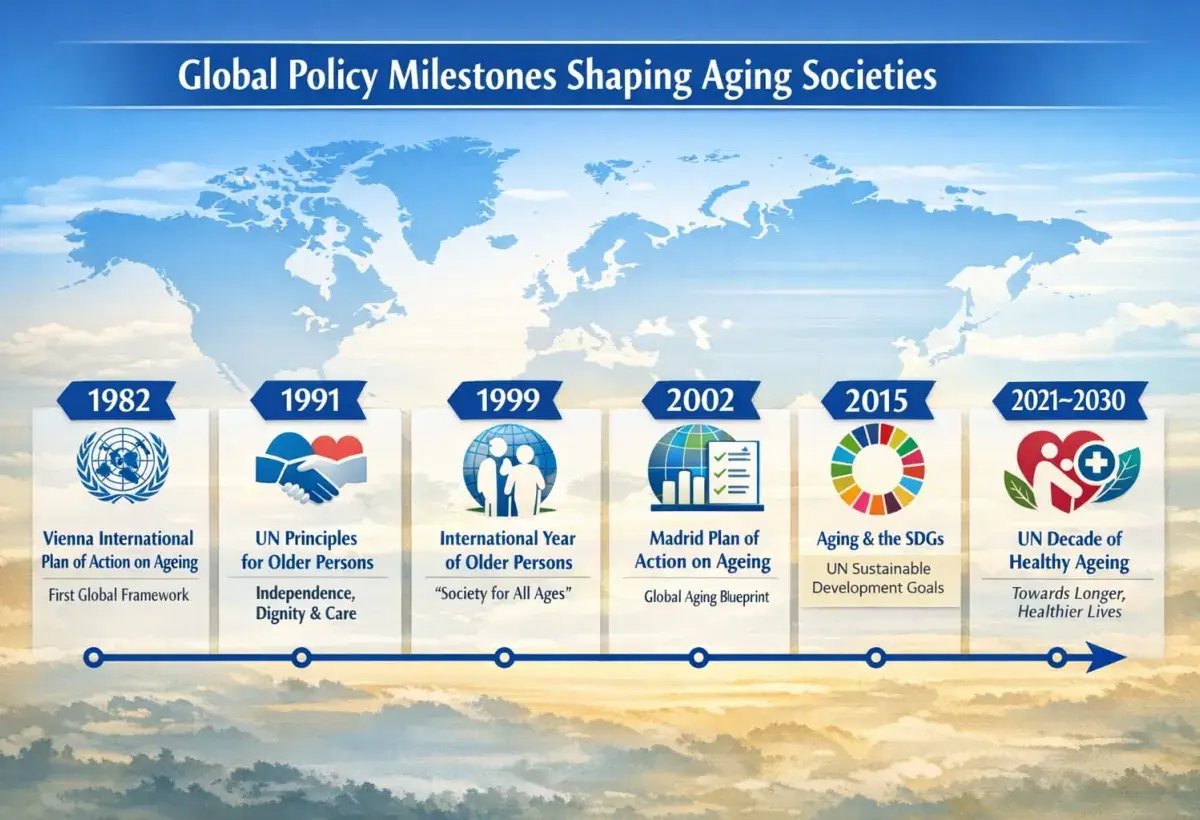
Over the past four decades, the international community has developed a series of frameworks to guide responses to population aging. These milestones reflect a growing recognition that aging is not only a social issue but a structural economic and policy concern. From early initiatives to contemporary global strategies, the evolution of aging policy demonstrates increasing sophistication and urgency.
The 1982 Vienna International Plan of Action on Ageing marked the first coordinated global effort to address aging populations. This was followed by the 1991 United Nations Principles for Older Persons, which established foundational values including independence, participation, care, self-fulfillment, and dignity. These principles continue to inform policy frameworks worldwide.
Subsequent developments, including the 2002 Madrid International Plan of Action on Ageing (MIPAA) and the integration of aging into the 2015 Sustainable Development Goals, expanded the scope of policy engagement. Most recently, the United Nations Decade of Healthy Ageing (2021-2030) has emphasized age-friendly environments, integrated care, and the elimination of ageism. Together, these frameworks signal a shift toward a more comprehensive and coordinated global response.
VI. The Emergence of the Silver Economy
As aging populations expand, a new economic paradigm is taking shape - the silver economy. International institutions such as the OECD, World Bank, and IMF increasingly highlight the economic potential of older populations. This perspective moves beyond traditional welfare models, recognizing older adults as active participants in economic systems.
The silver economy encompasses a wide range of activities, including extended workforce participation, consumption, entrepreneurship, and knowledge transfer. Older adults are not only beneficiaries of services but contributors to productivity, innovation, and community development. This reframing is essential for aligning economic systems with demographic realities.
At the same time, the transition requires coordinated policy responses. Labor markets must become more inclusive, education systems must support lifelong learning, and social protection frameworks must adapt to longer life spans. Without such adjustments, the potential of the silver economy may remain underutilized. With them, it can become a driver of resilience and sustainable growth.
Image

VII. Policy Priorities for the Silver Economy
Transforming demographic aging into an economic advantage requires deliberate and coordinated policy action. One critical priority is aligning retirement systems with increased life expectancy. Gradually adjusting retirement ages helps maintain balance between working years and retirement while preserving economic productivity. This approach reflects the reality that longer lives often include longer periods of health and capability.
Equally important is promoting lifelong workforce participation. Policies supporting reskilling, flexible work arrangements, and age-inclusive workplaces enable older individuals to remain engaged. Continuous learning ensures that workers can adapt to evolving economic demands, particularly in the context of digital transformation and technological change.
Pension reform also remains central to long-term sustainability. Diversified systems that combine public support with private savings mechanisms distribute financial responsibility more effectively. Additionally, strategic labor migration policies can help offset workforce declines by expanding the pool of contributors. Together, these measures form a comprehensive response to demographic change.
VIII. A Shared Responsibility
The transition to aging societies is not solely a policy challenge but a collective responsibility. Governments, institutions, families, and individuals all play a role in shaping how societies adapt to demographic change. Effective responses require alignment across these different actors, ensuring that policies translate into meaningful outcomes.
Older adults themselves remain central to this transformation. Their experience, knowledge, and practical insight represent valuable assets that can strengthen both economic systems and community life. Continued engagement through work, mentorship, and civic participation enhances both individual well-being and societal resilience.
At the same time, families and communities must recognize older individuals as contributors rather than dependents. Intergenerational relationships play a crucial role in sustaining social cohesion and facilitating knowledge transfer. At the global level, international collaboration allows countries to share best practices and develop more effective responses to shared challenges.
Image
IX. The Road Ahead
The silver economy now stands at a decisive crossroads. Demographic aging presents both risks and opportunities, and the outcomes will depend largely on how societies respond. Without adaptation, aging populations may intensify fiscal strain, deepen labor shortages, and constrain economic growth. With the right policies, however, they can become a foundation for resilience and innovation.
The path forward requires modernizing labor markets, pension systems, healthcare structures, and education frameworks. These systems must reflect the realities of longer, healthier lives. More importantly, they must be designed to harness, rather than sideline, the capabilities of older populations.
Ultimately, the future of aging societies will be determined by alignment between demographic realities and institutional design. When supported by forward-looking policies and inclusive frameworks, demographic aging can evolve from a structural challenge into a powerful driver of sustainable development.
X. Consultant Perspective
From a policy and economic development perspective, aging should be understood as a structural transition rather than a demographic burden. Countries that invest early in age-inclusive labor markets, sustainable pension systems, and lifelong learning ecosystems will be better positioned to navigate this shift. The competitive advantage will belong to those who recognize longevity not as a cost, but as an asset.
In this context, the silver economy represents more than an emerging trend. It is a strategic frontier. Nations that successfully integrate aging into their economic models will not only mitigate risk but unlock new forms of productivity, innovation, and social cohesion. The decisions made today will determine whether aging societies become constrained or empowered in the decades ahead.
Image

Suggested Citation
Lendez, M. (2026). The silver economy at a crossroads: Labor shortages and pension pressures in an aging world. Developed within the IKIGAI-Bayanihan Purpose-Driven Retirement Framework.
About the author
Written by Dr. Mariza Lendez, the developer of the Ikigai-Bayanihan Purpose-Driven Retirement Framework, a model that redefines aging through purpose, dignity, and community-centered living.
References and Policy Sources
United Nations Frameworks
United Nations. 1982. Vienna International Plan of Action on Ageing. United Nations Department of Economic and Social Affairs (UN DESA).
https://www.un.org/development/desa/ageing/resources/vienna-international-plan-of-action.html
United Nations General Assembly. 1991. United Nations Principles for Older Persons (Resolution 46/91).
United Nations. 1999. International Year of Older Persons: Towards a Society for All Ages.
https://www.un.org/en/events/olderpersons/
United Nations. 2002. Madrid International Plan of Action on Ageing.
United Nations Second World Assembly on Ageing.
https://www.un.org/development/desa/ageing/madrid-plan-of-action-and-its-implementation.html
Global Development Framework
United Nations. 2015. Transforming Our World: The 2030 Agenda for Sustainable Development.
https://sdgs.un.org/2030agenda
Global Aging Health Framework
World Health Organization. 2020. UN Decade of Healthy Ageing 2021–2030.
https://www.who.int/initiatives/decade-of-healthy-ageing
Silver Economy / Aging Economy Context
Organisation for Economic Co-operation and Development (OECD). 2023. OECD Economic Outlook.
OECD Publishing.
https://www.oecd.org/economic-outlook/
World Bank. 2024. Aging and Social Protection Systems.
World Bank Group.
International Monetary Fund (IMF). 2025. World Economic Outlook.
International Monetary Fund.