The Case of Aging Middle-Income ASEAN Countries
The demographic landscape of Southeast Asia is undergoing an extraordinary transformation characterized by “compressed aging,” a rapid transition from young to old age structures within only two to three decades. Unlike Western nations that required nearly a century to double their older population shares, many ASEAN countries are experiencing comparable demographic shifts in less than 25 years (United Nations Economic and Social Commission for Asia and the Pacific [UN ESCAP], 2022). This accelerated transition sharply compresses the policy window within which socioeconomic, healthcare, and institutional systems must adapt.
A Race Against Time: How ASEAN Countries Are Aging Faster Than History
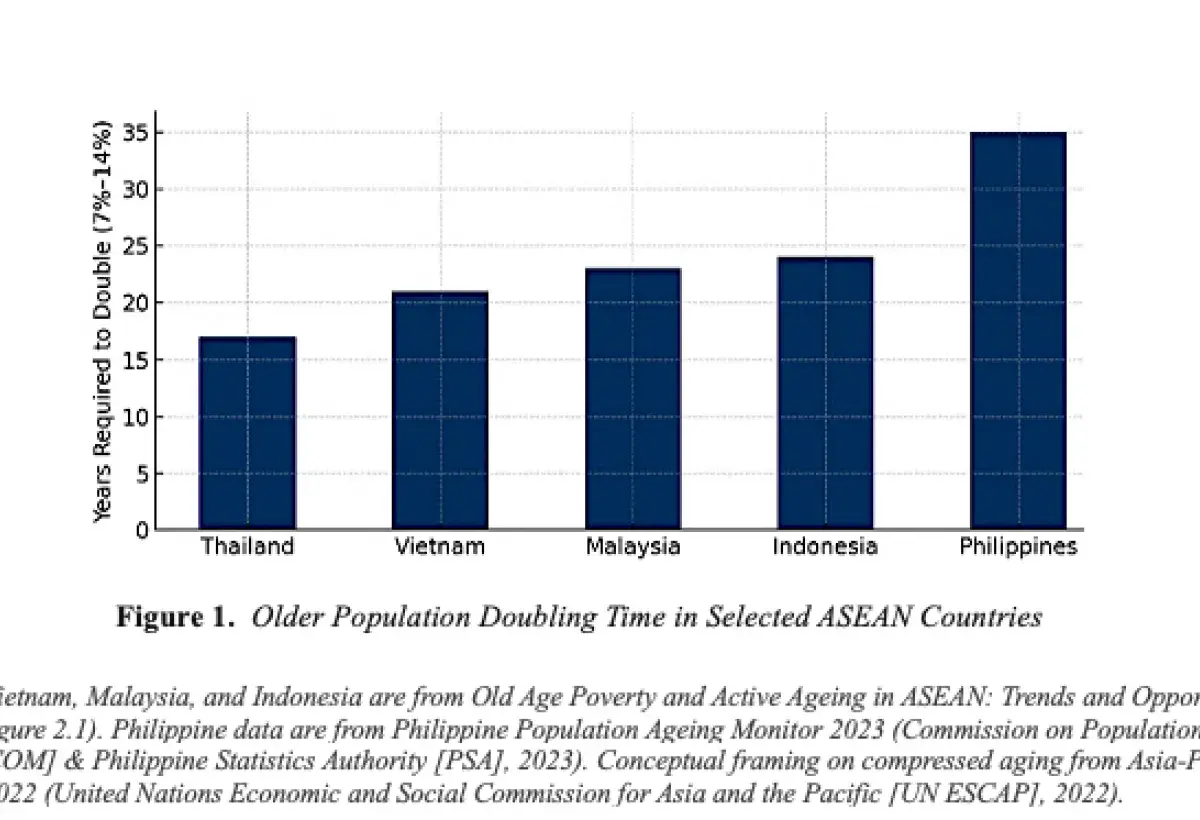
According to Old Age Poverty and Active Ageing in ASEAN: Trends and Opportunities (ASEAN Secretariat, 2024), the pace of aging across Southeast Asia varies by country but follows a consistent pattern of acceleration. Thailand, which reached 7% of its population aged 65 and above in 2004, crossed the 14% threshold by 2021 a transition of only 17 years. Vietnam is projected to take 21 years (2015-2036) to double its elderly population, while Malaysia is expected to experience a similar shift within 23 years (2020-2043). Indonesia, often perceived as demographically young, is projected to undergo this transition in just 24 years (2023-2047) (ASEAN Secretariat, 2024). These trajectories contrast sharply with Japan, which required approximately 24 years to double from 7% to 14% elderly (1956-1980), and France, which took more than a century to reach the same demographic milestone (UN ESCAP, 2022).
The Philippines: Entering the Acceleration Phase
Although slightly behind its ASEAN neighbors in demographic aging, the Philippines is now entering an accelerated phase of transition. The proportion of Filipinos aged 65 and older increased from 4.5% in 2000 to 6.8% in 2020 and is projected to reach approximately 14% by 2055, representing a doubling within about 35 years (Commission on Population and Development [POPCOM] & Philippine Statistics Authority [PSA], 2023). While this transition period is marginally longer than those of other ASEAN countries, it remains significantly shorter than the historical Western experience, confirming compressed aging as a shared regional phenomenon.
From Demographic Dividend to Demographic Pressure
Despite continuing to benefit from a demographic dividend, national projections indicate that the Philippines is expected to transition into an aging society by 2035 and an aged society by 2050, leaving policymakers and communities with limited time for preparation. The population aged 60 years and above is projected to increase from 9.3 million (8.5% of the total population) in 2020 to 23.7 million (19.6%) by 2050 (Philippine Statistics Authority [PSA], 2020). Compared with the more gradual aging trajectories of Japan and much of Europe, this compressed transition heightens vulnerabilities related to pension adequacy, healthcare access, and social support systems, reinforcing the need for integrated policy responses (ERIA & DRDF, 2023).
Image
Compressed Timelines: A Regional Pattern of Accelerated Aging
Collectively, these transitions underscore that ASEAN middle-income countries are aging faster, earlier, and under tighter fiscal constraints than previous generations of industrialized economies. The compressed aging trajectories of Thailand (17 years), Vietnam (21 years), Malaysia (23 years), Indonesia (24 years), and the Philippines (approximately 35 years) reveal a narrowing window for proactive reform. Policymakers must therefore accelerate investments in healthcare, social protection, and age-friendly communities to transform longevity from a socioeconomic liability into a regional opportunity for inclusive and dignified aging.
Mapping the Shift: Comparative Aging Timelines in ASEAN
Figure 1 compares the time required for five ASEAN countries to experience a doubling of their older population (aged 65 and over) from approximately 7% to 14% of the total population. Thailand exhibits the fastest transition at 17 years, followed by Vietnam (21 years), Malaysia (23 years), Indonesia (24 years), and the Philippines (approximately 35 years). These compressed timelines underscore the accelerating pace of demographic aging across middle-income Southeast Asia and highlight the narrowing policy window for social, economic, and healthcare adaptation.
Narrowing Policy Windows: The Cost of Delayed Adaptation
Such rapid demographic shifts further compress the policy window for adaptation, limiting the time available to reform pensions, health systems, and community-based long-term care. As UN ESCAP (2022) emphasizes, Southeast Asian governments are increasingly required to “age before becoming rich,” confronting population aging at lower levels of per-capita income and institutional maturity. Across the region, fiscal and care pressures are intensifying: Malaysia and Vietnam face rising elderly dependency ratios that outpace tax revenues, while Indonesia and Thailand experience strain on traditional family-based care systems due to urban migration and declining fertility. In the Philippines, these pressures are compounded by fragmented health coverage and limited geriatric infrastructure (ASEAN Secretariat, 2024; POPCOM & PSA, 2023).
Structural Constraints: Social Protection and Care System Gaps
Across the ASEAN region, this rapid demographic transition coincides with structural constraints in social protection and care systems. Pension coverage remains shallow due to large informal labor sectors, healthcare provision is fragmented, and strong societal expectations continue to place primary responsibility for elder care on families (ASEAN Secretariat, 2024; International Labour Organization [ILO], 2023; OECD, 2023). Policy responses including voluntary pension and micro-pension initiatives in Vietnam, enhanced retirement savings schemes under Singapore’s Central Provident Fund (CPF Board, 2024), and Malaysia’s Employees Provident Fund (EPF/KWSP, 2024) are promising but remain limited in reach for informal workers and insufficient in ensuring inclusive benefit adequacy (ILO, 2023; CPF Board, 2024; EPF/KWSP, 2024).
Beyond Economics: The Missing Dimension of Purpose and Well-Being
Moreover, evidence from the World Health Organization (2020) and recent aging studies in Asia emphasizes that economic security alone through income, pensions, or savings does not guarantee psychosocial well-being among older persons. Dimensions such as dignity, belonging, and purpose remain persistently overlooked (Recent Aging Studies in Asia, 2022-2024). In the Philippines, pension systems such as the Social Security System (SSS) and the Government Service Insurance System (GSIS) remain inadequate for most retirees, particularly those in the informal sector who lack consistent contributions (HelpAge International, 2021; “Informal Sector Problems in SSS Membership and Sustainability,” 2023). Healthcare provision is similarly fragmented, divided between PhilHealth coverage and limited long-term care infrastructure, with access further constrained in rural areas.The Philippine Reality: Cultural Shifts and Emerging Vulnerabilities
Culturally, Filipino families have traditionally assumed primary responsibility for elder care, grounded in values of filial piety and bayanihan. However, labor migration, urbanization, and economic pressures are steadily eroding this informal safety net. The overseas Filipino worker (OFW) phenomenon, while economically significant, disperses families and leaves many older adults socially isolated. These converging factors expose a critical gap: the absence of integrated retirement models that holistically address economic security, healthcare access, and psychosocial well-being.
Image

Rethinking Aging Frameworks: The Need for Integrated and Purpose-Driven Models
To situate these challenges within a broader scholarly and policy context, it is necessary to examine how retirement and aging have been conceptualized across global and local settings. Such a review provides the theoretical foundations, comparative frameworks, and empirical evidence needed to assess the strengths and limitations of existing approaches. While frameworks such as Active Aging and Successful Aging emphasize productivity, wellness, and social participation, significant gaps persist in adapting these models to developing contexts like the Philippines, where cultural norms, institutional constraints, and economic realities demand more localized, purpose-driven approaches.
Conclusion: Act Now or Age Unprepared
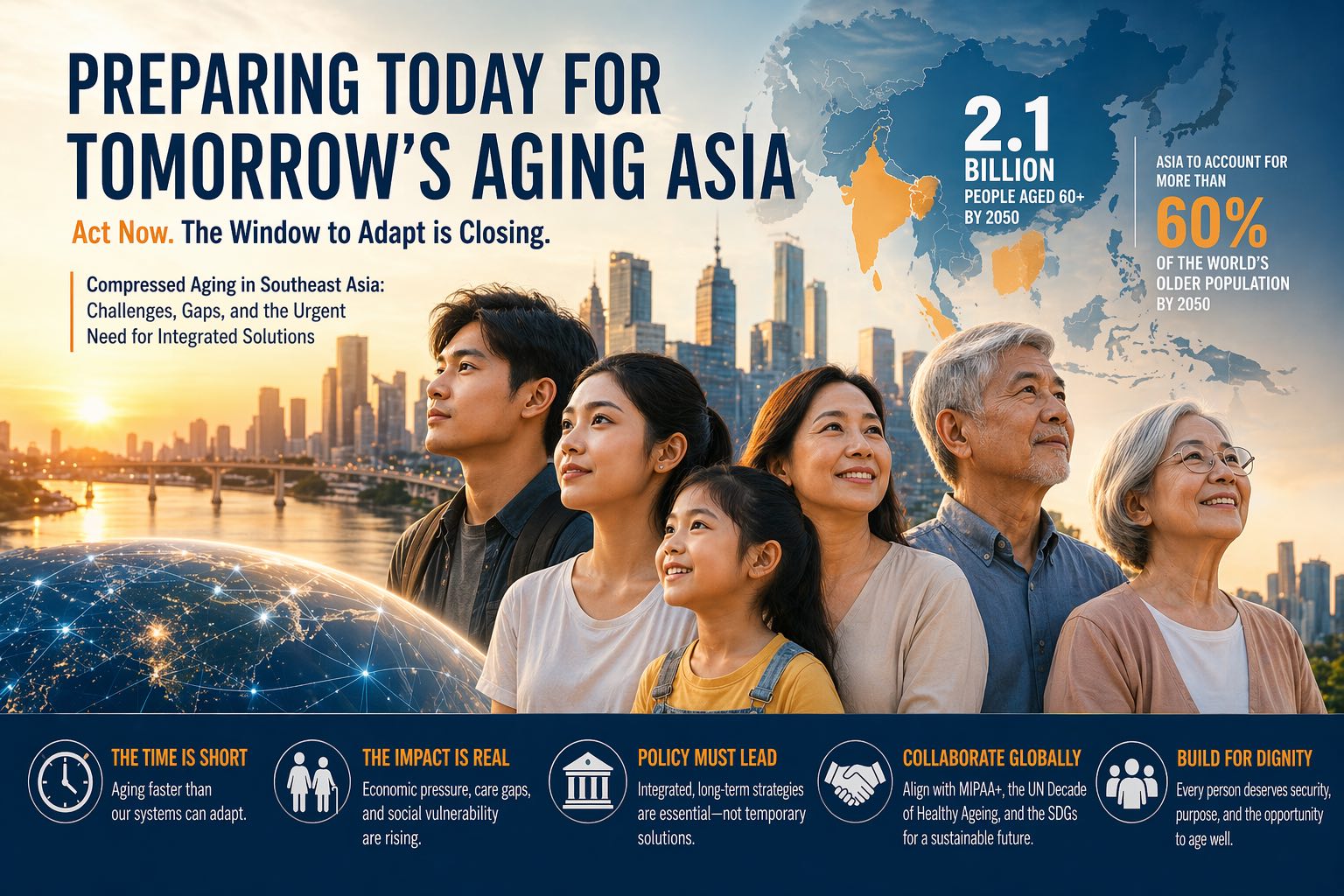
The evidence presented throughout this article converges on a single, unavoidable conclusion: Southeast Asia is not approaching an aging transition as it is already inside one, and the window to respond is rapidly narrowing. Compressed aging across ASEAN has fundamentally altered the timeline for policy action, leaving governments with little margin for delay or incremental reform. What makes this moment more consequential is that the “future elderly” are not a distant demographic, they are today’s younger and working-age populations. By 2050, the projected 2.1 billion people aged 60 and above globally will largely come from those currently in their late 20s onward, living in a world where longevity is no longer debated but expected, with life expectancy ranging between 72 and 86 years across countries. Nowhere is this shift more concentrated than in Asia, which is projected to account for more than 60% of the global older population. This reality reframes aging not as a future burden, but as a present structural transformation that will redefine labor markets, healthcare systems, family structures, and economic sustainability within a single generation.
In this context, governments must move beyond fragmented, short-term interventions and confront aging as a central development priority requiring systemic redesign. The remaining policy window though small, still offers a critical opportunity. Across Asia, policymakers must urgently reassess existing frameworks, or establish them where none exist, through coordinated, forward-looking strategies aligned with global initiatives such as the Madrid International Plan of Action on Ageing, the United Nations Decade of Healthy Ageing, and the Sustainable Development Goals. This requires not only policy alignment but institutional commitment: the formation of dedicated, cross-sectoral national task forces with the authority to integrate healthcare, social protection, labor participation, and community-based care into a coherent aging strategy. The urgency cannot be overstated. The question is no longer whether societies will age, but whether they will do so prepared or unprepared. The time to act is not in the coming decades, it is now, while there is still a narrow opening to build systems that can meet the scale, speed, and complexity of the 2050 aging reality.
Image

Suggested citation
Lendez, M. (2026). Compressed Aging in Southeast Asia: A Defining Demographic Shift. Chikicha.
About the Author: Written by Dr. Mariza Lendez, the developer of Ikigai-Bayanihan Framework, a model that redefines aging through purpose, dignity, and community-centered living.
References
Ageing, older persons and the 2030 Agenda for Sustainable Development | United Nations for Ageing. (n.d.). United Nations Department of Economic and Social Affairs.https://www.un.org/development/desa/ageing/news/2017/07/ageing-older-persons-and-the-2030-agenda-for-sustainable-development/
ASEANstats. (2023). ASEAN Statistical Yearbook 2023. ASEAN Secretariat / ASEANstats.
ASEAN Secretariat. (2024). Old age poverty and active ageing in ASEAN: Trends and opportunities. Jakarta, Indonesia: ASEAN Secretariat.
Retrieved from https://asean.org/wp-content/uploads/2024/07/Old-Age-Poverty-and-Active-Ageing-in-ASEAN-Trends-and-Opportunities-250724.pdf
Authentication challenge pages. (n.d.). Philippine population projected to be around 138.67 million by 2055 under scenario 2. Philippine Statistics Authority.https://psa.gov.ph/content/philippine-population-projected-be-around-13867-million-2055-under-scenario-2
HelpAge International. (2021). Social protection for older people in the Philippines: Situational analysis and policy recommendations. London, UK: HelpAge International. https://www.helpage.org/resource/social-protection-for-older-people-in-the-philippines/
International Labour Organization [ILO]. (2023). Extending social protection to workers in the informal economy: Lessons from Asia and the Pacific. Geneva, Switzerland: Internation. https://www.ilo.org/global/publications/books/WCMS_862536/lang--en/index.htm
Philippine Statistics Authority (PSA). (2023). Philippine population projections 2020–2055.https://psa.gov.ph
Poor Asian countries face an ageing crisis. (2023, October 12). The Economist (Online).https://www.proquest.com/magazines/poor-asian-countries-face-ageing-crisis/docview/2876090777/se-2
[PSA]. (2023). Philippine population ageing monitor 2023. Manila, Philippines: Government of the Philippines. https://popcom.gov.ph/philippine-population-ageing-monitor-2023/
[PSA]. (2023). Philippine population ageing monitor 2023. Manila, Philippines: Government of the Philippines. https://popcom.gov.ph/philippine-population-ageing-monitor-2023/
United Nations. (2022). World population prospects 2022. United Nations Department of Economic and Social Affairs.https://population.un.org/wpp
United Nations, Economic and Social Commission for Asia and the Pacific. (2022). *Asia-Pacific report on population ageing 2022: Trends, policies and good practices regarding older persons and population ageing (ST/ESCAP/3041).https://www.unescap.org/sites/default/d8files/knowledge-products/AP-Ageing-2022-report.pdf