A World Growing Older Faster Than It Was Prepared For
There was a time when humanity celebrated longer life as one of civilization’s greatest victories. Advances in medicine, sanitation, technology, and public health enabled millions of people to survive diseases that once shortened human existence. Families began witnessing grandparents living longer, societies saw populations grow older, and nations proudly reported rising life expectancy as evidence of progress.
Yet beneath this achievement, another reality quietly emerged. Around the world, millions of older adults were living longer but not necessarily living better. Many entered old age carrying the heavy weight of loneliness, financial insecurity, declining health, social invisibility, and the painful feeling of becoming disconnected from the societies they once helped build.
As populations aged rapidly across continents, governments and international institutions began realizing that traditional aging systems were no longer sufficient for the realities of the modern world. Earlier frameworks often focused primarily on disease management, institutional care, pensions, and dependency support. But aging in the 21st century was becoming more complex.
Older adults were not simply living longer; they were navigating changing family structures, urban migration, digital transformation, economic instability, and weakening intergenerational support systems. The world was entering an era where aging could no longer be treated solely as a healthcare concern. It had become a defining social, economic, developmental, and human rights challenge of our time.
Then came the COVID-19 pandemic.
The pandemic exposed, with brutal clarity, the vulnerabilities that many aging experts had warned about for years. Across the globe, older adults became disproportionately affected not only by illness, but also by isolation, neglect, institutional fragility, and social abandonment. Long-term care systems struggled under immense pressure. Families were separated from elderly loved ones. Many older adults died alone. The crisis revealed how deeply unprepared societies were for the realities of global aging despite decades of demographic warnings.
It was within this historical moment that the United Nations proclaimed the United Nations Decade of Healthy Ageing (2021–2030) through Resolution A/RES/75/131, led globally by the World Health Organization in partnership with governments, civil society organizations, researchers, healthcare institutions, communities, and older persons themselves. The initiative did not emerge merely as another international health campaign. It was born from a growing global recognition that humanity needed to fundamentally rethink what it means to age in the modern era.
Who Is the UN Decade of Healthy Ageing and Why Was It Born?
The United Nations Decade of Healthy Ageing is not a single organization or standalone institution. Rather, it is a global movement and collaborative international framework coordinated by the World Health Organization and supported by the broader United Nations system. Its purpose is both ambitious and deeply human: to transform the experience of aging so that people can live not only longer lives, but healthier, safer, more meaningful, and more dignified ones.
At the center of this framework is a powerful shift in philosophy. Traditionally, aging was often viewed through the lens of decline, dependency, and loss. The new framework challenges that perspective entirely. The World Health Organization now defines healthy ageing as the process of developing and maintaining the functional ability that enables well-being in older age.
This means that healthy aging is no longer measured solely by the absence of disease. Instead, it emphasizes the ability of older adults to continue participating in life, maintain relationships, preserve autonomy, contribute to society, and live with dignity regardless of physical limitations. This shift represents one of the most significant transformations in global aging policy in modern history.
The Decade recognizes that aging is shaped not only by biology, but also by environments, economies, communities, policies, relationships, and opportunities throughout the human lifespan. An older adult’s well-being depends not simply on healthcare systems, but also on whether communities remain accessible, whether social participation is encouraged, whether public transportation is available, whether digital technology is inclusive, whether caregivers receive support, and whether societies continue to value older persons as contributors rather than burdens.
From Survival to Dignity: A New Philosophy of Aging
For decades, many aging frameworks were fragmented. Healthcare systems treated diseases separately. Social protection systems often focused only on financial assistance. Urban planning rarely considered older populations. Public discourse frequently portrayed aging as a problem to manage rather than a stage of life deserving investment and respect. The UN Decade attempts to bring these fragmented systems together into a more integrated and person-centered vision of aging.
Unlike earlier aging strategies that relied heavily on declarations and policy aspirations, the Decade places strong emphasis on implementation, collaboration, accountability, and measurable outcomes. The framework encourages governments to integrate healthy aging into national development plans, healthcare systems, labor policies, urban planning, transportation systems, housing, digital inclusion initiatives, and long-term care reforms. It promotes a whole-of-society approach, recognizing that healthy aging cannot be achieved by healthcare institutions alone.
One of the most important aspects of the Decade is its recognition that older adults themselves must be included in shaping the future of aging policies and systems. Historically, many aging programs were designed for older adults but not necessarily with them. The new framework emphasizes participation, co-creation, and inclusion, acknowledging older persons as knowledge holders, workers, mentors, caregivers, volunteers, and active contributors to society.
The Decade also seeks to challenge one of the most deeply rooted but often invisible forms of discrimination in modern society: ageism. Across many cultures, older adults continue to face stereotypes that portray them as weak, dependent, technologically incapable, or economically irrelevant. These attitudes affect employment opportunities, healthcare quality, social inclusion, and even self-esteem among older persons themselves. The framework recognizes that transforming aging requires not only policy reform, but also cultural and societal transformation.
Image
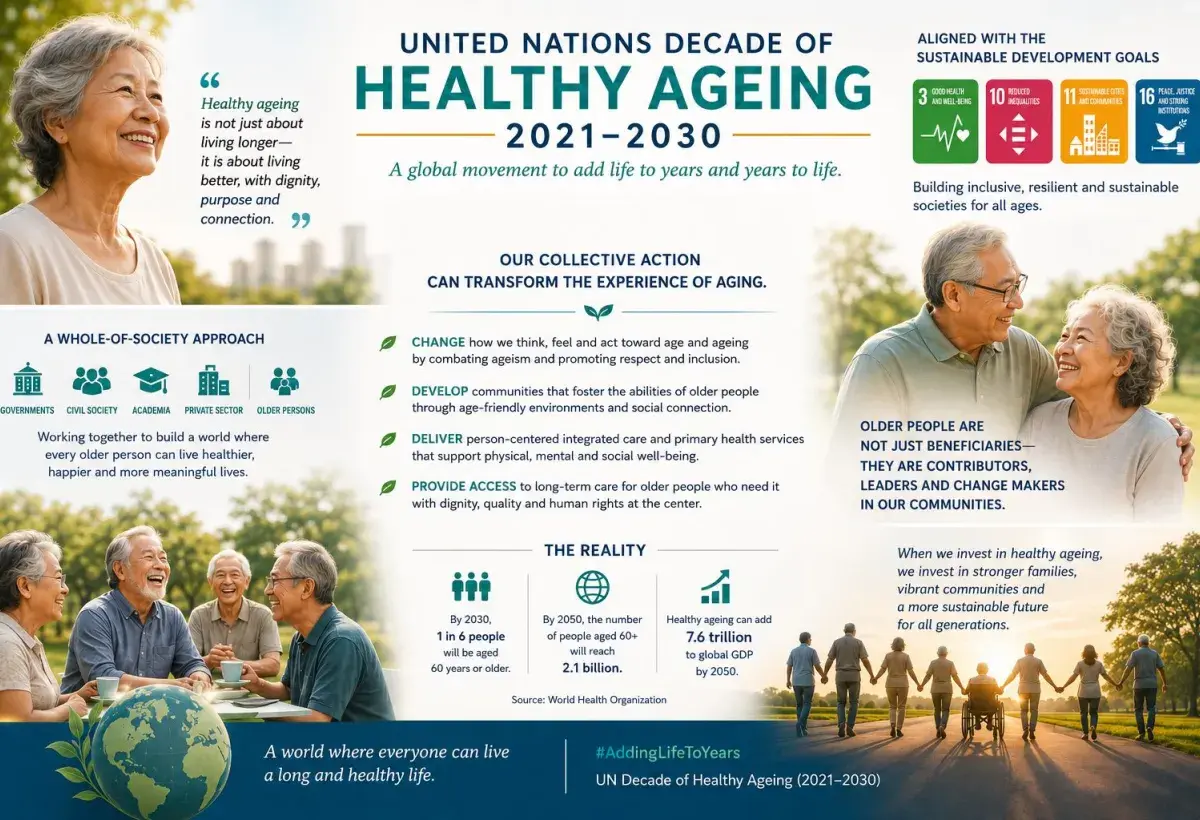
The Four Major Action Areas of the UN Decade of Healthy Ageing
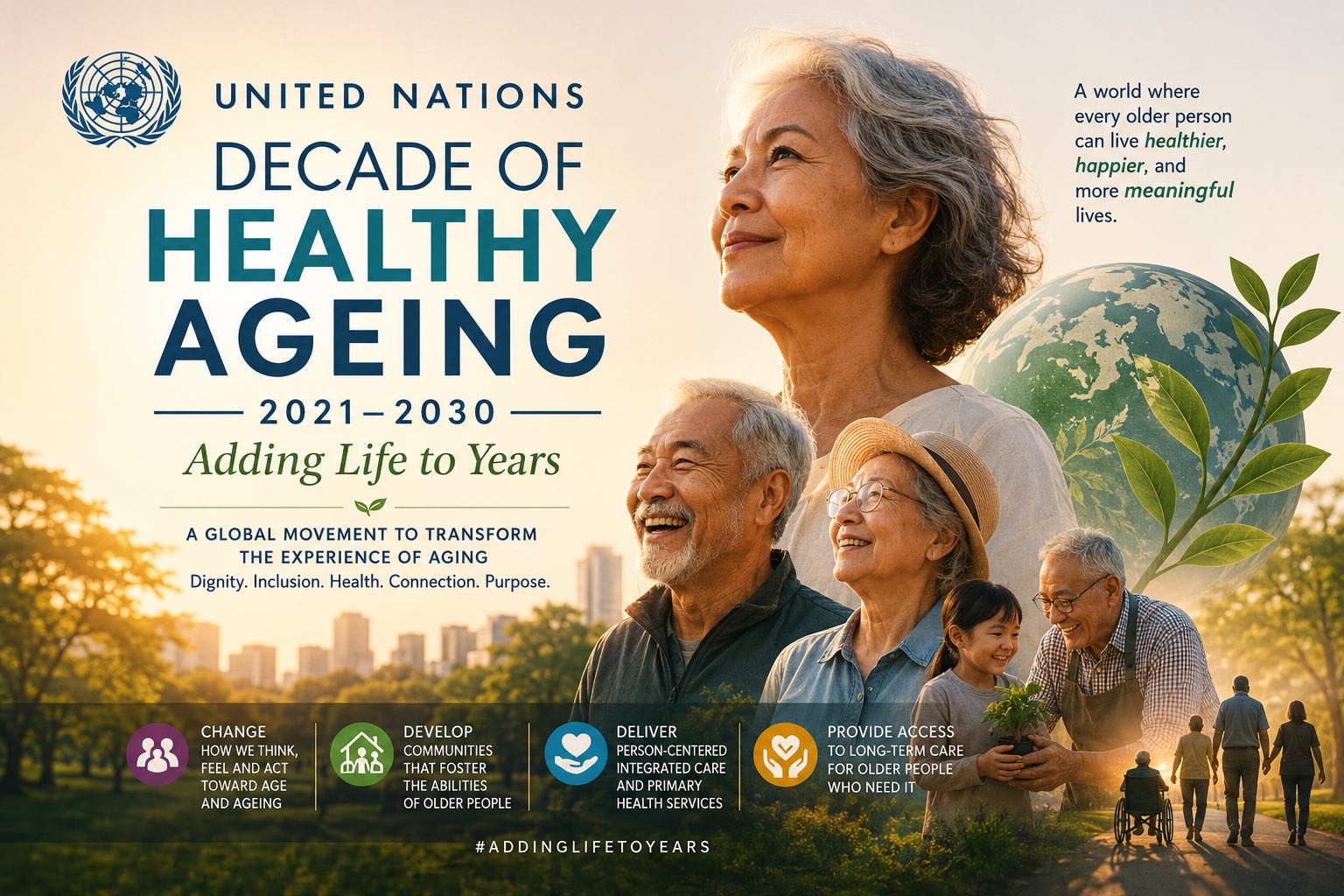
To operationalize its vision, the UN Decade of Healthy Ageing focuses on four major global action areas:
1. Changing How We Think, Feel, and Act Toward Age and Ageing
- Combat ageism and discrimination
- Promote positive perceptions of aging
- Encourage intergenerational understanding
- Reform policies influenced by age bias
- Increase visibility and representation of older adults
2. Developing Communities That Foster the Abilities of Older People
- Create age-friendly cities and communities
- Improve accessibility and transportation
- Promote safe housing environments
- Strengthen community participation
- Reduce social isolation and loneliness
- Encourage digital inclusion
3. Delivering Person-Centered Integrated Care
- Shift from disease-centered to person-centered healthcare
- Integrate physical, mental, and social care
- Improve primary healthcare responsiveness
- Strengthen preventive and rehabilitative care
- Support healthy aging throughout the life course
4. Providing Access to Long-Term Care for Older People Who Need It
- Strengthen caregiving systems
- Support family caregivers
- Expand home-based and community care
- Improve quality standards for long-term care
- Ensure dignity and human rights in elder care systems
- Develop sustainable financing for long-term support
Who Is Supporting the Decade and How Will It Be Implemented?
What makes the UN Decade particularly significant is that it recognizes aging as inseparable from sustainable development itself. Population aging affects labor markets, healthcare expenditures, housing systems, urban infrastructure, migration patterns, social protection systems, and economic productivity. The framework therefore aligns closely with the Sustainable Development Goals by emphasizing inclusion, equity, health, participation, and resilience across societies.
The initiative is supported by an extensive coalition that includes the World Health Organization, United Nations agencies, governments, academic institutions, civil society organizations, healthcare providers, researchers, urban planners, advocacy groups, and older persons organizations worldwide. This broad collaboration reflects a growing global understanding that no single institution can address population aging alone.
The Decade also places strong emphasis on evidence-based implementation. Unlike earlier international aging declarations that sometimes struggled with measurable accountability, the current framework encourages countries to establish monitoring systems, measurable indicators, data-driven policies, and long-term evaluation strategies. The initiative promotes collaboration across healthcare, housing, transportation, education, labor, technology, and social welfare sectors to create systems capable of supporting aging populations in the decades ahead.
Importantly, the Decade recognizes that solutions cannot be identical across all countries. Aging in high-income nations differs significantly from aging realities in developing regions. Therefore, the framework encourages local adaptation, cultural sensitivity, and community-based innovation rather than imposing a single universal model.
Reimagining the Future of Human Aging
At its deepest level, the UN Decade of Healthy Ageing is not simply about extending survival. It is about redefining the meaning of longevity itself. Humanity has entered an age where millions of people may live decades longer than previous generations. The central challenge now is determining whether those additional years will be lived in dignity, participation, purpose, connection, and well-being or in isolation, vulnerability, and exclusion.
The World Health Organization has repeatedly emphasized that by 2030, one in six people globally will be aged 60 years or older. This demographic transformation is unfolding at unprecedented speed, particularly in low- and middle-income countries where social and healthcare systems are still adapting to aging populations. The UN Decade emerged because the world recognized that aging could no longer remain an afterthought in development planning. It had become one of the defining realities shaping the future of humanity itself.
And so the Decade stands today not merely as a policy framework, but as a global promise. A promise that longer life should not mean longer suffering. A promise that older persons should not disappear into invisibility after decades of contribution to society. A promise that aging should not be viewed solely through decline, but through dignity, resilience, participation, and continued human value.
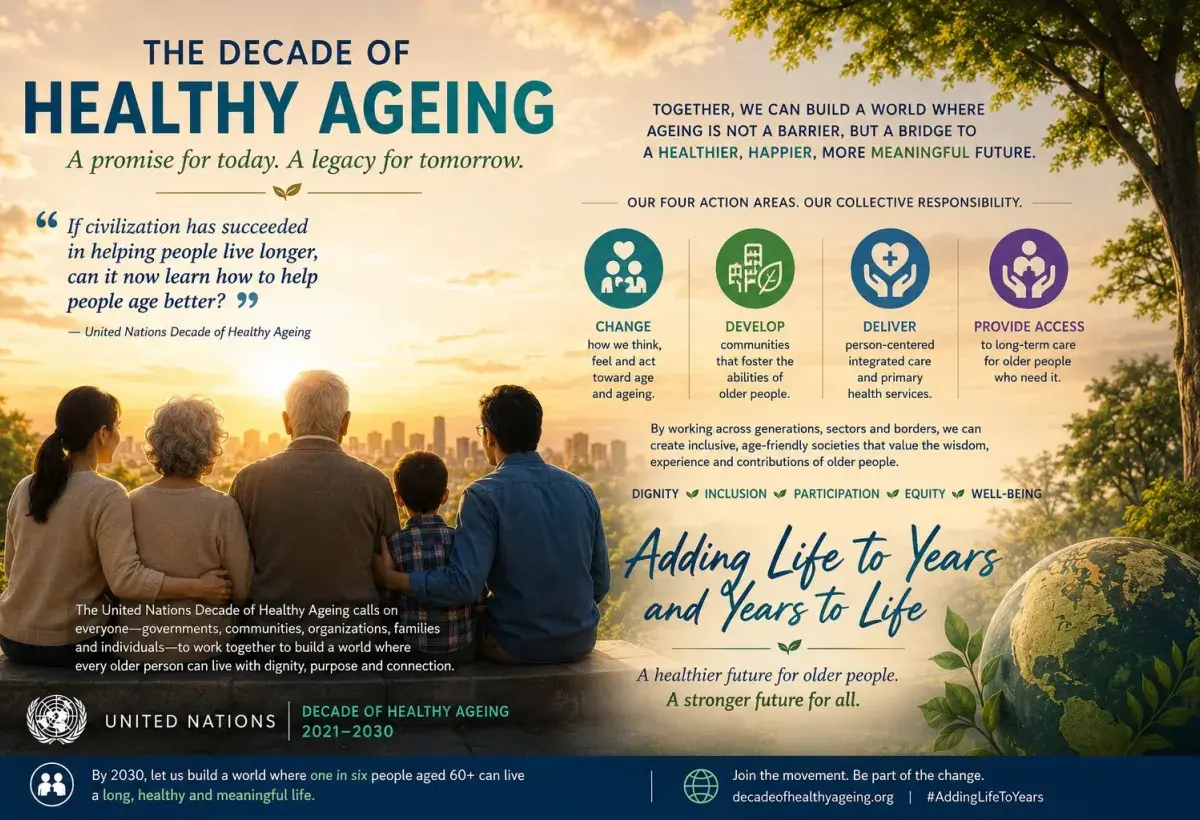
In many ways, the UN Decade of Healthy Ageing asks humanity a profound question: “If civilization has succeeded in helping people live longer, can it now learn how to help people age better?” The answer to that question may define not only the future of older persons, but the future character of societies themselves.
Image
Suggested Citation
Lendez, M. (2026). The United Nations Decade of Healthy Ageing (2021–2030): Humanity’s New Promise to an Aging World. Chikicha. (Lendez, M., the developer of Ikigai-Bayanihan Framework).
About the Author: Written by Dr. Mariza Lendez, the developer of Ikigia-Bayanihan Framework, a model that redefines aging through purpose, dignity, and community-centered living.
Note:
Developed with the assistance of AI-supported deep research and evidence-based scientific sources.
References
World Health Organization. (2020). Decade of healthy ageing: Baseline report. World Health Organization. https://www.who.int/publications/i/item/9789240017900
World Health Organization. (2020). Decade of healthy ageing: Plan of action 2021–2030. World Health Organization. https://cdn.who.int/media/docs/default-source/decade-of-healthy-ageing/decade-proposal-final-apr2020-en.pdf
World Health Organization. (2024). WHO’s work on the UN Decade of Healthy Ageing (2021–2030). https://www.who.int/initiatives/decade-of-healthy-ageing
United Nations General Assembly. (2020). United Nations Decade of Healthy Ageing (2021–2030): Resolution adopted by the General Assembly (A/RES/75/131). United Nations. https://digitallibrary.un.org/record/3895802
United Nations Department of Economic and Social Affairs. (2024). Decade of Healthy Ageing 2021–2030. United Nations. https://social.desa.un.org/sdn/decade-of-healthy-ageing-2021-2030
Thiyagarajan, J. A., Araujo de Carvalho, I., Peña-Rosas, J. P., Chadha, S., Mariotti, S. P., Dua, T., & Beard, J. R. (2022). The UN Decade of healthy ageing: Strengthening measurement for monitoring health and well-being of older people. Age and Ageing, 51(7), afac147. https://doi.org/10.1093/ageing/afac147
Guaraldi, G., Malagoli, A., Calcagno, A., Mussi, C., & Mussini, C. (2024). The UN Decade of Healthy Ageing (2021–2030) for people ageing with HIV. The Lancet Healthy Longevity, 5(8). https://www.thelancet.com/journals/lanhl/article/PIIS2666-7568(24)00169-7/fulltext
World Health Organization. (2020, December 14). Decade of Healthy Ageing: A new UN-wide initiative. https://www.who.int/news/item/14-12-2020-decade-of-healthy-ageing-a-new-un-wide-initiative
UN Decade of Healthy Ageing. (2024). The platform. https://www.decadeofhealthyageing.org/