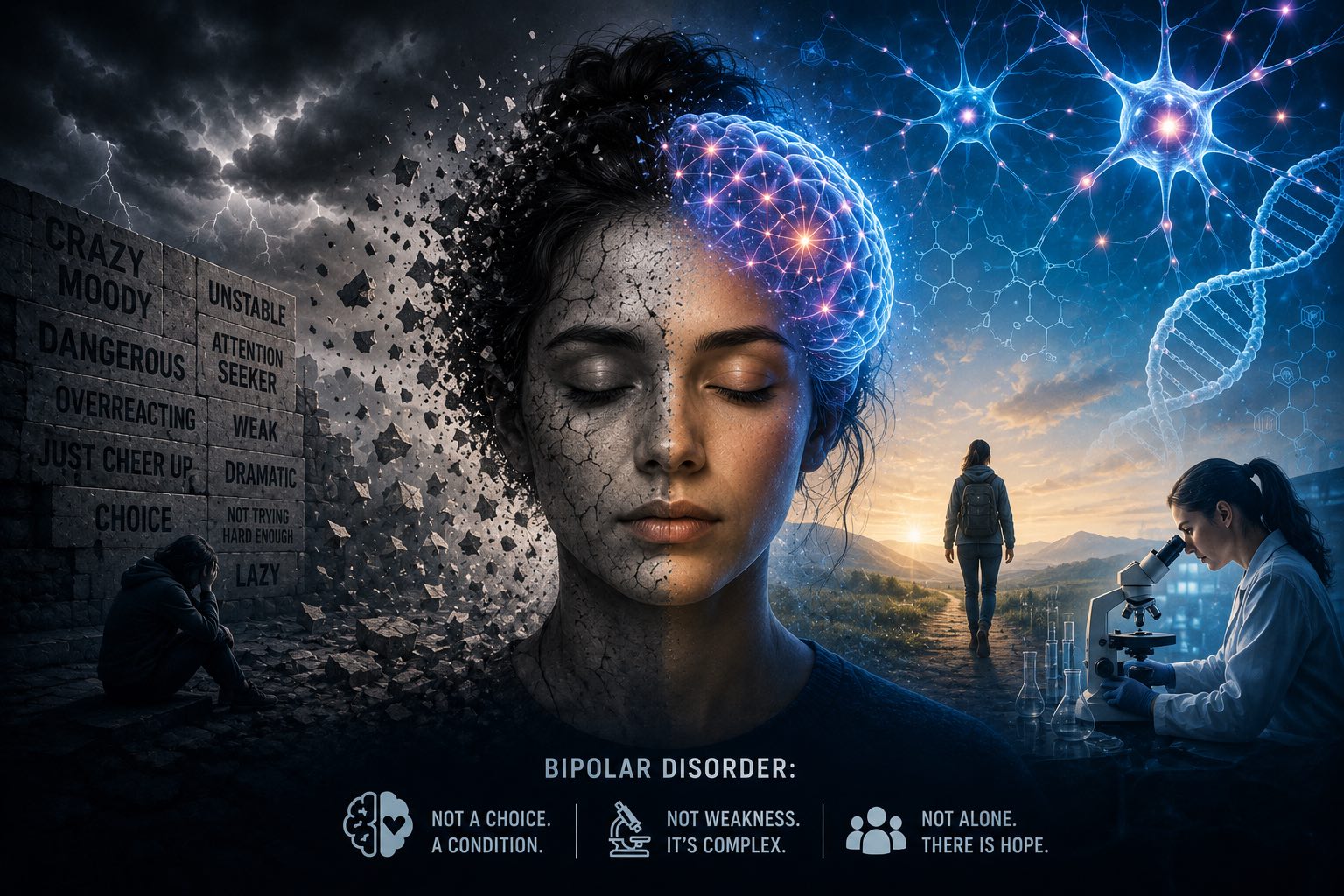
How science changed the world’s understanding of bipolar disorder. This first article can focus on correcting society’s old perception versus what modern science now understands.
Bipolar Disorder: What Is It Really About?
We hear the term bipolar almost everywhere, in conversations, on social media, in entertainment, and sometimes even used casually to describe unpredictable emotions or changing moods. Yet despite how familiar the word has become, society often continues to understand it within a gray area of uncertainty, hearing the term repeatedly without fully grasping its medical meaning, psychological depth, and human reality.
According to the World Health Organization, bipolar disorder is a mental health condition characterized by significant shifts in mood, energy, activity levels, and the ability to function in daily life.
These shifts commonly involve episodes of mania or hypomania, periods of unusually elevated energy, impulsivity, heightened activity, or emotional intensity, alternating with episodes of depression, which may involve emotional heaviness, exhaustion, hopelessness, and withdrawal from normal functioning (WHO, 2025).
Similarly, the National Institute of Mental Health, explains that bipolar disorder is not simply ordinary emotional fluctuation, but a chronic psychiatric condition that can affect cognition, sleep, judgment, relationships, occupational stability, and long-term quality of life (NIMH, 2025).
Development of Modern Understanding
From a scientific perspective, bipolar disorder is no longer interpreted as a defect of personality or a weakness of emotional discipline.
Contemporary psychiatric science increasingly understands it as a complex interaction between neurobiology, genetics, emotional regulation, environmental stress, trauma exposure, sleep disturbance, and psychosocial conditions. Modern research therefore moves beyond simplistic assumptions and instead examines how the brain, body, environment, and lived experiences interact within the individual.
Earlier Understanding: “what is wrong with this person?”
However, while science has evolved, public perception often remains behind. In many communities, bipolar disorder continues to be interpreted through older social lenses associated with instability, irrationality, unpredictability, or even danger. Historically, psychiatric language itself contributed to this perception.
Earlier psychiatric frameworks largely approached bipolar disorder under the term manic-depressive illness, focusing heavily on severe behavioral episodes, hospitalization, and visible dysfunction rather than the broader biological and environmental systems now recognized by modern science.
As psychiatric research progressed, this framework began to change substantially. International authorities such as WHO and NIMH now recognize bipolar disorder as existing on a spectrum, meaning it may present differently across individuals and across stages of life. Some individuals experience severe manic episodes, while others may experience more subtle hypomanic states combined with prolonged depression.
This broader understanding also explains why bipolar disorder is frequently misunderstood or misdiagnosed, particularly when depressive symptoms appear more visible than manic ones.
Image

Modern Understanding: "what systems are affecting this person biologically, psychologically, socially, and emotionally?'
Research additionally shows that bipolar disorder does not emerge from a single cause. Rather, it develops through interactions between inherited vulnerability, environmental stressors, chronic sleep disruption, trauma, social instability, and emotional strain.
Modern psychiatric literature increasingly emphasizes that stress alone does not “create” bipolar disorder, yet prolonged psychological pressure, unresolved trauma, sleep irregularity, substance use, and major life disruptions may influence its onset or severity. This multidimensional understanding represents one of the most important shifts between older psychiatric models and modern psychiatric science.
Consequently, treatment approaches have also evolved. Earlier psychiatric care frequently focused on containment and crisis management. Contemporary mental health frameworks now emphasize early intervention, psychotherapy, medication management, emotional regulation, stable routines, sleep consistency, family support systems, and community-based care.
Modern psychiatry increasingly aims not only to reduce symptoms, but to preserve dignity, social functioning, relationships, and long-term quality of life.
Why This Matters to Society
Equally important is the recognition that stigma itself has become part of the public health problem. WHO repeatedly warns that social discrimination, ridicule, labeling, and fear surrounding mental illness discourage many individuals from seeking treatment or openly discussing their condition.
In this sense, the challenge is not solely bipolar disorder itself, but also the societal response surrounding it. A condition becomes more dangerous when silence, shame, and misunderstanding prevent support from reaching the person who needs it.
At the same time, science is moving toward earlier detection and more personalized approaches. Current psychiatric research increasingly studies biological rhythms, sleep cycles, digital mood monitoring, inflammatory processes, neurocognitive functioning, and individualized treatment strategies.
The direction of modern psychiatry is becoming less about institutional control and more about prevention, support, adaptation, and sustained stability.
Conclusion
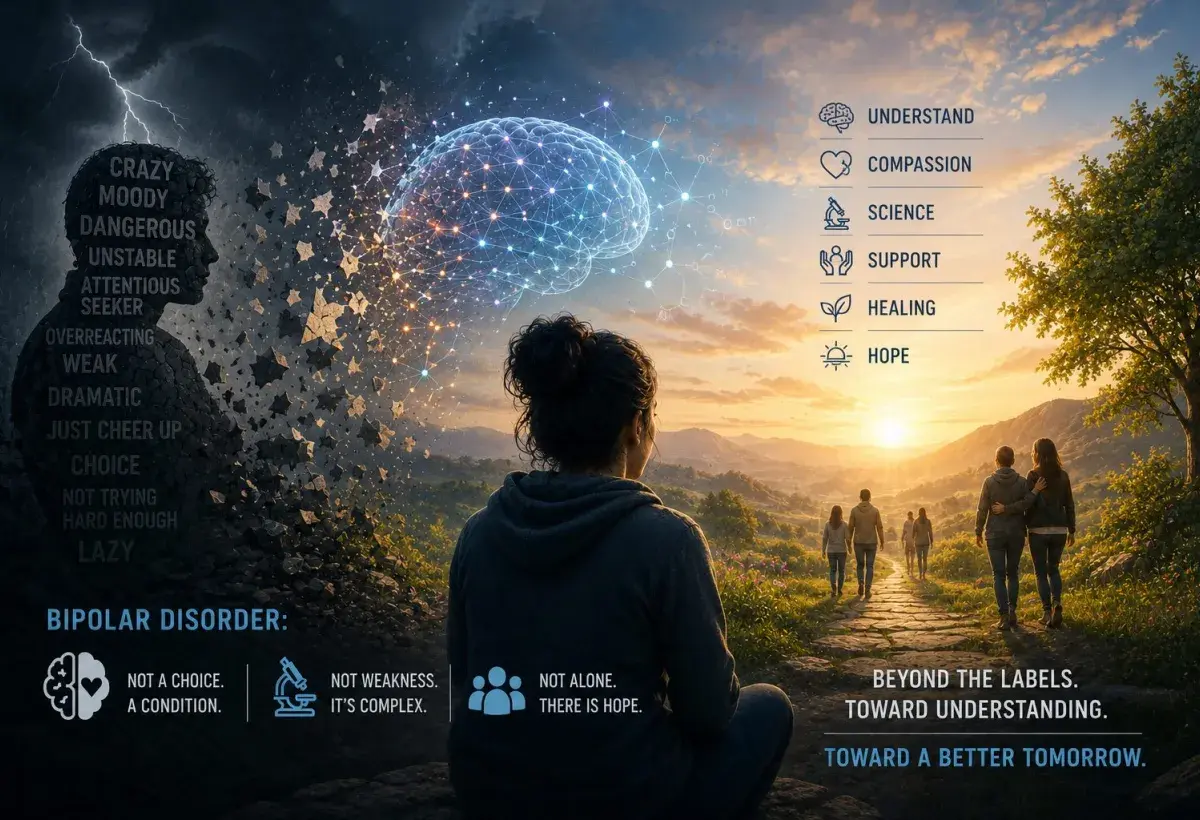
So again, what is bipolar disorder? Now that we have listened to the voices of science rather than the echoes of stigma, perhaps the more important question is no longer whether society understands the term, but whether society is willing to become part of the healing environment surrounding it.
Mental health does not improve through ridicule, fear, or oversimplified judgment. It improves through informed understanding, responsible support systems, evidence-based intervention, and the willingness to recognize that behind every diagnosis is still a human being attempting to function, survive, and preserve dignity.
For individuals identified as living with bipolar disorder, the responsibility toward healing and management also becomes deeply personal. Scientific authorities consistently emphasize the importance of treatment adherence, emotional awareness, sleep regulation, therapy, structured routines, and supportive environments.
The battle, in many ways, often begins within the mind itself. Thoughts continuously influence emotional response, perception, fear, stress, and behavior. The heart merely reacts to what the mind repeatedly feeds into it.
And this is where reflection becomes necessary. How does one learn to regulate the language within the mind so it does not continuously wound the heart, the same heart that continues beating approximately 60 to 100 times per minute, tirelessly sustaining human life even in moments of emotional exhaustion?
The future of mental health awareness is not merely about identifying disorders, but about teaching society how to respond to suffering without removing the humanity of the person experiencing it.
Disclaimer:
The author is not a licensed medical doctor, psychiatrist, or healthcare professional. This article is written for educational and public awareness purposes only, based on scientific literature, peer-reviewed studies, and information from recognized international health authorities. It is not intended to replace professional medical advice, diagnosis, or treatment. Readers experiencing mental health concerns are strongly encouraged to consult a qualified physician or licensed mental health professional.
Read 👉️ Article 2: Bipolar Disorder: How Does It Develop, What Science Now Understands https://www.chikicha.com/bipolar-disorder-how-does-it-develop-what-science-now-understands
Read 👉️ Article 3: Bipolar Disorder, Aging, and the Human Systems Surrounding It https://www.chikicha.com/bipolar-disorder-aging-and-human-systems-surrounding-it
Image
Suggested Citation
Lendez, M. (2026). Bipolar Disorder: Beyond the Labels, into the Science. Chikicha. (Lendez, M . developer of Ikigai-Bayanihan Framework).
About the Author:
Written by Dr. Mariza Lendez, the developer of Ikigai-Bayanihan Framework, a retirement model that redefines aging through purpose, dignity, and community-centered living.