
Chikicha Series - The Forgotten Pillars of Being Human: Part 1: Dignity - The Structural Value of Human Worth | Part 2: Decency - The Behavioral Expression of Human Value | Part 3: The Moral Ecosystem - Integrating Dignity and Decency in Aging
The Moral Ecosystem in Aging: Integrating Dignity and Decency into Sustainable Human Systems
I. Introduction: From Values to Systems
Dignity and decency are often discussed as moral principles - important, but abstract. In the previous discussions, dignity was established as intrinsic human worth, while decency was defined as its behavioral expression. Each, on its own, provides a partial understanding of how human value is sustained.
However, neither operates independently in real life.
What becomes increasingly evident particularly in the context of aging is that dignity and decency function as part of a broader system. Their interaction shapes not only individual experience but also the stability of relationships, institutions, and communities over time.
This article introduces the concept of a moral ecosystem a framework in which dignity and decency operate together as interdependent forces. Within this system, human worth is not only recognized in principle but reinforced through consistent behavior and supported by institutional structures.
Understanding this ecosystem is essential, particularly as societies face demographic transitions in which aging populations are increasingly becoming a defining feature of the global landscape (United Nations, 2023).
II. The Moral Ecosystem: A Conceptual Framework
The idea of a moral ecosystem begins with a simple observation: human experience is shaped by how those values are practiced, reinforced, and sustained across environments.
Dignity, as a principle, establishes that every individual has inherent worth. Decency ensures that this worth is expressed in everyday interactions. But for these to be consistently experienced, they must be supported by systems; social, cultural, and institutional.
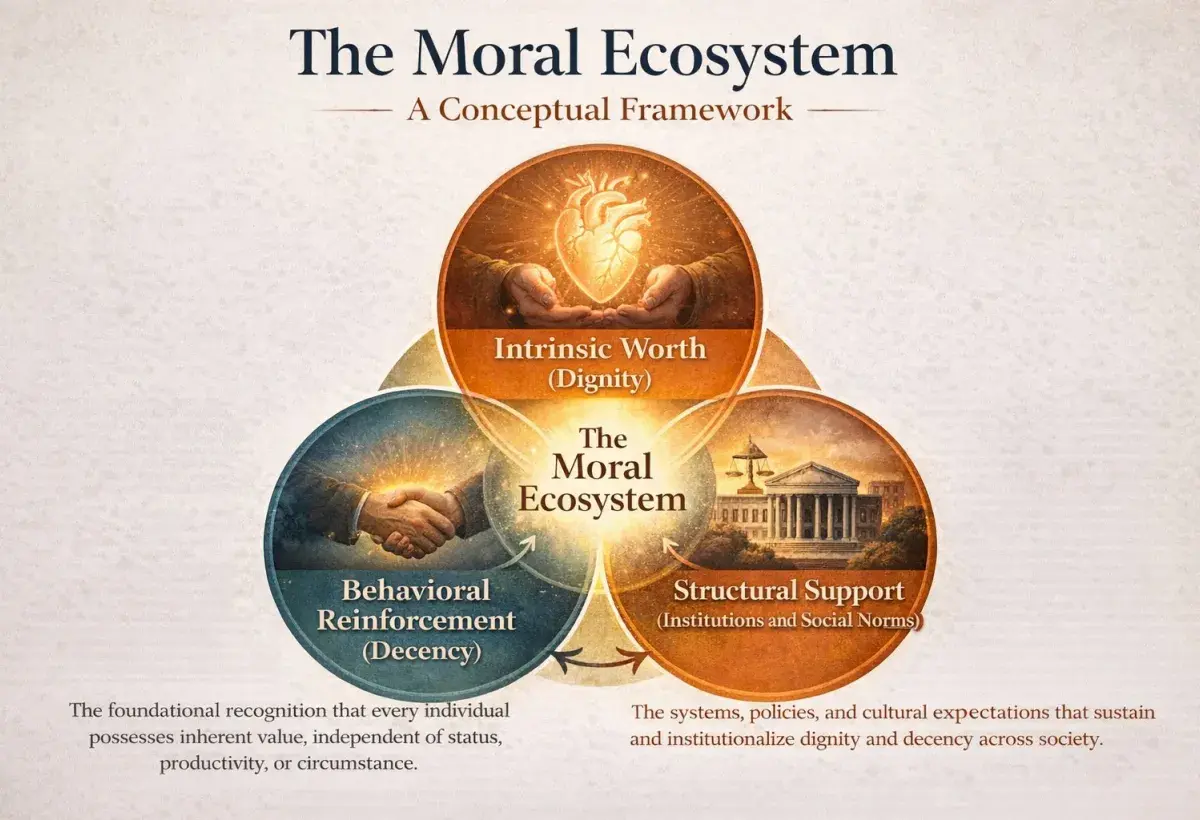
In this sense, the moral ecosystem can be understood as a dynamic structure composed of three interacting elements:
- Intrinsic Worth (Dignity): The foundational recognition that every individual possesses inherent value, independent of status, productivity, or circumstance.
- Behavioral Reinforcement (Decency): The everyday expression of dignity through actions on how individuals treat one another with respect, fairness, and consideration.
- Structural Support (Institutions and Social Norms): The systems, policies, and cultural expectations that sustain and institutionalize dignity and decency across society.
When these elements are aligned, individuals experience continuity, trust, and participation. When they are misaligned, even strong principles fail to translate into lived reality.
This framework aligns with broader theories of human development and capability, which emphasize that well-being depends not only on internal capacities but also on the conditions that enable individuals to function and participate meaningfully (Sen, 1999).
Image
III. How the Moral Ecosystem Functions
The moral ecosystem is not static but continuously shaped by interactions at multiple levels by individual, social, and institutional. Each level contributes to the overall condition of the system.
At the individual level, dignity influences self-perception. When individuals recognize their own worth, they are more likely to engage with others confidently and constructively. However, this internal recognition is reinforced or weakened by external experience.
At the interpersonal level, decency translates dignity into action. It determines whether individuals feel acknowledged, respected, and included. These interactions create feedback loops. When respect is consistently experienced, it becomes expected and reciprocated.
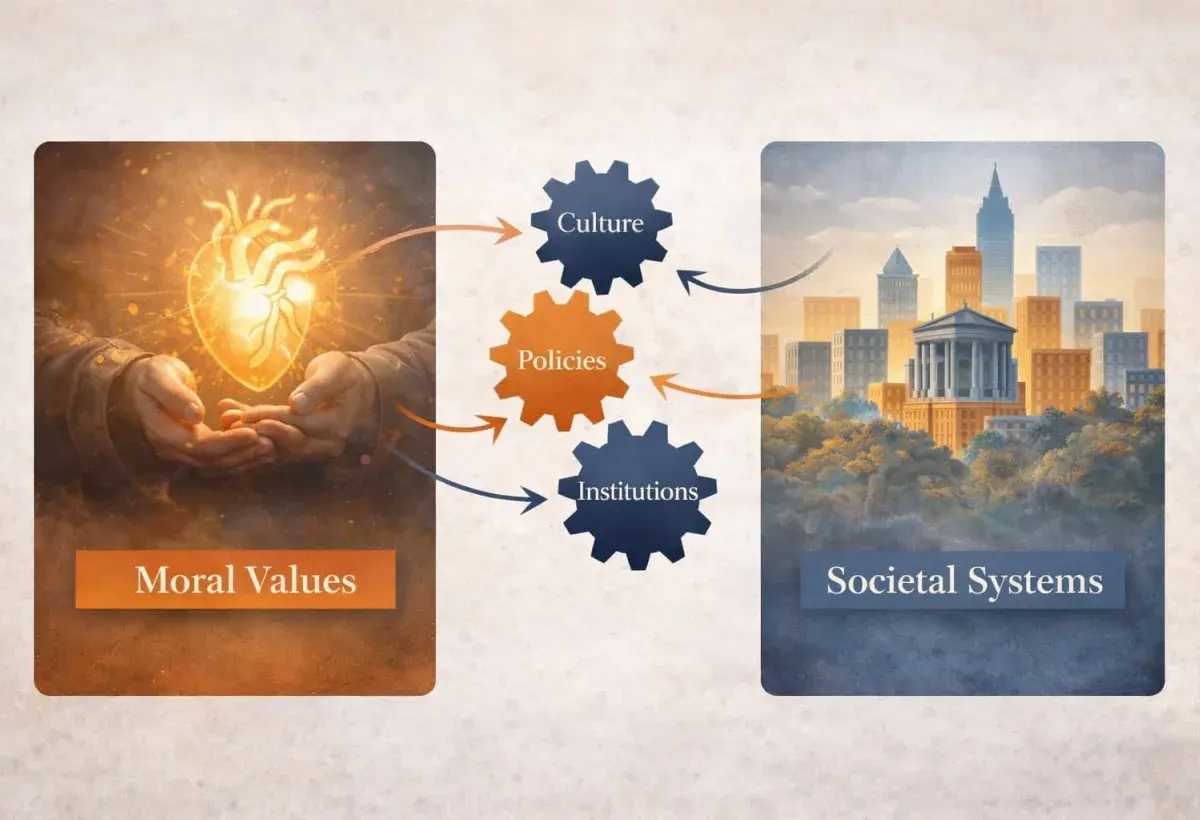
At the institutional level, systems either stabilize or destabilize the ecosystem. Policies, processes, and organizational cultures determine whether dignity is protected or compromised. Institutions that prevent humiliation and ensure fair treatment reinforce both dignity and decency at scale (Margalit, 1996).
These levels are interdependent. A breakdown at one level affects the others. For example, institutional disregard can undermine interpersonal trust, which in turn affects individual self-perception.
IV. Aging Within the Moral Ecosystem
Aging provides a critical context in which the functioning of the moral ecosystem becomes more visible. As individuals move through later stages of life, the balance between internal worth and external recognition becomes increasingly important.
Earlier in life, individuals often rely on structured roles, employment, social responsibilities, and economic participation to reinforce their sense of value. These structures provide consistent feedback about one’s place in society. However, as these structures evolve, the ecosystem is tested.
When dignity is supported by consistent decency and reinforced by inclusive systems, aging remains a process of continuity. Individuals continue to participate, contribute, and engage. Their roles may change, but their sense of worth remains intact.
Research on aging supports this pattern. Well-being in later life is strongly associated with perceived respect, autonomy, and continued participation (World Health Organization, 2021; Carstensen, 2021). These are not independent variables as they are indicators of a functioning moral ecosystem.
When the ecosystem weakens, the experience of aging shifts. The absence of recognition, inconsistent behavior, or exclusionary systems leads to disengagement. Individuals withdraw not simply because of age, but because the conditions for participation are no longer present.
This distinction is essential: aging, in itself, does not create isolation rather, isolation emerges from the failure of the systems meant to support, include, and value individuals as they grow older.
V. System-Level Outcomes: Stability or Fragmentation
The condition of the moral ecosystem has direct implications for how societies function over time. It influences whether systems remain stable or gradually fragment.
When dignity and decency are consistently reinforced, certain outcomes tend to emerge:
- Higher levels of institutional trust (OECD, 2023)
- Stronger social cohesion and cooperation
- Greater resilience in the face of inequality (Wilkinson & Pickett, 2009; Marmot, 2020)
These outcomes are not coincidental. They reflect a system in which individuals feel recognized and valued, even within complex or imperfect structures. Conversely, when the ecosystem is weakened, and when dignity is inconsistently recognized and decency is unevenly practiced, different patterns emerge.
Trust becomes conditional, participation declines, and social interactions grow increasingly fragmented and transactional.
Global data continues to show that perceptions of unfair treatment, exclusion, and lack of voice are key drivers of declining trust and social instability (Edelman, 2024; World Health Organization, 2022). These are not isolated issues, in fact, they are indicators of systemic imbalance.
In this sense, the moral ecosystem functions as an underlying condition of social life, largely unseen, yet clearly revealed through its measurable effects.
Image
VI. Rebuilding the Moral Ecosystem
Restoring the moral ecosystem requires alignment across multiple levels. It is not sufficient to affirm dignity in principle if it is not reinforced in practice and supported structurally.
The process involves coordinated effort:
- At the Individual Level
Individuals must maintain awareness of how their behavior reinforces or undermines the dignity of others. This includes consistent attention to tone, acknowledgment, and presence. - At the Social Level
Communities must establish and reinforce norms that prioritize respect as a baseline condition. Inclusion must be consistent rather than selective. - At the Institutional Level
Systems must be designed to prevent humiliation and ensure fair treatment. This includes policy frameworks, service delivery models, and organizational cultures that recognize human worth.
These levels are deeply interconnected because change in one inevitably shapes the others. Lasting, sustainable progress depends on their alignment working in harmony.
VII. Conclusion: Sustaining the Conditions of Human Life
Dignity and decency, when viewed in isolation, appear as ethical considerations. When understood within a system, they become structural conditions.
The moral ecosystem provides a framework for understanding how these conditions interact. It explains why dignity alone is insufficient without decency, and why both require institutional support to be consistently experienced.
In aging societies, this framework becomes particularly relevant. As traditional structures of validation evolve, the stability of the moral ecosystem determines whether individuals remain engaged or gradually disengage. The implications extend beyond aging. They affect how societies maintain trust, cohesion, and long-term resilience.
What emerges is a clear conclusion: Human systems do not sustain themselves through efficiency alone, but they are sustained through the consistent recognition of human worth and the everyday practice that reinforces it.
What ultimately emerges is this: human systems are not sustained by efficiency alone, but by the consistent recognition of human worth, and the everyday practices that affirm it.
Dignity defines that worth.
Decency expresses it.
The moral ecosystem sustains it.
In the end, the strength of that system determines not only how individuals age, but how societies endure.
Image

Suggested Citation
Lendez, M. (2026). Dignity and decency: The forgotten pillars of being human (Chikicha Series). Chikicha.
Dr. Mariza Lendez is the developer of the Ikigai-Bayanihan Purpose-Driven Retirement Framework, a model that redefines aging through purpose, dignity, and community-centered living.
Explore the Ikigai-Bayanihan Retirement Model presented by Chikicha Co-founder:
https://www.chikicha.com/chikicha-co-founder-present-ikigai-bayanihan-retirement-model-iafor-egen-2026
Chikicha Series - The Forgotten Pillars of Being Human
👉 Part 1: Dignity - The Structural Value of Human Worth
👉 Part 2: Decency - The Behavioral Expression of Human Value
👉 Part 3: The Moral Ecosystem - Integrating Dignity and Decency in Aging
References
Foundational Theoretical Sources
Kant, I. (1993). Groundwork of the metaphysics of morals (M. Gregor, Trans.). Cambridge University Press. (Original work published 1785)
Honneth, A. (1995). The struggle for recognition: The moral grammar of social conflicts. MIT Press.
Margalit, A. (1996). The decent society. Harvard University Press.
Sen, A. (1999). Development as freedom. Oxford University Press.
Inequality, Trust, and Social Systems
Rothstein, B., & Uslaner, E. M. (2005). All for all: Equality, corruption, and social trust. World Politics, 58(1), 41–72.
Wilkinson, R., & Pickett, K. (2009). The spirit level: Why more equal societies almost always do better. Allen Lane.
Marmot, M. (2020). Health equity in England: The Marmot review 10 years on. Institute of Health Equity.
Global Institutions and Contemporary Evidence
World Health Organization. (2021). Decade of healthy ageing: Baseline report. World Health Organization.
World Health Organization. (2022). World mental health report: Transforming mental health for all. World Health Organization.
United Nations. (2023). World social report 2023: Leaving no one behind in an ageing world. United Nations.
Organisation for Economic Co-operation and Development (OECD). (2023). Trust and public governance review. OECD Publishing.