


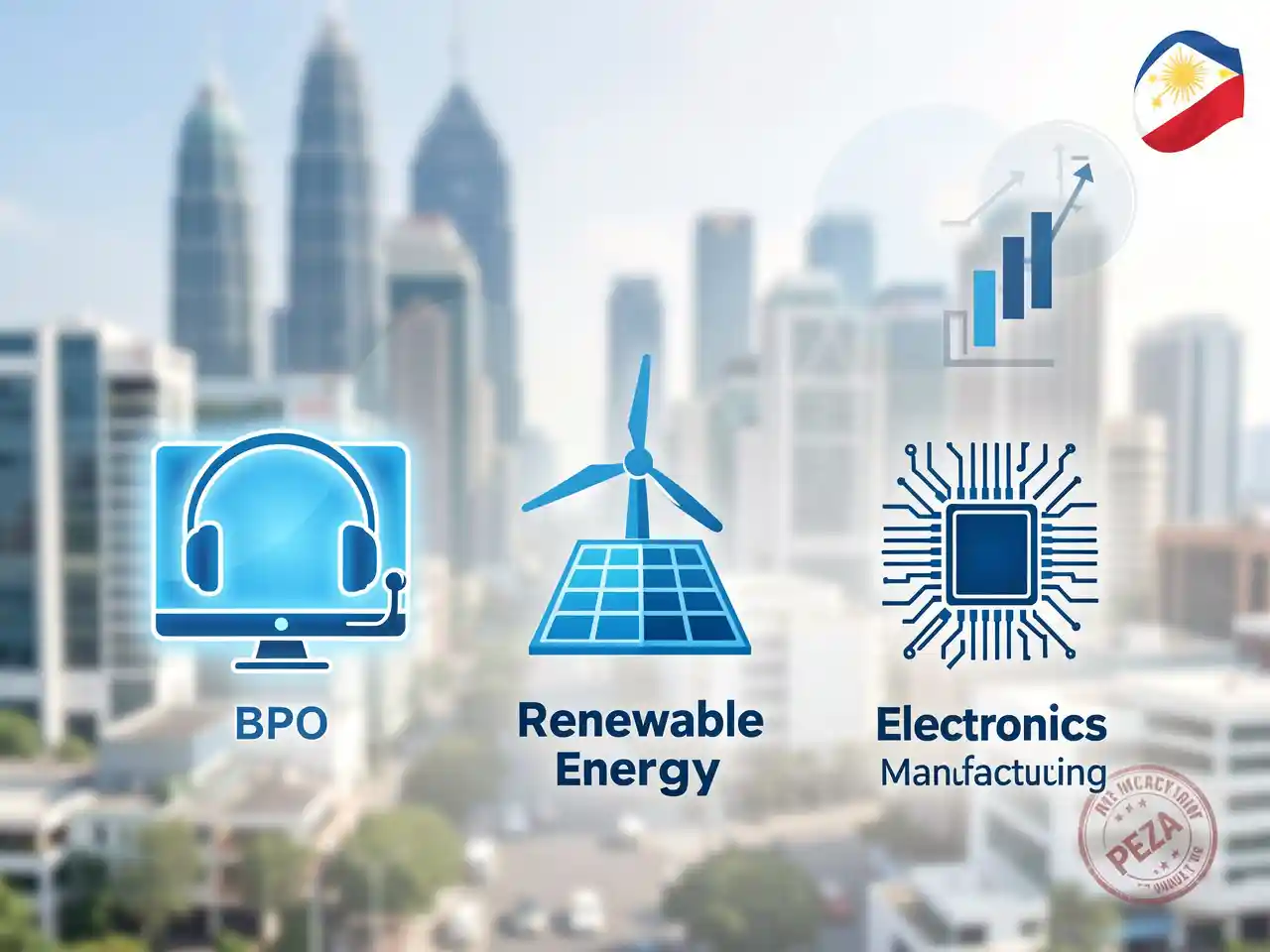
Unlock the Philippines’ top investment sectors in 2025 with this comprehensive guide. Explore the Business Process Outsourcing (BPO), Renewable Energy, and Electronics Manufacturing industries, including regulatory frameworks, tax incentives, and foreign ownership rules. Compare the Philippines with ASEAN peers and learn how to maximize opportunities in PEZA and BOI zones while avoiding common pitfalls.
I. BPO and IT-BPM Sector
Regulatory Framework
-
100 Percent Foreign Ownership: Allowed under PEZA and BOI.
-
Work-from-Home Policy: PEZA-registered firms may allow up to 30 percent remote work while maintaining 70 percent on-site operations.
-
Data Laws: Compliance with the Data Privacy Act (RA 10173) and the Cybercrime Prevention Act (RA 10175) is mandatory.
Tax Incentives for PEZA-Registered Firms
| Incentive | BPO/IT-BPM | Non-PEZA Firms |
| Corporate Tax | 5% on gross income | 20-25% CIT |
| VAT | 0% on export services | 12% |
| Import Duties | 0% for equipment | 3-10% |
| Income Tax Holiday | 4-6 years (new firms) | None |
Case Study: Accenture Philippines, a PEZA-registered firm, reportedly saves approximately fifty million dollars annually through tax perks.
II. Renewable Energy Sector
Regulatory Framework
-
100 Percent Foreign Ownership: Permitted since 2023 under the amended Renewable Energy Act.
-
Key Permits: Department of Energy service contracts, Energy Regulatory Commission licenses, and DENR environmental compliance certificates are required.
-
Green Energy Auction Program: A total of eleven thousand six hundred megawatts of new capacity has been targeted since 2023.
Tax Incentives for BOI or PEZA-Registered Firms
| Incentive | Renewable Energy Projects | Non-Incentivized Firms |
| Income Tax Holiday | Seven years (pioneer) | 20-25% CIT |
| Duty-Free Imports | Yes (solar panels) | 3-10% duty |
| VAT Exemption | Yes (equipment) | 12% VAT |
Case Study: ACEN, part of the Ayala Group, leveraged BOI perks to develop twelve hundred megawatts of solar farms across the country.
III. Electronics Manufacturing
Regulatory Framework
-
100 Percent Foreign Ownership: Allowed for fully export-oriented enterprises.
-
PEZA or BOI Registration: Required to access tax incentives.
-
Environmental Compliance: Strict DENR regulations apply to e-waste management.
Tax Incentives for PEZA or BOI Firms
| Incentive | PEZA/BOI Firms | Domestic Firms |
| Corporate Tax | 5% or Income Tax Holiday | 20% CIT |
| VAT | 0% for exports | 12% VAT |
| Duty-Free Imports | Yes (raw materials) | 3-10% duty |
Case Study: Texas Instruments Philippines reportedly saves thirty million dollars per year by taking advantage of PEZA benefits.
IV. ASEAN Comparison: Philippines vs. Regional Peers
| Policy | Philippines | Vietnam | Thailand |
| BPO Ownership | 100% | 100% | 49% cap |
| Renewable Energy Ownership | 100% | 100% (wind/solar) | 100% (conditions) |
| Corporate Tax Rate | 20% | 20% | 20% |
| Ease of Doing Business | Rank 95 | Rank 70 | Rank 21 |
Key Insight: The Philippines leads in BPO incentives, but infrastructure and logistics remain challenges compared to Thailand.
V. Investor Action Plan
A. For BPO Firms
-
Register with PEZA in ecozones such as Clark or Cebu.
-
Comply with WFH regulations, keeping on-site operations at 70 percent.
B. For Renewable Energy Projects
-
Participate in upcoming Green Energy Auction Program rounds.
-
Partner closely with the Department of Energy for service contracts.
C. For Electronics Manufacturing
-
Establish operations in PEZA zones such as Batangas or Clark to access tax incentives.
-
Join SEIPI to gain supply chain and industry network advantages.
Final Tip: For investors focused on ASEAN markets, the Philippines provides excellent BPO incentives but requires careful planning regarding infrastructure and logistics. Renewable energy and electronics manufacturing offer growth opportunities when regulatory and tax frameworks are properly leveraged.
Image

Disclaimer
This guide is for informational purposes only. It does not promote or sell any investment. The insights are based on independent research, supported by AI tools to gather verified data from trusted sources such as the IMF, World Bank, ASEAN reports, and official Philippine government publications.
References
-
World Bank. (2024). Philippines Tax Guide.
-
ASEAN. (2023). Energy Policy Review.
-
Philippine Economic Zone Authority. (2024). PEZA Investment Guide.