



The Rise of Money: A Story of Trust, Power, and Human Nature
Money often appears simple: coins in a pocket, numbers in a bank account, or digital balances moving across screens. Yet behind these symbols lies one of the most powerful inventions in human history.
Money is not merely a tool for trade. It is a social contract, a shared belief that something has value because others accept it. Economists, historians, and anthropologists increasingly agree that the history of money is ultimately a story about trust how societies create it, protect it, and sometimes lose it.
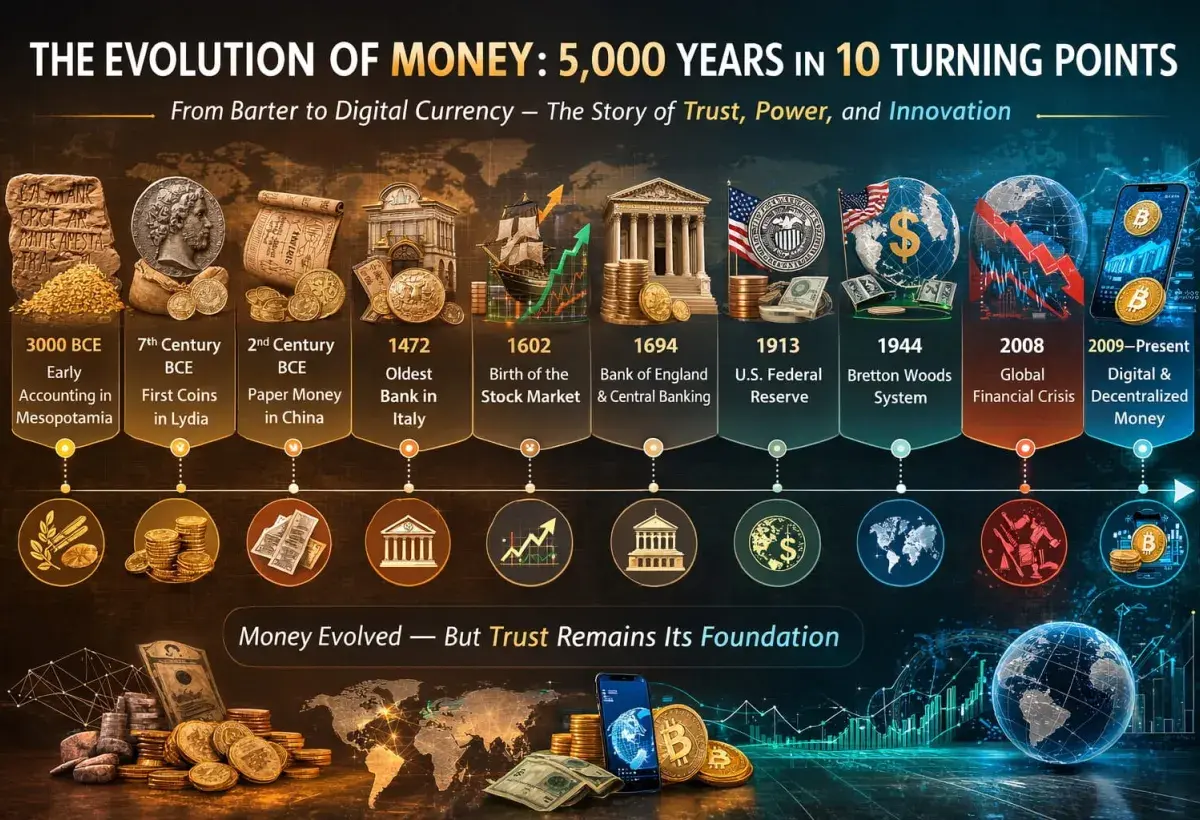
Over the past five thousand years, money has evolved from grain and silver to paper currencies, stock markets, central banks, and digital payments. Each transformation reflects deeper changes in human cooperation, political authority, and economic organization. Understanding this evolution reveals not only how financial systems emerged, but also how money continues to shape human behavior and global power.
The Limits of Barter and the Birth of Money
Long before coins or banks existed, early societies relied on barter direct exchanges of goods and services. Farmers traded grain for tools, craftsmen exchanged labor for livestock, and merchants negotiated complex trade networks. Yet barter had a fundamental limitation. Economists describe it as the “double coincidence of wants.” For trade to occur, each party had to want exactly what the other offered at the same time.
Economic historians note that this inefficiency constrained early markets and encouraged the search for a common medium of exchange.
Archaeological evidence from Mesopotamia suggests that early civilizations began using standardized commodities such as silver weights and grain deposits as units of value. Clay tablets from Sumerian cities show that debts and payments were often recorded in silver equivalents, even when transactions involved other goods.
According to economic historian Niall Ferguson and anthropologist David Graeber, these early systems demonstrate that money began not as coins but as accounting systems used to record obligations and debts. In other words, money began as trust written into records.
Image

The First Coins and the Power of Governments
Around the seventh century BCE, a major innovation appeared in the kingdom of Lydia, located in modern-day Turkey.
Lydian rulers began minting standardized coins made from electrum, a natural alloy of gold and silver. These coins were stamped with official symbols that guaranteed their weight and purity. For the first time, governments provided state-backed trust in currency.
Coins rapidly spread throughout the Mediterranean world. Greek city-states adopted them for commerce and taxation, while the Roman Empire used them to finance armies and administer vast territories. Meanwhile, in ancient China, early forms of money included cowrie shells and bronze coins, reflecting the diversity of monetary systems emerging across civilizations.
Historians note that these developments marked a turning point. Money was no longer simply a commodity it became a political instrument tied to state authority.
When Money Learned to Multiply: The Birth of Capital Markets
As trade networks expanded during the early modern period, merchants faced new financial challenges. Global voyages required enormous capital investments and carried significant risks.
In 1602, the Dutch East India Company known as the VOC introduced a groundbreaking solution. Instead of relying on a few wealthy investors, the company sold shares of ownership to the public. This innovation created the world’s first permanent stock market, established in Amsterdam.
Investors could buy and sell shares, spreading risk across many participants. The system allowed merchants and traders from various social classes to participate in global commerce. According to economic historians, this development transformed finance. Capital could now be mobilized at unprecedented scale, fueling international trade and economic expansion.
Yet markets also revealed another dimension of human behavior: speculation.
During the Dutch Tulip Mania of the 1630s, prices for rare tulip bulbs soared to extraordinary levels before collapsing suddenly. The episode became one of the earliest documented speculative bubbles. Economist Charles Kindleberger later used it as a case study to illustrate recurring patterns of financial exuberance, panic, and crisis.
Image
The Rise of Banking and the Creation of Central Banks
As trade and markets expanded, societies needed more stable financial systems.
Early banking practices emerged in Europe during the seventeenth century, when goldsmiths began storing precious metals for merchants and issuing paper receipts that could circulate as money. These receipts gradually evolved into early forms of banknotes.
Banks discovered that depositors rarely withdrew all their money simultaneously. This allowed them to lend a portion of deposits while keeping reserves an innovation that became known as fractional reserve banking. Over time, governments began establishing central banks to stabilize financial systems.
Institutions such as the Bank of England (1694) and later the U.S. Federal Reserve (1913) were created to manage currency supply, regulate banks, and act as lenders of last resort during financial crises. According to the Bank for International Settlements, central banks now play a crucial role in maintaining economic stability and preventing systemic financial collapse.
The Psychology of Money
Money is not only an economic instrument it also shapes human behavior.
Research in behavioral economics and psychology shows that exposure to money can influence how people interact with others. In a widely cited study, psychologist Kathleen Vohs found that individuals reminded of money tended to behave more independently and were less likely to seek or offer assistance. Other research suggests that societies with extreme income inequality often experience lower levels of trust, social cohesion, and well-being.
Public health scholars Richard Wilkinson and Kate Pickett have documented correlations between inequality and social challenges such as mental illness, substance abuse, and reduced community trust. These findings suggest that money magnifies existing social dynamics. It can encourage cooperation and growth but it can also intensify competition and division.
Financial Crises and the Fragility of Trust
Throughout history, financial systems have repeatedly faced moments when trust collapses. The global financial crisis of 2008 demonstrated how interconnected modern economies have become. When major financial institutions failed, credit markets froze and global trade contracted.
According to the International Monetary Fund and World Bank, the crisis revealed vulnerabilities in financial regulation and highlighted the importance of strong institutional oversight. Yet crises also show the resilience of economic systems. Reforms implemented after 2008 strengthened banking regulations and increased international coordination among financial authorities.
The Digital Future of Money
Today, money is entering another transformation. Digital payments, mobile banking, and cryptocurrencies are reshaping how people store and transfer value. At the same time, central banks are exploring central bank digital currencies (CBDCs) that could modernize national monetary systems.
The Bank for International Settlements reports that more than 90 percent of central banks are now researching or developing digital currencies. These innovations raise important questions about privacy, financial inclusion, and government oversight. As technology evolves, societies must decide how to balance efficiency, security, and freedom in the next generation of monetary systems.
Image

Did You Know? Key Facts About Money
Money predates coins by thousands of years.
Archaeological evidence from Mesopotamia shows that as early as 3000 BCE, societies recorded debts and payments using clay tablets that tracked values in silver and grain. These systems functioned as early monetary accounting tools.
The first stock market began in Amsterdam in 1602.
The Dutch East India Company issued shares to the public, allowing investors to fund global trade voyages. This innovation created the world’s first permanent stock exchange and laid the foundation for modern capital markets.
Central banks help stabilize financial systems.
Institutions such as the Bank of England and the U.S. Federal Reserve were created to manage currency supply, regulate banks, and act as lenders of last resort during financial crises.
Digital money is rapidly expanding worldwide.
According to the Bank for International Settlements, more than 90 percent of central banks are researching or developing central bank digital currencies (CBDCs) as governments explore the future of digital finance.
Trust is the foundation of money.
Economists and historians widely agree that money functions not because of its physical form but because societies collectively trust that it will be accepted in exchange for goods and services.
Image
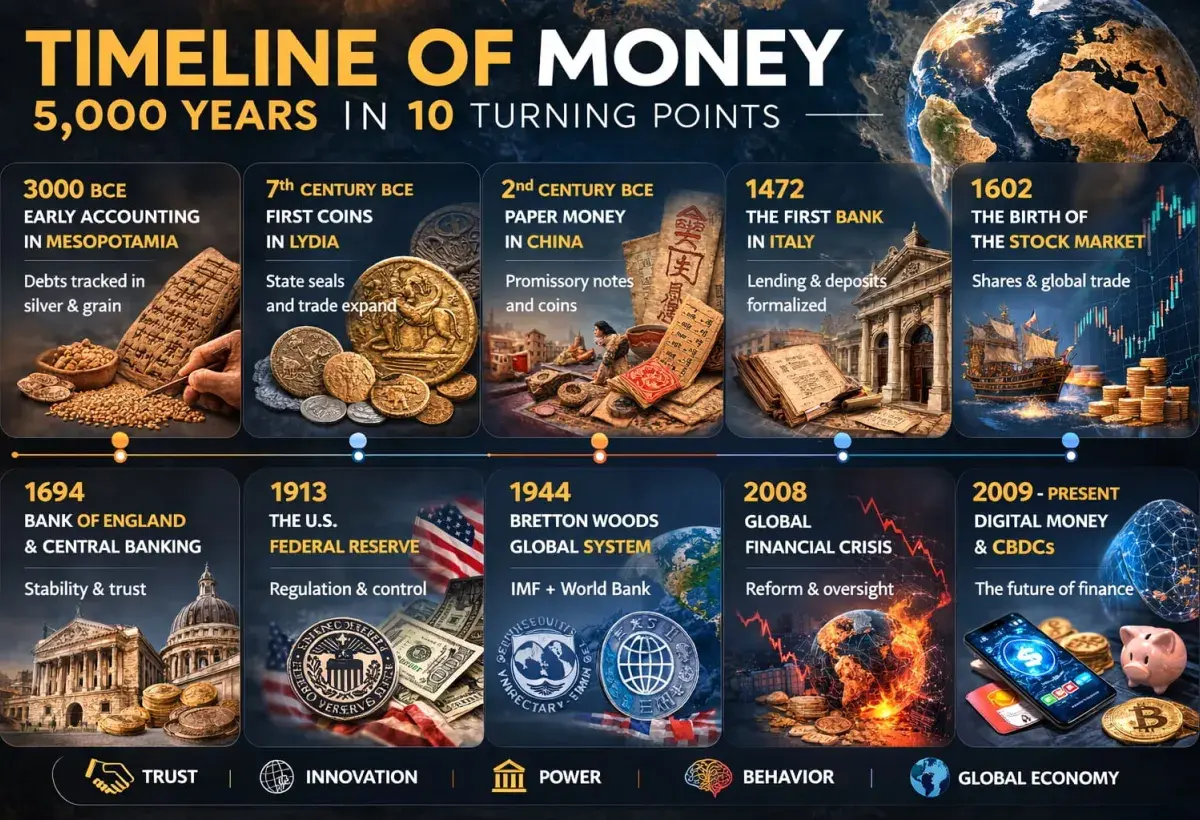
Timeline of Money: 5,000 Years in 10 Turning Points
The history of money did not emerge overnight. It evolved gradually as societies searched for more efficient ways to trade, record value, and build trust across communities and nations. Several key milestones shaped the financial systems that govern the modern world.
3000 BCE - Early Accounting Systems in Mesopotamia
Archaeological records from Sumerian cities show clay tablets used to track debts and trade in commodities such as barley and silver. Economic historians consider these accounting systems among the earliest forms of monetary record-keeping.
7th Century BCE - The First Coins in Lydia
The kingdom of Lydia, located in present-day Türkiye, began minting standardized coins made from electrum. These coins carried official state seals guaranteeing their weight and purity, allowing trade to expand across the Mediterranean.
2nd Century BCE - Paper Money in Ancient China
Chinese merchants began using promissory notes and later government-issued paper currency during the Tang and Song dynasties. This innovation allowed large commercial transactions without transporting heavy metal coins.
1472 - The Creation of One of the World’s Oldest Banks
Monte dei Paschi di Siena in Italy, founded in 1472, is often considered the world’s oldest surviving bank. Institutions like this helped formalize lending and deposit systems that would later influence modern banking.
1602 - The Birth of the Stock Market
The Dutch East India Company (VOC) issued shares to the public in Amsterdam, creating the world’s first permanent stock exchange. This innovation allowed investors to share risk and helped finance global trade.
1694 - The Bank of England and the Rise of Central Banking
The establishment of the Bank of England marked a turning point in financial governance. Central banks would eventually become responsible for issuing currency, stabilizing banking systems, and managing national monetary policy.
1913 - The Creation of the U.S. Federal Reserve
Following repeated banking crises, the United States established the Federal Reserve System to regulate banks, control money supply, and serve as a lender of last resort during financial turmoil.
1944 - The Bretton Woods Global Financial System
After World War II, global leaders created a new international monetary framework anchored to the U.S. dollar. Institutions such as the International Monetary Fund and the World Bank were established to stabilize the global economy.
2008 - The Global Financial Crisis
The collapse of major financial institutions triggered the most severe global economic downturn since the Great Depression. The crisis led to major reforms in banking regulation and financial oversight.
2009 - Present - The Rise of Digital and Decentralized Money
The emergence of cryptocurrencies and digital payment systems marked the beginning of a new financial era. At the same time, central banks around the world are exploring central bank digital currencies (CBDCs) to modernize monetary systems.
Key Insights from Global Institutions
Money functions because societies share trust in institutions and collective belief in value. Research from international organizations highlights several important patterns:
• The World Bank notes that stable financial systems depend on strong institutions and transparent regulation.
• The International Monetary Fund (IMF) emphasizes that trust in financial systems is essential for economic growth and global stability.
• The Bank for International Settlements (BIS) highlights the continuing role of central banks in maintaining monetary stability.
• Studies from the OECD and academic research institutions show that financial innovation from coins to digital payments continues to reshape global economies.
Conclusion: The Human Story Behind Money
Money has taken many forms throughout history from grain accounts and silver weights to coins, banknotes, stock markets, and digital currencies. Yet its foundation has always remained the same: trust.
Money works only because societies believe in it. It relies on confidence in institutions, cooperation between individuals, and shared expectations about the future. When that trust is strong, economies flourish. When it breaks down, financial systems falter.
The rise of money is therefore not just an economic story. It is a reflection of human cooperation, political power, and the choices societies make about how value should be created, exchanged, and shared.
-This article synthesizes insights from economic historians, global financial institutions, and peer-reviewed research to provide a balanced perspective on the evolution of money.
Image
References
Academic Sources
Ferguson, N. (2008). The Ascent of Money: A Financial History of the World. Penguin Press.
Graeber, D. (2011). Debt: The First 5,000 Years. Melville House.
Kindleberger, C., & Aliber, R. (2011). Manias, Panics, and Crashes: A History of Financial Crises. Palgrave Macmillan.
Vohs, K., Mead, N., & Goode, M. (2006). The Psychological Consequences of Money. Science.
Wilkinson, R., & Pickett, K. (2009). The Spirit Level: Why Greater Equality Makes Societies Stronger. Bloomsbury Press.
Cambridge University Press. (2019). The Cambridge Economic History of the Greco-Roman World.
Institutional Sources
Bank for International Settlements (BIS). (2023–2024). Central Bank Digital Currency Reports.
International Monetary Fund (IMF). (2023–2024). Global Financial Stability Report.
World Bank. (2023–2024). Global Economic Prospects.
OECD. (2023). Financial Markets and Economic Development Reports.
Federal Reserve System. (2023). History of Central Banking in the United States.
Bank of England. (2023). The Role of Central Banks in Modern Financial Systems.
Stanford University. (2024). Global Financial Innovation Research.
Disclaimer
This article is provided for informational purposes only and does not promote or sell any financial or investment product. Insights are based on independent research supported by verified data from international institutions including the World Bank, International Monetary Fund, OECD, and central bank research publications.