


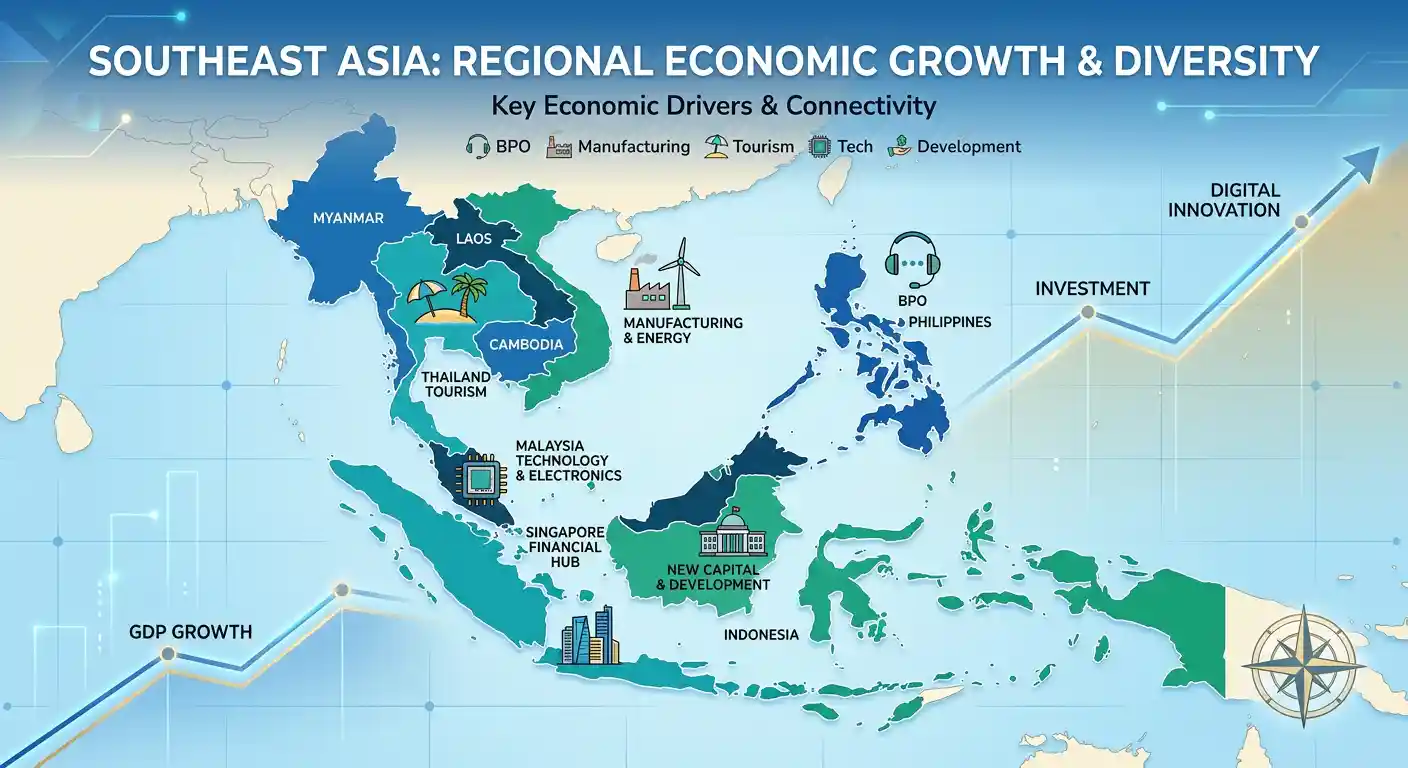
Southeast Asia’s economic and real estate landscape has undergone substantial transformation in the first half of 2025. Countries including Thailand, Vietnam, Malaysia, Indonesia, and the Philippines made strategic moves to attract foreign direct investment, stimulate real estate development, and strengthen sector-specific growth. Post-election policies, infrastructure expansion, and emerging investment hotspots reshaped the region’s competitive dynamics.
This report examines H1 2024 versus H1 2025 performance across key markets, offering insights for investors, policymakers, and business leaders seeking to understand regional trends. The focus includes real estate developments, economic growth drivers, sector-specific opportunities, and the comparative advantages of the Philippines against its Southeast Asian peers.
1. Economic Growth Trends: H1 2024 vs. H1 2025
Thailand
-
H1 2024: The Thai economy faced a slow recovery following post-election uncertainty. GDP growth hovered at 2.8 percent, reflecting cautious consumer sentiment and limited foreign investment inflows.
-
H1 2025: A digital wallet stimulus program injected approximately $14 billion into consumer spending, helping GDP growth rise to 3.5 percent. This intervention revitalized retail, tourism, and hospitality sectors, particularly in Bangkok, Phuket, and Chiang Mai.
-
Real Estate Impact: Luxury condo demand in Bangkok remained modest due to oversupply, but Phuket and regional vacation properties experienced a 20 percent increase in sales.
Vietnam
-
H1 2024: Manufacturing faced significant challenges, with exports declining 12 percent year-on-year as global demand contracted.
-
H1 2025: The rebound in electronics and semiconductor production, including expansions by Samsung and Intel, drove GDP growth to 6.2 percent.
-
Real Estate Impact: Industrial parks and logistics hubs near Hanoi and Ho Chi Minh City experienced surging demand, although a residential condo oversupply persisted, particularly in Hanoi.
Malaysia
-
H1 2024: The weak Malaysian ringgit limited import capacity but provided a boost to tourism. GDP growth remained moderate.
-
H1 2025: Implementation of foreign investment-friendly policies and tax incentives for technology and innovation-driven firms lifted GDP to 4.8 percent.
-
Real Estate Impact: Kuala Lumpur office vacancy increased to 24 percent, while Penang’s industrial sector expanded rapidly, fueled by investments in high-tech manufacturing and electronics supply chains.
Indonesia
-
H1 2024: Growth was constrained by nickel export bans, with GDP at 4.9 percent.
-
H1 2025: The accelerated construction of the new capital, Nusantara, contributed to a GDP increase of 5.3 percent.
-
Real Estate Impact: Jakarta’s luxury condo market declined by 15 percent, but Bali villas, tourism real estate, and industrial zones in East Java experienced significant growth.
Philippines Comparison
-
H1 2024: Pre-election uncertainty slowed luxury real estate transactions, while investors remained cautious.
-
H1 2025: Post-election stability boosted BPO, office, and industrial demand. GDP growth reached 5.8 percent.
-
Competitive Advantage: The Philippines benefits from a highly skilled, English-proficient workforce, giving it an edge over Vietnam and Indonesia in outsourcing and service-based industries.
2. Real Estate Market Analysis: Sector Highlights
Office Market Vacancy Rates
| Country | H1 2024 Vacancy | H1 2025 Vacancy | Trend |
| Philippines | 14.2% | 12.5% | Improving |
| Vietnam | 18% | 20% | Declining |
| Malaysia | 22% | 24% | Declining |
| Thailand | 15% | 13% | Improving |
Analysis: The Philippines and Thailand exhibit strong office market recovery, supported by BPO expansion, foreign investment inflows, and urban infrastructure improvements. Vietnam and Malaysia face oversupply challenges, affecting rental growth and occupancy rates.
Residential Market: Condominiums and Townships
-
Vietnam: Hanoi and Ho Chi Minh City continue to face a condo oversupply of approximately 50,000 units, placing downward pressure on prices.
-
Thailand: While Bangkok’s luxury condo market remains stagnant, Phuket and Bali vacation homes saw a 20 percent increase in demand, highlighting the importance of lifestyle and tourism-linked real estate.
-
Malaysia: Kuala Lumpur high-rises face slow absorption, but Johor’s Iskandar region benefits from Singapore spillover investments.
-
Philippines: A critical shortage of affordable housing exists, with a gap of 6.7 million units, while luxury condos remain in oversupply in key urban centers.
Industrial and Logistics Sector
-
Vietnam: Continues to lead the region in manufacturing and logistics, supported by electronics giants such as Samsung and LG.
-
Malaysia: Penang’s industrial sector thrives due to investments in high-tech manufacturing, including semiconductors and automotive supply chains.
-
Philippines: Industrial parks in Laguna and Cavite are expanding, though they lag behind Vietnam in both scale and efficiency. Infrastructure upgrades, such as the North-South Commuter Railway and the Bulacan International Airport, are expected to improve competitiveness.
3. Competitive Positioning: Country Rankings
| Factor | Philippines | Vietnam | Thailand | Malaysia | Indonesia |
| Manufacturing | Growing | Leader | Automotive | Tech | Nickel |
| BPO / IT Services | Leader | Rising | Weak | Small | Low |
| Tourism Real Estate | Lagging | Danang | Bangkok / Phuket | Langkawi | Bali |
| Infrastructure | NSCR, Bulacan Airport | North-South Expressway | Eastern Economic Corridor | Delays | Nusantara |
Legend: Leader / Moderate / Lagging
The Philippines excels in BPO and IT services due to a skilled workforce and favorable English proficiency. Vietnam dominates manufacturing and industrial parks. Thailand leads in tourism real estate, while Malaysia focuses on tech-driven industrial expansion. Indonesia presents a high-risk, high-reward scenario, particularly with Nusantara’s new capital development.
4. Key Takeaways for Investors
-
Vietnam: Optimal for manufacturing, industrial parks, and logistics expansion.
-
Philippines: Strong BPO, office, and REIT investment opportunities. Affordable housing remains a critical growth area.
-
Thailand: Tourism-driven real estate presents moderate but stable returns.
-
Indonesia: High-risk, high-reward potential, especially in Nusantara and Bali.
-
Malaysia: Targeted technology and industrial manufacturing investments in Penang are promising.
Philippines’ Unique Advantages:
-
Young and English-proficient workforce supports outsourcing and global service operations.
-
Urban housing demand is growing due to population demographics.
-
Infrastructure projects such as Bulacan International Airport, the North-South Commuter Railway, and new industrial parks are improving logistics and connectivity.
Challenges to Address:
-
Oversupply in luxury condos in Metro Manila.
-
Infrastructure bottlenecks slowing industrial park efficiency.
5. Strategic Recommendations
-
BPO and Service Sector Investors
-
Prioritize PEZA-registered zones in Clark and Cebu.
-
Capitalize on post-election stability and government incentives.
-
-
Industrial and Logistics Investors
-
Target Laguna and Cavite industrial parks while monitoring Vietnam’s competitive edge.
-
Plan for long-term infrastructure upgrades to maximize operational efficiency.
-
-
Residential and REIT Investors
-
Focus on affordable housing projects to bridge the 6.7 million unit gap.
-
Avoid oversaturated luxury condo markets in Manila and Cebu.
-
-
Cross-Border Opportunities
-
Evaluate partnerships in Vietnam for manufacturing and industrial expansion.
-
Monitor Thailand for tourism-related property investments.
-
Image

Disclaimer
This guide is for informational purposes only. It does not promote or sell any investment. The insights are based on independent research and AI-assisted analysis using verified data from sources including the IMF, World Bank, ASEAN reports, and official Philippine government publications.
References
-
CBRE. (2025). Thailand and Vietnam office and residential reports.
-
Savills Vietnam. (2025). Condo oversupply analysis.
-
Knight Frank Malaysia. (2025). Industrial and office trends.
-
Colliers Indonesia. (2025). Nusantara development update.
-
JLL Philippines. (2025). BPO and industrial demand reports.
-
World Bank. (2025). Southeast Asia regional economic outlook.
-
UBS. (2025). Global real estate bubble index.
-
Asian Development Bank. (2025). ASEAN housing needs report.