

I didn’t sit down that evening expecting to watch anything meaningful. We were having dinner, talking about ordinary things, while the television murmured behind us. A sitcom was playing one of those shows designed to fill space, to be half-noticed, half-ignored. I had missed more than half of the story. And yet, toward the end, something unfolded that refused to stay in the background.
A father was speaking to a friend. His voice carried hesitation, the kind that comes when truth feels heavier than silence. He said he could not tell his daughter that her pet rabbit had died. He could not break her heart. His friend insisted on honesty “go and tell her now”. It was the sensible advice. The correct one.
But love is not always sensible.
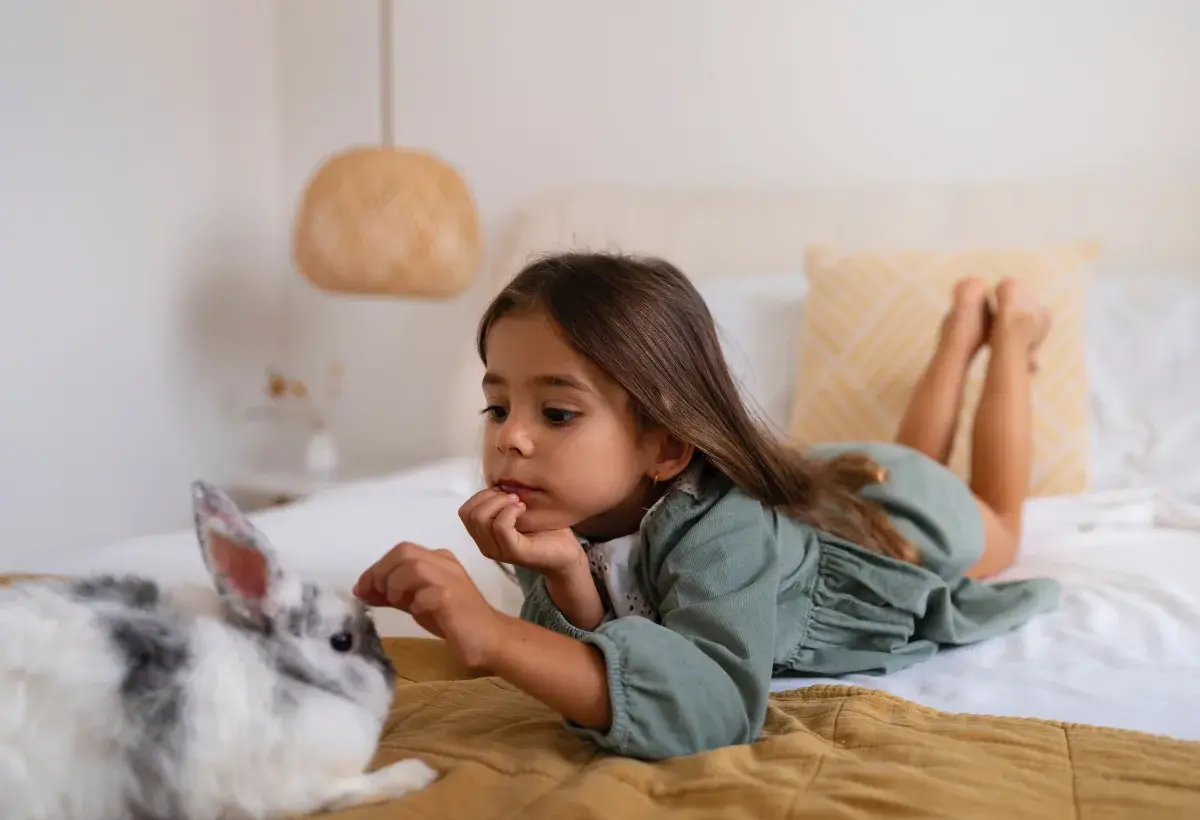
The next scene shifted into a child’s bedroom. A small girl five or six years old sat quietly, wearing her tiny glasses, enclosed in her own gentle world. Her father entered carrying a bag. His words came slowly, carefully, as if he were testing each one before letting it fall. He told her he had a surprise. He said the rabbit survived. He opened the bag.
Her face lit up and she thanked him with a joy so sincere it almost erased doubt. She said she knew it would survive. She told him she had seen him staying up late, trying to revive it. Her happiness felt real enough to make the moment believable. The father left the room relieved, perhaps thinking he had saved his daughter from grief. Then the camera did not follow the father out of the room. It stayed.
The little girl was alone now. She slowly lifted the bag, careful, almost reverent, and spoke to the rabbit inside in a voice meant only for the two of them. She welcomed it gently, as one does a guest who has traveled far. She described the room where it would sit, where it would rest making sure it would be placed just right, so her daddy could see it the moment he walked in. There was no confusion in her voice. And in that small, tender monologue, the truth surfaced, but whole, and unmistakable.
She knew…she had known from the very beginning that this was not her rabbit.
Image
In that instant, the scene shifted.
What had seemed like a simple story about a child and her pet unfolded into something far more fragile. The father’s lie was not born of deceit, but of love too deep to risk injury. He chose silence because truth, in that moment, would have landed like a wound. He spent his time, his energy, and what little hope he had trying to undo what could not be undone. He tried to restore life not because he believed he could but because he could not yet bring himself to introduce loss into his child’s still-soft world.
And the daughter, in her own way, chose silence, too.
She accepted the bag with surprised. She smiled. She spoke the rabbit’s name with practiced joy. She played her part beautifully not because she was fooled, but because she understood. She saw her father’s effort in the lines of his hesitation. She sensed his fear in the way his words stumbled. And so she decided, quietly, to protect him from the knowledge that his love had not been enough to change the outcome.
They met each other there, in that narrow space between truth and tenderness.
Two lies. One love.
No exposure. No need to be right.
So what do we call something like this?
It is easy to dismiss it as a “white lie,” but that phrase feels far too small. This was not dishonesty born from convenience. It was not avoidance. It was sacrifice. A mutual agreement unspoken, intuitive to carry pain privately so the other could remain whole.
Perhaps it is protective love, the kind that absorbs hurt rather than passing it on. Perhaps it is empathetic restraint, where truth is not denied but handled with reverence. Or perhaps it is simply unspoken love the kind that requires no explanation because both hearts already understand.
What made the moment extraordinary was not the father’s decision alone, nor the child’s. It was the symmetry between them. Love flowed both ways, even across an age gap that supposedly separates wisdom from innocence. The child was not naïve. The adult was not all-powerful. They stood on equal emotional ground, each choosing kindness over clarity.
And yes, the rabbit was the casualty. In life, this is often how it happens. Objects become vessels for our deepest emotions. The rabbit carried grief, hope, effort, and fear all at once. It was never really about the animal, but about the longing to preserve gentleness in a world that introduces loss far too early. What struck me most was how naturally they accepted the scene they were given.
There were no questions, neither asked, Is this real? Instead, both seemed to ask, Is this loving? And they answered in silence.
In a way, it mirrors how we watch films and sitcoms. We know they are constructed. We recognize the illusion. And yet, we willingly suspend disbelief not because we are fooled, but because belief feels kinder than disruption. Love often works the same way. It is not blind. It sees clearly and chooses peace anyway.
This kind of love moves without sound. It slips into the spaces where words would only bruise. It recognizes effort without asking for proof, and devotion without needing to be named. It looks at another’s trembling attempt and chooses tenderness over exposure. It whispers, I see you trying. And then, more softly still, I know and that is enough.
In a world that is so loud, transactional, and relentlessly material, this kind of love feels almost radical.
We live in an age where happiness is marketed and measured, where affection is displayed publicly and validated through numbers. Even care often comes with conditions. What do I get in return? How will this look? Is it worth it?
What lived in that small bedroom could not be measured or traded. Nothing was earned, nothing collected. No hands were raised in praise, no lesson declared won. There was only the careful sheltering of two hearts, each choosing the other’s safety. And in that choosing, everything necessary was already complete.
Image
A Quiet Closing
I carry a simple hope, one shaped by moments like this that everyone might experience this kind of love at least once in their lifetime. Not always in the shape of a parent and a child, but wherever human hearts are allowed to meet: between companions who grow old together, friends who know when not to ask, siblings who understand without explanation, even strangers who sense when silence is the kinder offering.
It is a love that sees without cornering, that recognizes effort even when it does not succeed. A love that handles truth the way one handles something fragile not to hide it, but to keep it from causing harm. Here, silence is not absence. It is presence, deliberate and full. Because happiness, I have learned, is not always found in what is real or restored. Sometimes it lives in the knowledge that someone tried quietly, imperfectly, with all the love they had.
And sometimes it lives in the gentler courage of allowing that effort to stand, untouched by correction. In a world eager to assign value, to label joy, to sell fulfillment by the measure, this kind of love escapes calculation. . . it lingers without proof, it costs nothing, and it remains quiet, unspoken, and whole.
And when the day finally softens, when the noise loosens its grip and the world grows still enough to hear oneself think, it is not the things we owned or proved that remain. It is the moments we chose gentleness over certainty, silence over spectacle, love over being right. These are the truths we carry without needing to explain them. These are the stories that stay. And long after the lights are out, this kind of love lingers unannounced, unmeasured, and faithfully beside us.
Image