


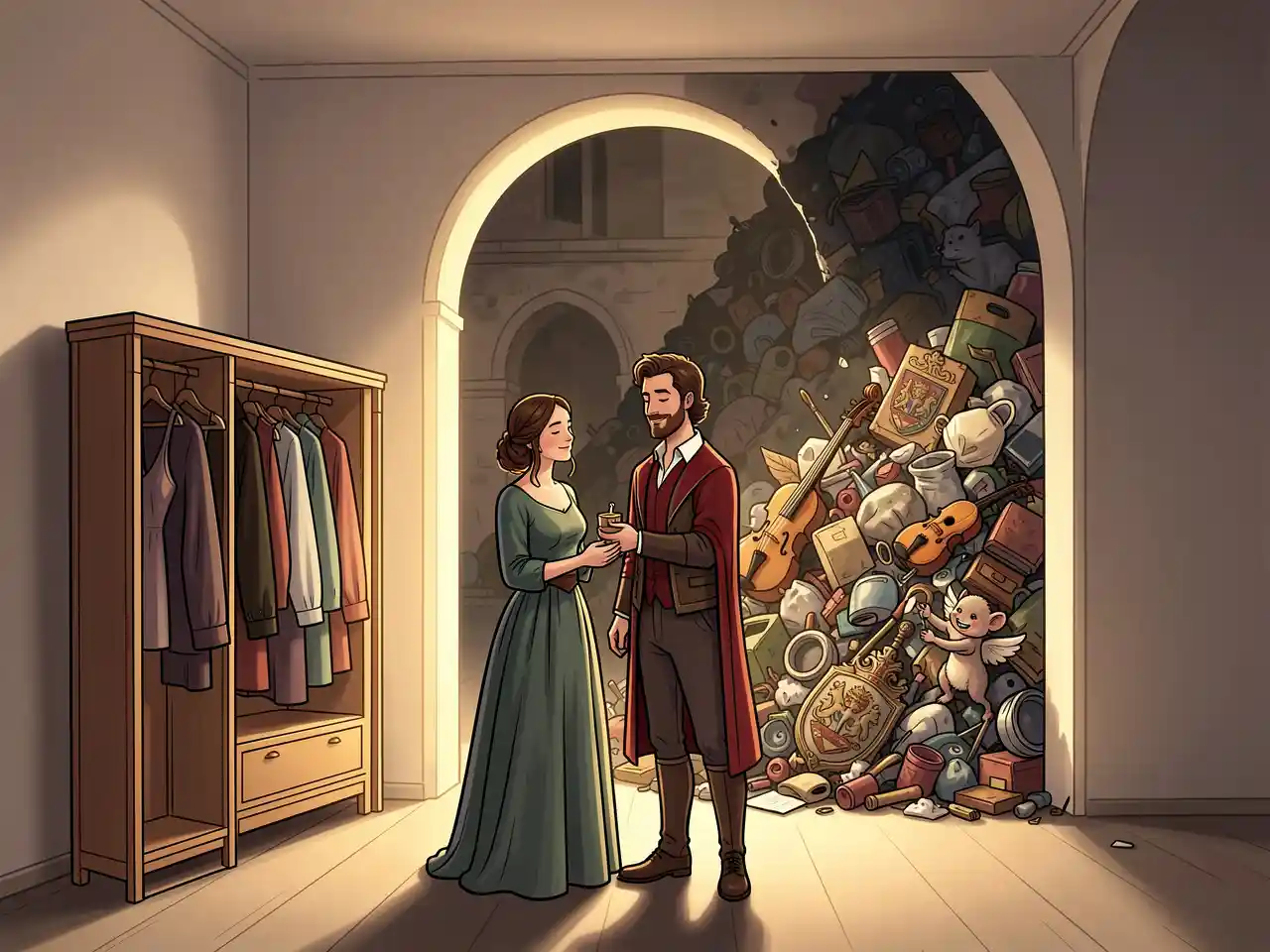
Shakespeare’s Romeo and Juliet is a masterpiece of passion, fate, and the catastrophic consequences of division. But look beyond the poetry and you will find a story tragically relevant to a modern dilemma: the chaos of clutter. Imagine if Romeo had not been delayed by a cluttered path in the Capulet orchard. Imagine if Juliet’s chamber had been clear of superfluous trinkets, making her feigned death less convincing. Their greatest tragedy might not have been the family feud, but a life suffocated by unnecessary junk. Let us rewrite their story, and perhaps our own, by reuniting what actually belongs together and banishing the rest to the Verona trash heap.
Act 1: The Feud Between You and Your Stuff
Our homes often become a stage for a silent, draining civil war. The Capulets and Montagues are not just families; they are metaphors for the factions within our own spaces. The "keep" pile versus the "donate" pile. The sentimental mementos versus the practical necessities. This internal feud creates a state of constant, low level stress, much like the tension that filled the streets of Verona.
Your closet is not a battlefield for a family rivalry. It is simply fabric, wood, and metal. The war is an illusion you can end by picking a side. The only two sides that matter are a joyful "hell yes" and a definitive "Verona trash heap." Every item must pledge its allegiance. Does this shirt spark the passionate, immediate love Romeo felt upon seeing Juliet? Or does it inspire the disdain Tybalt held for all Montagues? There is no middle ground. The "maybe" pile is the most tragic character of all; it is the Paris of your possessions, an uninspiring suitor that lingers, taking up space and adding nothing to the narrative of your life.
We must learn to laugh at our own procrastination. That pile of "one day" projects, the cables for devices long turned to dust, the broken chair you swear you will fix; this collection is more tragically pointless than Mercutio's death scene. It serves no purpose other than to remind you of your inaction. The clutter becomes a physical manifestation of unmet goals and delayed decisions.
Here is a hack worthy of a clandestine balcony meeting: The Balcony Test. Hold any questionable item in your hand and ask yourself, "Is this worth hauling up a rope ladder for a midnight reunion?" If you would not go through the dramatic, risky, and frankly romantic effort to be with it, then it does not deserve a place in your castle. If you would not scale a wall for it, you should not have to navigate around it every day. This simple question cuts through the noise and reveals the true objects of your affection.
Image

Act 2: The Friar's Sage Wisdom for Your Emotional Clutter
The chaos in our physical environment is often a reflection of the clutter within our minds. Just as Friar Laurence served as a confidant and guide, we must seek wisdom to clear our internal landscapes. This means confronting the emotional baggage we hoard with a stubbornness that rivals the family feud.
It is time for a stupidity confession. Many of us have hoarded old grudges, past slights, and lingering resentments far longer than Juliet's sleeping potion was ever meant to last. We store these toxic emotions in the attic of our minds, allowing them to gather dust and poison our present. We cling to relationships that drain our energy, replay arguments we can never win, and hold onto versions of ourselves that no longer exist. This is not romance; it is bad theater. It is a melodrama we force ourselves to star in every single day.
Holding onto a toxic relationship or a career defining failure is like Romeo refusing to let go of Rosaline. It blocks the space needed for a truly transformative love or opportunity to enter. The "what if" and "if only" are the siren songs that keep us trapped in a cluttered past.
The fix for this requires a dramatic, symbolic gesture. Take a page from the Friar's book of remedies. Write down the names of these energy vampires, these grudges, these old stories on a piece of paper. Then, with great ceremony, burn them. This act is poetic, cathartic, and final. Please, of course, be fire safe. A metal bowl or a sink will do. The point is to witness the physical destruction of the emotional weight you have been carrying. Watch the smoke rise and dissipate, and with it, your attachment to that which no longer serves you. It is a purging more effective than any potion.
Act 3: The Final Reunion for Your Career and Finances
Our professional and financial lives are often the most cluttered acts of our personal play. We cling to outdated skills, half finished projects, and spending habits that betray our long term goals. We confuse activity with achievement, much like the citizens of Verona confused the frantic sword fights with a solution to their problems.
Your resume is not a Shakespearean sonnet. You must stop trying to make your "2008 Excel skills" rhyme with a "modern job market." This is a painful truth bomb. The world has moved on, and your professional identity must evolve. A cluttered resume, filled with obsolete jargon and ancient accomplishments, is as useful as a sword in a gunfight. It is time for a ruthless edit. What skills truly represent your value today? What achievements tell the story of the professional you are now, not the one you were a decade ago?
We must also laugh at the financial clutter we create. Our "side hustle" culture often devolves into "side buying." We earn a little extra only to immediately spend it, making Amazon the true MVP of our financial game. Our homes fill with the evidence: gadgets for hobbies we never started, bulk purchases that went bad, and subscriptions we forget we have. This financial drama is a tragedy we fund with our own hard work.
The solution is The Apothecary's Purge. In the play, the Apothecary provided the means for an ending. In our lives, his archetype can provide the means for a new beginning. Commit to selling or donating one unused thing from your home every single day. It does not have to be large. A book, an old kitchen gadget, a piece of clothing. This daily, deliberate act of release creates powerful momentum. It clears physical space, but more importantly, it reprogrammes your mindset from accumulation to curation. You are not just removing objects; you are reclaiming your financial and mental real estate. No poison is required, just consistent, purposeful action.
A New Ending
Let us imagine a different final scene for our star crossed lovers. Romeo, having undergone a profound shift, looks at his collection of "just in case" daggers and dueling gear. He sees them not as symbols of honor, but as heavy, pointless clutter. He decides to chuck them. Juliet, in her chamber, looks at her fourteen unworn corsets and piles of ornate dresses. She realizes they are costumes for a life she is not living. She donates them.
They do not meet in a tomb crowded with the ghosts of the past. They reunite in a sunlit, minimalist villa, free from the weight of their former possessions. The air is light, the space is clear, and their future is unwritten. Romeo turns to Juliet, a smile on his face, and whispers the most romantic line for the modern age, "Parting is such sweet sorrow... but storage units are two hundred dollars a month." They have learned that true love is not about dramatic gestures fueled by clutter and chaos, but about creating a peaceful space where only what truly belongs together remains.
Image