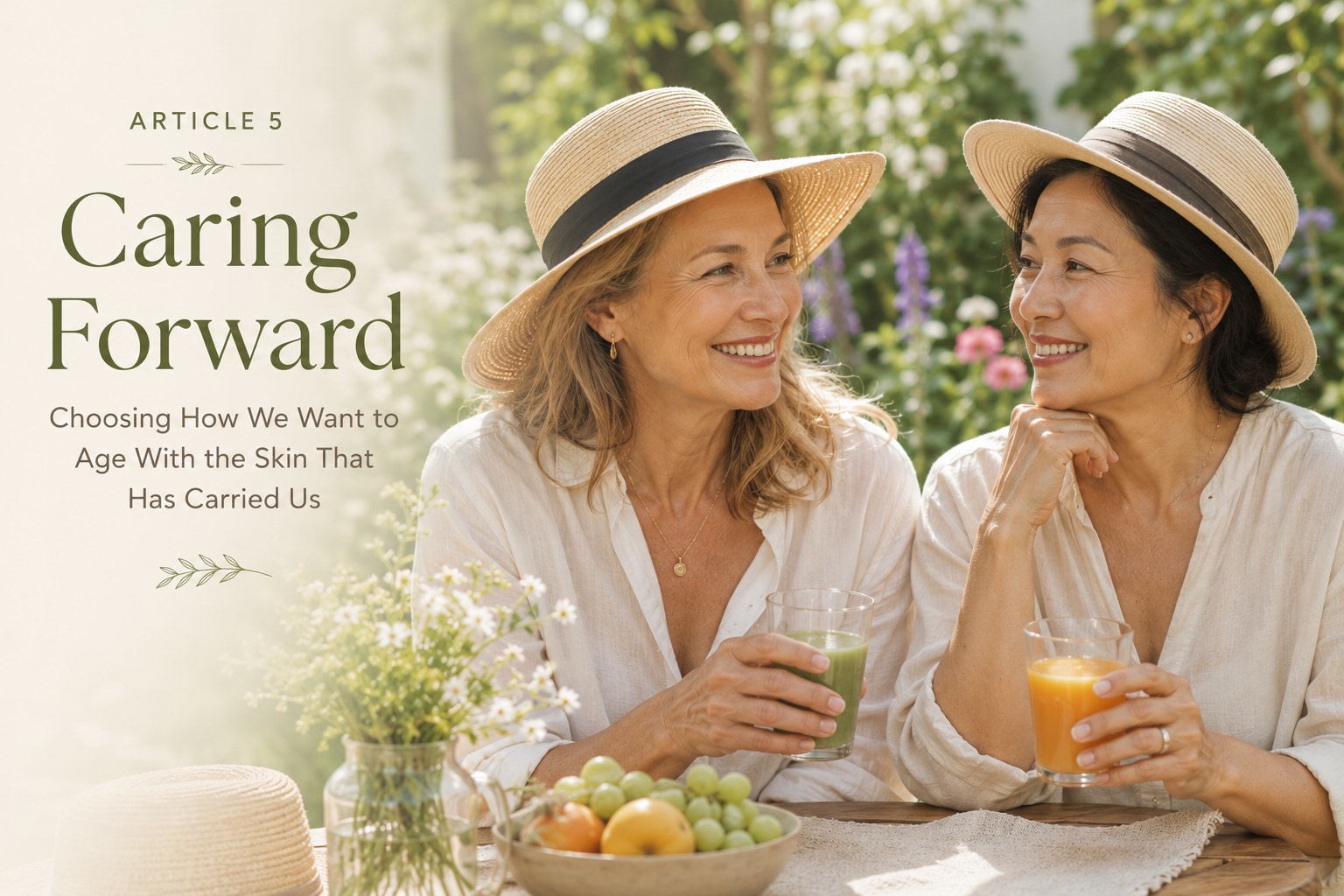
Choosing How We Want to Age With the Skin That Has Carried Us
After the evidence, the choice is still ours.
After Everything We Have Learned
For four articles, we have followed the skin through a progression of knowing, observing, understanding, and investigating. We began by recognizing that skin changes as we grow older, not because it has failed, but because it has continued to live, function, adapt, and respond to everything we have experienced. We then learned to observe the skin we have today, considered the environment that has shaped it, and finally examined what science has actually demonstrated about the possibilities we place on it.
Along the way, we heard the voices of researchers and allowed their findings to remain within the boundaries of what they actually studied. We looked at what changed, what did not, what could be demonstrated, and where evidence remained limited, because understanding requires us to see the whole picture rather than only the result we hope to find. Now the research can step back, because after everything we have learned, there is another question that science alone cannot answer: How do we want to care for the skin that has carried us this far?
We Have Been Taught to See Aging as Something to Correct
We live in a world that is remarkably good at telling us what we should see when we look in the mirror. A line becomes a problem, a change in texture becomes a concern, and a face that visibly carries time can quickly become something presented as needing correction. The message does not always arrive as a direct instruction; sometimes it comes quietly through images, language, promises, and the repeated suggestion that looking younger is something we should continue pursuing.
There is nothing wrong with caring about appearance, and we should be honest about that. Looking good can make us feel confident, comfortable, expressive, attractive, or simply more like ourselves, and wanting that experience does not require an apology. But there is a difference between caring about how we look and believing that every visible sign of aging represents something that has gone wrong.
What If We Changed the Question?
The conversation changes when we stop asking only, “How can I make my skin look younger?” and begin asking, “How can I care for the skin I have now?” The difference is subtle, but the starting point is completely different: one begins with correction, while the other begins with understanding. Instead of automatically treating change as a problem, we begin by asking what that change means and what the skin may need because of it.
After everything we have examined, we know that age alone does not tell us the condition of our skin. We also know that appearance does not tell the entire story of how skin functions or what it has experienced throughout a lifetime. The more mature question, therefore, may not be how successfully we can erase the evidence of time, but how thoughtfully we can respond to the skin that exists today.
The Skin Has Been Protecting Us All Along
Before we ever purchased a moisturizer, our skin was already there doing its work. Before we understood the language of the skin barrier or environmental exposure, it was already meeting the outside world every day and protecting what lies beneath it. We rarely thought about this work because protection is often noticed only when something goes wrong.
Our skin has experienced sunlight, weather, changing temperatures, pollution, friction, illness, stress, and the countless ordinary exposures that accompany living. It has repaired itself, adapted to changing circumstances, and remained with us through years that we sometimes barely noticed were passing. Perhaps this is why caring for aging skin can become something more meaningful than simply maintaining an appearance: the tissue that protected us deserves protection in return.
Science Has Given Us More Choices
We should also acknowledge how much has changed in our ability to understand and care for skin. Research has expanded our knowledge of skin biology, environmental exposure, the barrier, photoaging, ingredients, formulations, and the many processes involved in visible changes over time. We also have more ways to alter appearance than previous generations had, giving people choices that simply did not exist before.
More choices, however, do not create one correct answer. They create more decisions, and decisions become more meaningful when we understand what we are actually choosing rather than simply responding to the newest promise. Science can expand what is possible, but it cannot determine which possibility matters most to a particular person.
Looking Younger Is Not the Same as Being Younger
A younger-looking face is an appearance; it is not a return to a younger life. It does not erase the years that have passed, the experiences we have accumulated, or the biological process of aging that continues regardless of how closely our appearance may resemble an earlier version of ourselves. A visible wrinkle, pigmentation, change in texture, or loss of elasticity can tell us that something has changed, but it cannot tell us everything about the person or the skin carrying that change.
This is why appearance, skin function, and healthy aging should not be treated as though they are interchangeable ideas. We can care about how skin looks while also caring about its comfort, protection, and ability to perform its functions, and we can pursue aesthetic changes without declaring aging itself a failure. Looking younger can be a personal preference, however, it does not have to become a definition of what healthy aging means.
Image

You Are Allowed to Care About Appearance
This is where we want to be completely honest with the reader: you are allowed to care about appearance. You are also allowed to care about aging with dignity. And you are allowed to value both. We do not need to create another rule telling people what they should want simply because we are challenging the old rules about aging.
If looking younger makes you feel good, that matters, and if maintaining a particular appearance gives you confidence, that matters too. You may want to explore ways of changing certain visible signs of aging, you may prefer to preserve and protect what you have, or you may find yourself somewhere between the two. The important question is not which choice we can declare superior, but whether the choice genuinely belongs to the person making it.
Caring Is Different From Correcting
This is the distinction that has been developing throughout the entire series: to correct something suggests that something is wrong, while to care for something recognizes that it matters. We care for a home because it shelters us, a garden because it grows, and a body because it is where we live. In the same way, we can care for aging skin without treating its age as a defect that must constantly be corrected.
Choosing to have an aging healthy skin is another option. Caring forward does not mean giving up on appearance or refusing to improve something we genuinely want to improve.
It means that protection, nourishment, preservation, and thoughtful attention can exist alongside aesthetic choices without turning aging into an enemy. We can care for the skin without exposing it to unnecessary harshness simply because someone has convinced us that looking older is unacceptable.
Protection Is Not the Same as Fighting
Protecting aging skin does not mean trying to preserve the exact face we had decades ago. Preservation does not mean pretending that time has stopped, and acceptance does not mean neglect. It means recognizing that aging skin has changing needs and responding to those needs with greater attention rather than greater hostility.
We can protect the skin from exposures we can reasonably protect it from, give it the nourishment and care it needs, observe changes instead of ignoring them, and seek appropriate professional attention when something genuinely concerns us. We can also question whether every new claim, treatment, or preparation deserves access to our skin simply because it promises to make us look younger. There is a difference between caring for aging skin and punishing skin for becoming older.
The Tiny Voice We Hope You Take With You
Perhaps these five articles cannot give the reader a perfect answer, and that was never the purpose. What we hope they can leave behind is something much smaller, and quieter, internal voice that creates a moment of thought between the claim and the purchase, between the advertisement and the decision, and between seeing a wrinkle and immediately deciding that it must disappear.
That voice can ask simple but important questions: What exactly is being promised? What evidence supports it? What was actually studied? What does my skin need? Am I choosing this because it is right for me, or because I have been made to believe that something is wrong with me? A small voice may seem insignificant, but once we learn to question the claim, the claim no longer gets to make the decision for us.
The Battle Is No Longer Against Aging
We have been fighting the wrong battle.
The skin will continue to age, and that is not something we need to defeat; what deserves greater attention is the pressure that tells us aging itself is something to fear, hide, or correct at any cost. We can recognize exaggerated promises without becoming cynical about every product or intervention, because discernment does not require rejection.
We can learn to distinguish evidence from marketing, demonstrated outcomes from attractive language, and genuine care from unnecessary harshness. Sometimes an informed decision will be yes, sometimes it will be no, and sometimes it will simply be, “I need to understand this better before I decide.” That pause is not indecision; it is the beginning of mature choice.
Image
Paying It Forward
There is something deeply human about realizing that our relationship with our skin can change as we grow older. For much of our lives, our skin protected us without asking for recognition while we were working, raising families, building relationships, facing difficult seasons, enjoying beautiful ones, and simply moving through the ordinary business of being alive. We could not protect it from everything, and no one can, but we know more now than we once did.
And knowing more gives us an opportunity to change the relationship. It is time to pay it forward by giving our skin the attention, nourishment, preservation, and protection that it has quietly given us for all these years. Not to force it backward, not to demand that it prove we are still young, but to help it continue doing what it has always done: accompany us through whatever years remain.
Caring Forward
Caring forward means understanding that the skin we have today will continue to change. Its texture may change, its needs may change, and our relationship with our appearance may change as well, but none of these changes means that the journey has failed. They are simply part of living in a body that has continued through time.
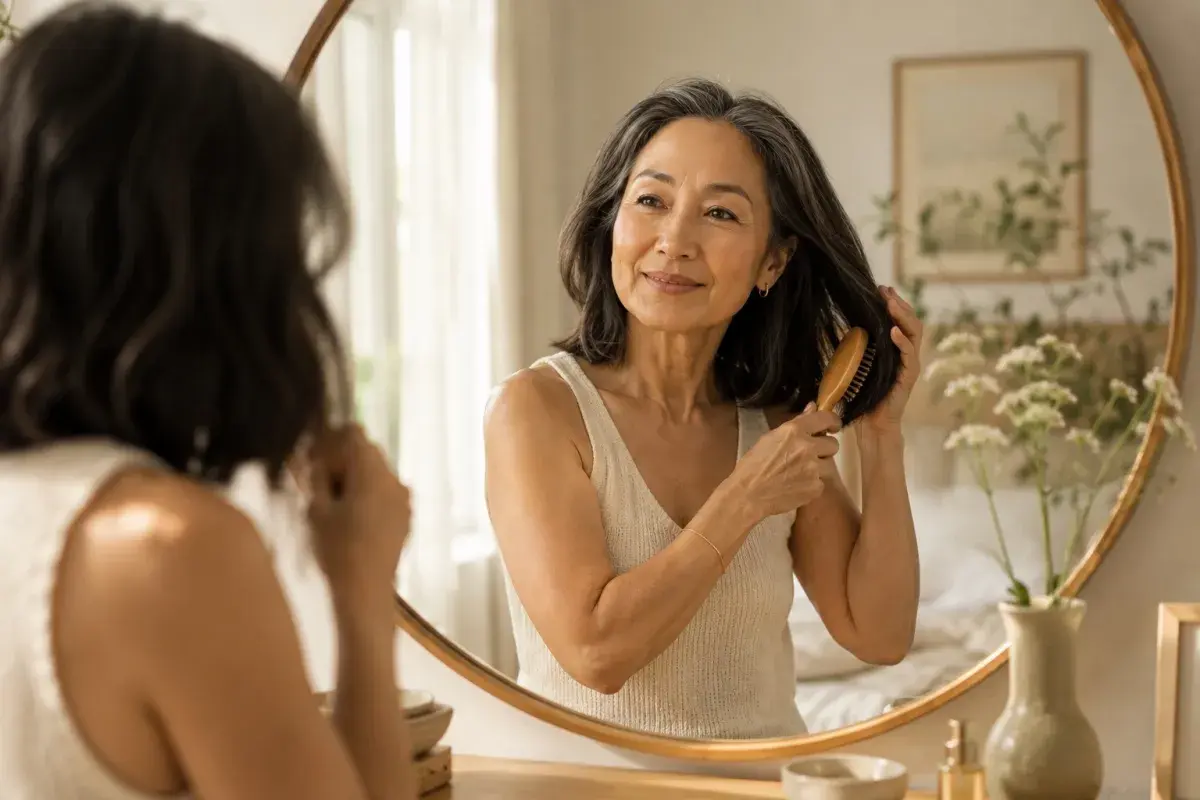
So maybe we can look at the mirror a little differently now, not with surrender, denial, nor with fear, but with understanding. We can see the lines without immediately declaring them defects, notice the changes without assuming they diminish us, and care for the skin without demanding that it return to an earlier version of itself. This is the skin I have today; it has a history, it has worked hard, it has protected me, and now I have the opportunity to protect it.
The Person Becomes the Protector
For years, the skin has been the boundary between us and the world. Now there is another boundary we can create: the space between ourselves and the claims that compete for our attention, our money, and our confidence. We do not have to accept every promise simply because it is beautifully presented, repeated often, or attached to the idea that younger is automatically better.
We can become more careful about what we allow onto our skin and into our thinking. We can ask questions, look for evidence, understand limitations, recognize unnecessary harshness, and choose nourishment and protection when those are what our skin actually needs. The person who once depended on the skin for protection can now become its protector not against aging, but against the unnecessary battles created around aging.
The Choice Is Still Ours
After four articles of evidence, we should not end by giving the reader another command. We have already done what we promised to do: we looked, we questioned, we examined, and we allowed the evidence to speak without forcing it to produce a predetermined answer. What remains is not another scientific conclusion but a personal decision about what we value and how we want to care for the skin that will continue to accompany us.
You may choose appearance, protection, preservation, nourishment, intervention, acceptance, or some combination that changes as your life changes. You may care about looking younger and still respect the fact that you are aging, or you may decide that visible age no longer needs to be something you actively change. There is room for all of these choices when they are made consciously, wisely, and freely.
And This Is What Caring Forward Means
We began this series by looking at aging skin as something to understand rather than something to fear. We learned to observe it, to recognize the history written into it, to understand the world it has lived in, and to examine the claims made about what might improve it. We have now reached the place where information becomes personal.
Perhaps caring forward is simply learning to treat our aging skin with the same thoughtfulness we would give to anything that has faithfully served us. We protect what can be protected, nourish what needs nourishment, preserve what matters, investigate what concerns us, and change what we genuinely choose to change. We do not have to fight the skin for growing older; we can care for it because it has grown older with us.
And so we return to where this series began, not with the promise of stopping time, but with a different understanding of what it means to live well within time. The skin we have today is not the skin we had in our youth; it has lived longer, experienced more, adapted, repaired, protected, and carried the evidence of a lifetime. The right question to ask this time is: “how well we can care for the skin that has carried us this far?
What the Evidence Reminds Us
Sreekantaswamy et al. (2021) placed aging skin within the broader context of healthy aging and emphasized that the visible signs of aging should not be treated as the entirety of what healthy aging means. They also noted that aging itself is inevitable and that clinicians should not assume what a person wants from their aging skin simply because of age, appearance, or functional status. Their perspective supports the final principle of this series: the goal is not to prescribe how a person should look as they age, but to recognize that the person's own goals and values have a legitimate place in decisions about aging skin.
Image

Suggested Citation
Lendez, M. L. (2026). PRO-AGING SKIN CARE: CHOOSING. Caring Forward. Chikicha.com (the author is the developer of the Ikigai-Bayanihan framework for Purposeful Aging).
About the Author
Dr. Mariza Lendez is a researcher, social entrepreneur, and creator of the Ikigai-Bayanihan (Purpose + Collective Ethos) Retirement Model, an innovative framework that integrates purpose, community engagement, and sustainability to support meaningful aging and later-life well-being.
Reference
Sreekantaswamy, S. A., Butler, D. C., & Shah, A. A. (2021). Reframing aging in dermatology: The role of the dermatologist in healthy aging. International Journal of Women's Dermatology, 7(5, Part A), 529–532. https://doi.org/10.1016/j.ijwd.2021.08.014