Who Shapes the Future of Healthy Ageing?
Earlier time conversations about ageing were relatively straightforward.
Health belonged to hospitals and public health systems. Beauty belonged to the worlds of aesthetics and personal care. Wellness was associated with lifestyle, exercise, and self-improvement. Gerontology studied the biological, psychological, and social aspects of growing older, while demographers measured life expectancy and population ageing.
Each field had its own language, its own evidence, and its own purpose.
Today, those boundaries are no longer as distinct.
A discussion about healthy ageing may involve physicians, nutritionists, psychologists, physiotherapists, wellness coaches, technology companies, architects, insurers, pharmaceutical researchers, cosmetic specialists, fitness professionals, policymakers, economists, and artificial intelligence developers. At the same time, older adults are encountering an unprecedented volume of information through digital platforms, social media, advertising, healthcare providers, and scientific discoveries.
In many ways, this convergence reflects a remarkable degree of progress. Advances in medicine have extended life expectancy. Public health has reduced preventable disease. Digital technology has expanded access to health information. Scientific discoveries continue to reshape our understanding of ageing, prevention, and human longevity.
Yet progress also introduces complexity; when multiple disciplines use similar words to describe different objectives, clear communication becomes increasingly vital for the public. Therefore, this is not merely a question of terminology.
Throughout this series, we have explored how the language surrounding health, wellness, beauty, healthy ageing, longevity, lifespan, and healthspan has evolved. We have seen that these concepts frequently intersect, but they are not interchangeable. Each emerged from a distinct scientific or professional tradition, and each contributes something valuable to the broader conversation about living longer and living well. The challenge before the public is therefore not to separate these concepts completely, nor to merge them indiscriminately, but to learn how to hold them together without losing their individual meaning.
The Convergence of Science, Society, and the Longevity Economy
Population ageing is reshaping societies across the world. Longer lives are changing healthcare systems, labour markets, housing, technology, financial planning, transportation, education, and community design. At the same time, scientific discoveries are transforming what is possible through preventive medicine, digital health, precision healthcare, regenerative science, and innovations that were unimaginable only a generation ago.
These developments have also created one of the fastest-growing sectors of the global economy: the longevity and wellness marketplace. This growth should not be viewed simply as commercialization, as innovation has the potential to improve lives. Better diagnostics, healthier nutrition, improved mobility, assistive technologies, age-friendly housing, and evidence-based preventive interventions all contribute to healthier ageing when supported by sound science.
Economic opportunity and public health are not opposing forces, as they can reinforce one another.
However, as more organizations participate in this expanding ecosystem, language becomes increasingly influential. The words used to describe products, services, interventions, and outcomes shape public expectations long before individuals experience their actual benefits. This is why conceptual clarity matters: language is often the first point of contact between science and society.
Who Shapes the Language?
No single institution owns the language of longevity.
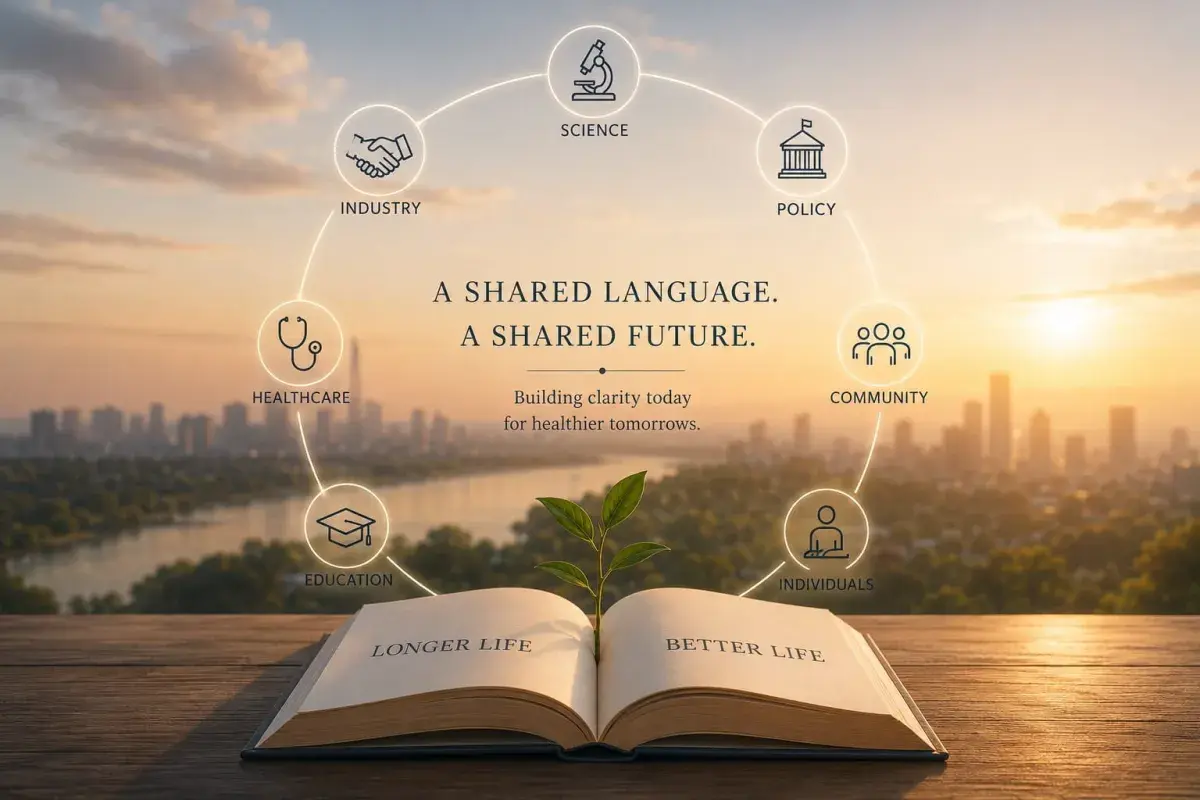
The World Health Organization defines healthy ageing and provides global public health guidance. Researchers generate new evidence. Universities educate future professionals. Scientific journals evaluate and disseminate knowledge. Governments develop policy and regulatory frameworks. Professional associations establish standards of practice. Healthcare professionals translate evidence into patient care. Industry transforms research into products and services. Journalists, educators, and communicators interpret complex information for the public.
Finally, individuals themselves bring lived experience, personal values, and cultural understanding to every decision they make. Each contributes to the conversation, and each also carries responsibility. Therefore, healthy public understanding is rarely created by one institution alone. It emerges through the collective interaction of evidence, communication, education, policy, professional practice, and public engagement.
This represents one of the defining challenges of the longevity era. Science is advancing faster than ever before, yet the language surrounding that science must strive to keep pace.
Image
Health Literacy in an Age of Abundance
Never before have people had access to so much health information. With a few taps on a smartphone, individuals can explore scientific discoveries, nutrition advice, exercise programmes, skin care routines, longevity podcasts, wearable technologies, genetic testing, and countless recommendations promising healthier, younger, or longer lives.
Access to information is a remarkable achievement, yet understanding that information is a different challenge.
Health literacy is not simply the ability to read health information. It is the ability to find, understand, evaluate, and apply reliable information when making decisions about health. As scientific knowledge grows more sophisticated, the need for clear communication becomes even greater, since confusion easily breeds misinformation.
Confusion often arises not from the concepts themselves, but from the language surrounding them. Across healthcare, wellness, beauty, public health, and gerontology, familiar words carry different meanings. Health describes a state of well-being; wellness is the ongoing pursuit of it; beauty relates to aesthetic perception; healthy ageing centers on functional ability; longevity measures the length of life; and healthspan emphasizes the years lived in good health. These are not competing ideas but complementary dimensions of the human experience. Understanding where they differ is the first step toward understanding how they work together.
Image
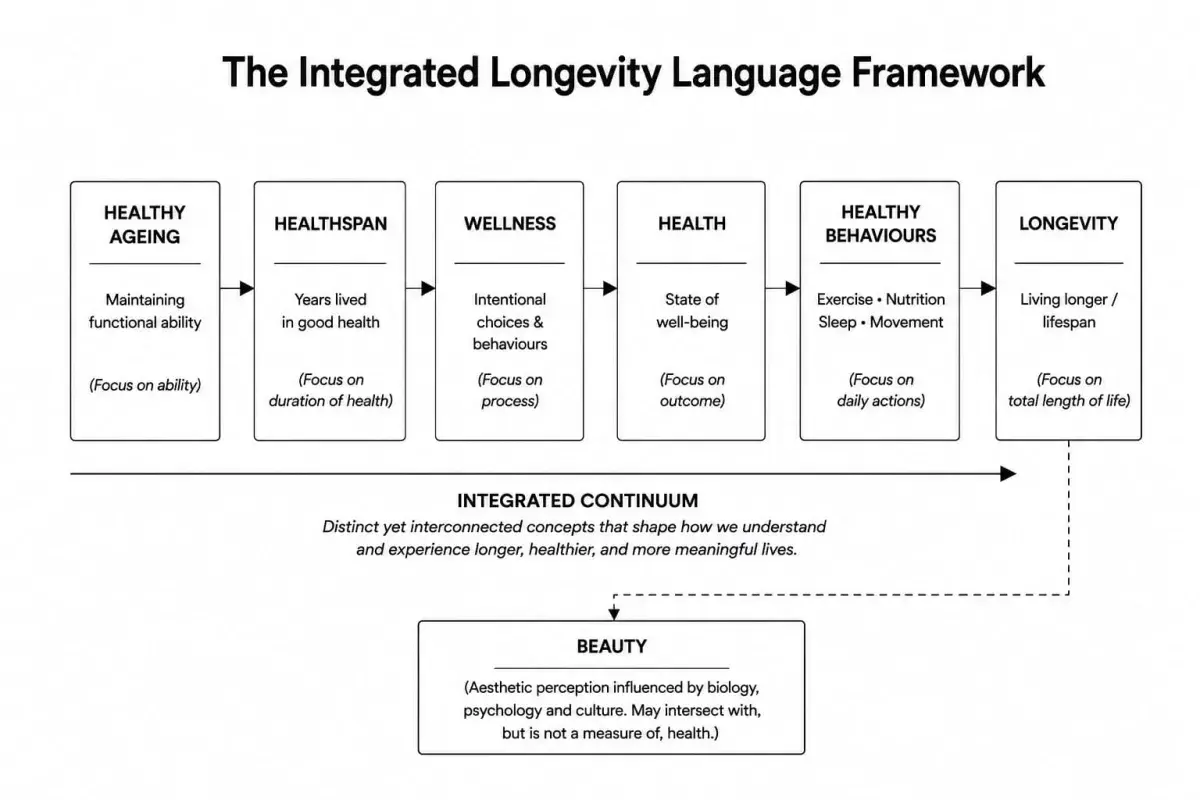
Figure 1. illustrates that the concepts surrounding longevity are neither interchangeable nor isolated. Each emerged from a different scientific or professional discipline, yet together they influence how individuals, healthcare systems, industries, and societies understand ageing. Recognizing both their distinctions and their relationships provides a common language for researchers, practitioners, policymakers, businesses, and the public as the longevity economy continues to evolve.
The Integrated Longevity Language Framework illustrates how these concepts relate without reducing one to another. At its foundation lies health, which provides the bedrock for human well-being. Complemented by wellness as the daily choices that influence that state. Moving into the dimension time, healthy ageing emphasizes maintaining functional ability throughout later life, while healthspan reflects the actual years lived in good health, and longevity represents the total duration of life itself. Beauty intersects with these concepts through biological, psychological, cultural, and aesthetic dimensions, but remains a distinct construct rather than a measure of health.
Ultimately, quality of life, well-being, and purpose emerge as broader outcomes that reflect how these concepts interact across the lifespan. Rather than competing with one another, these concepts become complementary when their individual meanings are preserved.
Beyond Years Added
Throughout modern history, success has often been measured by life expectancy.
Longer lives remain one of humanity's greatest public health achievements, yet longevity alone cannot answer every question. Consider two individuals who both live to ninety years of age: one may remain socially connected, physically active, intellectually engaged, emotionally resilient, and deeply purposeful; the other, however, may experience prolonged isolation, declining function, and diminished quality of life.
Their lifespans may be identical, yet their experience of those years may be profoundly different. This distinction reminds us that extending life and enriching life are related, but not identical, goals.
Increasingly, healthy societies will be evaluated not only by how long people live, but by how well people continue to live throughout those additional years.
Shared Responsibility
The future of healthy ageing cannot rest solely with governments, nor can it rest exclusively with healthcare professionals, researchers, businesses, or individuals. It requires partnership.
Researchers must continue producing trustworthy evidence. Healthcare professionals must communicate that evidence with clarity and compassion. The Industry must innovate responsibly while respecting scientific integrity. Governments and regulators must create environments that protect public welfare and encourage evidence-based practice, while educational institutions prepare future professionals to navigate an increasingly interdisciplinary landscape.
The public, in turn, deserves information that empowers rather than confuses.
When every stakeholder recognizes both opportunity and responsibility, the language of longevity becomes more than terminology; it becomes a shared commitment to informed decision-making.
The Next Measure of Progress
The twentieth century taught humanity how to extend life, while the twenty-first century is teaching us how to rethink it. The next measure of progress will not be determined solely by the number of years we add to life, but by the clarity with which we understand those years, the wisdom with which we support them, and the purpose with which we choose to live them.
The language of longevity is still being written. As researchers continue making discoveries, healthcare evolves, technology advances, industries innovate, and society age, the core question is no longer simply how long people can live.
With global life expectancy rising, the defining challenge of our time is how clearly we define what it means to live well - and how responsibly we communicate that understanding to future generations. In the end, the most enduring legacy of longevity will not be measured only in years added to life. It will be measured by the quality, dignity, connection, and purpose we help those years contain.
Yet, how can we build a legacy of purposeful aging if our foundational vocabulary remains blurred? Before we can architect a society that truly honors these added years, we must confront a vital question: do we actually mean the same thing when we say health, wellness, beauty, healthy ageing, healthspan, and longevity?
Image
Article I
👉 Read Article https://www.chikicha.com/language-longevity-article-1-are-health-wellness-and-beauty-really-same
Article II
👉 Read Article https://www.chikicha.com/language-longevity-article-2-health-vs-wellness-vs-beauty-explained
Suggested Citation
Lendez, M. L. (2026). The Language of Longevity - Article 3 of 3: Who Shapes the Future of Healthy Ageing?. Chikicha Longevity. (she is the developer of Ikigai-Bayanihan Framework for Purposeful Ageing).
About the Author
Dr. Mariza Lendez is a researcher, social entrepreneur, and creator of the Ikigai-Bayanihan (Purpose + Collective Ethos) Retirement Model, an innovative framework that integrates purpose, community engagement, and sustainability to support meaningful aging and later-life well-being.
References
Beard, J. R., Officer, A., de Carvalho, I. A., Sadana, R., Pot, A. M., Michel, J. P., Lloyd-Sherlock, P., Epping-Jordan, J. E., Peeters, G., Mahanani, W. R., Thiyagarajan, J. A., & Chatterji, S. (2016). The World report on ageing and health: A policy framework for healthy ageing. The Lancet, 387(10033), 2145–2154. https://doi.org/10.1016/S0140-6736(15)00516-4
Dahlberg, L., McKee, K. J., Fritzell, J., & Marmot, M. (2022). Healthy ageing and care of older people: The role of health promotion and prevention. Scandinavian Journal of Caring Sciences. https://doi.org/10.1111/scs.13196
Dimitrov, D., & Kroumpouzos, G. (2023). Beauty perception: A historical and contemporary review. Clinics in Dermatology, 41(1), 33–40. https://doi.org/10.1016/j.clindermatol.2023.02.006
Global Wellness Institute. (2025). The Global Wellness Economy Monitor 2025. https://globalwellnessinstitute.org/wp-content/uploads/2025/11/2025-GWI-WE-Monitor_DIGITAL-FINAL.pdf
Huber, M., Knottnerus, J. A., Green, L., van der Horst, H., Jadad, A. R., Kromhout, D., Leonard, B., Lorig, K., Loureiro, M. I., van der Meer, J. W. M., Schnabel, P., Smith, R., van Weel, C., & Smid, H. (2011). How should we define health? BMJ, 343, d4163. https://doi.org/10.1136/bmj.d4163
National Institute on Aging. (2025). What do we know about healthy aging? U.S. Department of Health and Human Services, National Institutes of Health. https://www.nia.nih.gov/health/healthy-aging/what-do-we-know-about-healthy-aging
Rowe, J. W., & Kahn, R. L. (1997). Successful aging. The Gerontologist, 37(4), 433–440. https://doi.org/10.1093/geront/37.4.433
World Health Organization. (1948). Constitution of the World Health Organization. https://www.who.int/about/governance/constitution
World Health Organization. (2015). World report on ageing and health. World Health Organization. https://www.who.int/publications/i/item/9789241565042
World Health Organization. (2021). UN Decade of Healthy Ageing (2021–2030). https://www.who.int/initiatives/decade-of-healthy-ageing
World Health Organization. (2024). Ageing and health. https://www.who.int/news-room/fact-sheets/detail/ageing-and-health