The Language of Longevity: Health vs. Wellness vs. Beauty Explained
Returning to the Original Definitions: What Health, Wellness, Beauty, Healthy Ageing, and Longevity Really Mean
"The beginning of wisdom is the definition of terms." - Attributed to Socrates
Language has always been one of humanity's most powerful tools. It shapes how we think, communicate, and ultimately make decisions. In medicine, public health, science, and policy, precise language is not merely a matter of semantics as it is the foundation upon which evidence, practice, and public understanding are built. Yet language also evolves. As societies change, words acquire new meanings, new associations, and sometimes entirely new identities. Few areas illustrate this evolution more clearly than the rapidly expanding conversation surrounding ageing.
Today, words such as health, wellness, beauty, healthy ageing, longevity, healthspan, anti-ageing, preventive health, and life optimization frequently appear together in public discourse. They share advertising campaigns, healthcare websites, product labels, wellness programmes, and social media platforms. While this convergence reflects the growing complexity of modern ageing, it also raises an important question. Do these words actually mean the same thing?
The answer, according to international health authorities and decades of scholarly research, is no.
Although these concepts often overlap, they were developed within different disciplines, serve different purposes, and answer different questions. Understanding these distinctions is not an academic exercise. It is an essential step toward improving health literacy and enabling informed decisions in an increasingly complex longevity landscape.
This article therefore returns to the original definitions, not to create rigid boundaries between concepts that naturally interact, but to restore clarity by examining how each has been understood within science, public health, medicine, psychology, and the social sciences.
Health: More Than the Absence of Disease
The most widely accepted definition of health has remained remarkably consistent for more than seven decades. In 1948, the World Health Organization defined health as:
“A state of complete physical, mental and social well-being and not merely the absence of disease or infirmity.” (WHO, 1948).
This definition transformed the understanding of health. Rather than viewing health solely as freedom from illness, the WHO recognised that physical condition, mental well-being, and social relationships are inseparable components of human health.
Importantly, health is described as a state - a multidimensional condition that reflects overall well-being at a given point in time. It is not a product that can be purchased, nor is it a single laboratory value or physical appearance. Instead, it represents the interaction of biological, psychological, social, and environmental factors that enable individuals to live productive and fulfilling lives. This definition continues to influence healthcare systems, public health policies, and medical education around the world.
Wellness: A Lifelong Process Rather Than a Destination
If health describes a state, wellness describes a journey. One of the most influential conceptualizations of wellness was introduced by Bill Hettler, founder of the National Wellness Institute, who described wellness as an active process through which individuals become aware of and make choices toward a more successful existence (Hettler, 1980).
Unlike health, wellness is dynamic. It requires intentional choices that influence physical, emotional, intellectual, occupational, social, spiritual, environmental, and, in many contemporary models, financial well-being. This distinction is significant.
An individual living with a chronic condition may still experience a high level of wellness by actively managing health, maintaining meaningful relationships, engaging in purposeful activities, and participating fully in community life. Conversely, a person free from diagnosed disease may experience poor wellness if chronic stress, social isolation, inactivity, or unhealthy behaviours diminish overall quality of life.
Wellness, therefore, is best understood as the ongoing process of living in ways that support health and human flourishing rather than a guarantee of perfect health.
Image
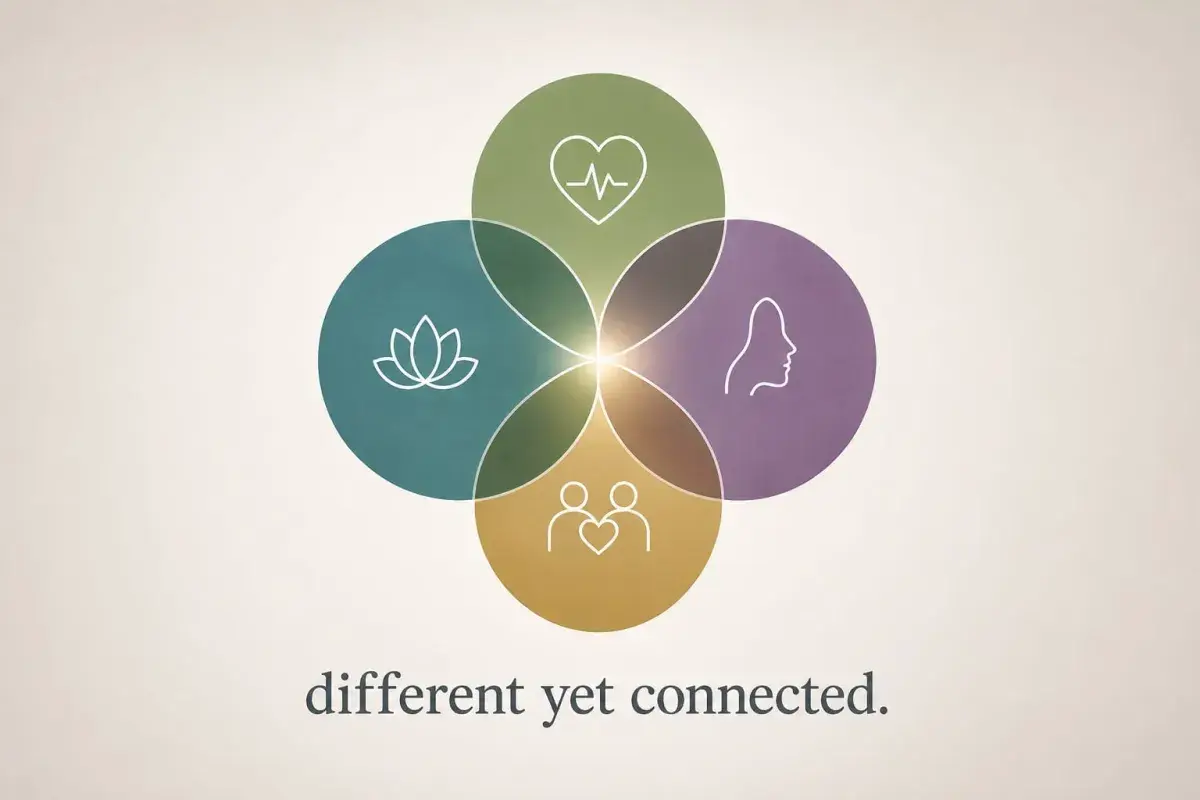
Beauty: An Aesthetic Concept, Not a Clinical Definition
Beauty occupies a different intellectual tradition. Rather than emerging from public health or medicine, beauty has been explored through philosophy, psychology, anthropology, art, and, more recently, dermatology and aesthetic medicine.
A comprehensive review by Dimitrov and Kroumpouzos (2023) demonstrates that perceptions of beauty are influenced by biological characteristics, psychological responses, cultural norms, historical context, and social expectations. Scientific evidence suggests that certain physical features including facial symmetry, skin quality, and apparent vitality, may influence perceptions of attractiveness. However, these characteristics are only part of a much broader and culturally shaped understanding of beauty.
Beauty is therefore not equivalent to health. Nor is it synonymous with wellness.
Although healthier lifestyles may contribute to healthier skin, improved posture, or greater vitality, appearance alone cannot reliably indicate an individual's physical, psychological, or social well-being. Recognising this distinction allows aesthetic medicine and public health to be appreciated for their respective contributions without conflating their objectives.
Healthy Ageing: Shifting the Focus from Survival to Function
As populations began living longer, researchers recognised that increasing life expectancy alone did not guarantee better lives. In response, the World Health Organization reframed the conversation. Healthy ageing is now defined as:
"The process of developing and maintaining the functional ability that enables well-being in older age." (WHO, 2015).
This definition represents one of the most significant conceptual shifts in gerontology. Rather than asking whether older adults are free from disease, it asks whether they retain the ability to do the things they value.
Functional ability includes the capacity to move, think, communicate, maintain relationships, participate in society, make decisions, and live with dignity and independence. Recent scholarship further reinforces this perspective. Dahlberg and colleagues (2022) argue that healthy ageing depends not only on healthcare but also on health promotion, prevention, supportive environments, and opportunities for continued participation throughout later life. Healthy ageing is therefore not simply a medical objective. It is a societal one.
Longevity, Lifespan, and Healthspan
While longevity, lifespan, and healthspan are frequently used interchangeably in public discourse, they describe fundamentally distinct dimensions of the aging experience. Longevity refers broadly to the overarching duration of life and the biological capacity to reach an advanced age, whereas lifespan describes the literal, total number of years an individual lives. Healthspan, by contrast, shifts the focus from quantity to quality, representing the specific years lived in good health and characterized by preserved physical, cognitive, emotional, and social functioning.
Because of these distinctions, modern gerontology increasingly argues that extending healthspan must become just as vital a priority as extending lifespan itself. This shift reflects a profound evolution in aging research: success is no longer measured solely by the number of birthdays an individual celebrates, but rather by their ability to continue living independently, meaningfully, and with purpose throughout those additional years.
Image
Where the Concepts Meet and Where They Do Not
These concepts are neither isolated nor identical - they overlap. Regular physical activity, for example, improves cardiovascular health, supports emotional well-being, preserves muscle strength, reduces frailty, and may also enhance physical appearance. Nutritious eating contributes to metabolic health, functional ability, cognitive performance, and healthier skin.
Likewise, aesthetic procedures may improve self-confidence, psychological well-being, or quality of life for some individuals without necessarily changing underlying physical health. Understanding these intersections does not erase the distinctions between them; instead, it helps clarify the primary purpose of each concept within a broader framework.
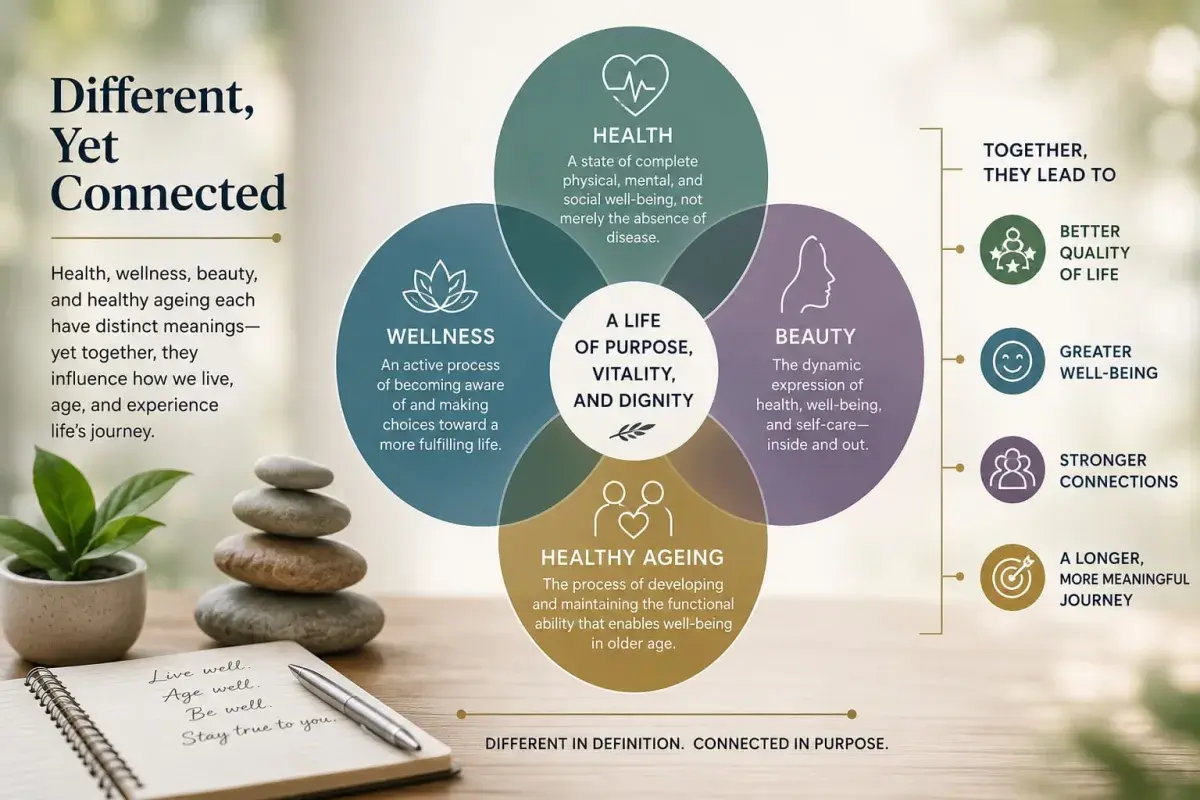
Under this lens, health serves as the foundational, multidimensional state of well-being, while wellness describes the ongoing process of making choices that support that state. Within this ecosystem, beauty introduces perceptions of attractiveness shaped by complex biological, psychological, and cultural influences. As time progresses, these elements manifests as healthy ageing, which focuses on maintaining essential functional ability throughout later life. This journey is structurally defined by two distinct temporal vectors: longevity, which represents the total duration of living longer, and healthspan, which demands living healthier for longer. Together, these interconnected concepts contribute to a far richer, more comprehensive understanding of the ageing experience than any single term could ever provide alone.
Although these concepts originate from different disciplines, they frequently intersect in practice. Their relationship is often misunderstood because they are increasingly presented together in healthcare, public discourse, and the longevity marketplace. Bringing these concepts together reveals both their points of convergence and the distinctions that give each its unique purpose.
Table 1. Understanding the Language of Longevity: Distinguishing Key Concepts
| Concept | Authoritative Definition | Primary Purpose | Focus | How It Is Commonly Measured | Principal Authority |
| Health | A state of complete physical, mental, and social well-being, not merely the absence of disease. | To achieve overall well-being. | Physical, mental, and social health. | Health status, morbidity, mortality, quality of life. | World Health Organization (1948) |
| Wellness | An active process of becoming aware of and making choices toward a more successful existence. | To continuously improve one's quality of life through intentional choices. | Lifestyle and health-promoting behaviours. | Physical activity, nutrition, stress management, life balance, self-care. | Hettler (1980); National Wellness Institute |
| Beauty | A multidimensional perception of attractiveness influenced by biological, psychological, cultural, and social factors. | To enhance or appreciate aesthetic appearance. | Appearance and aesthetic perception. | Subjective perception, cultural standards, dermatological and aesthetic outcomes. | Dimitrov & Kroumpouzos (2023) |
| Healthy Ageing | The process of developing and maintaining the functional ability that enables well-being in older age. | To preserve independence, function, and participation throughout later life. | Functional ability and well-being. | Mobility, cognition, social participation, intrinsic capacity, functional ability. | World Health Organization (2015) |
| Longevity | Living to an advanced age or extending the duration of life. | To increase years of life. | Length of life. | Life expectancy and survival. | Gerontology & Demography |
| Lifespan | The total number of years an individual lives. | Measure survival. | Duration of life. | Age at death. | Gerontology |
| Healthspan | The period of life spent in good health, free from significant disease or disability. | Maximize healthy years rather than simply longer years. | Quality of health across the lifespan. | Years lived without major disability or chronic disease. | Modern Gerontology; Nature Aging; The Lancet |
Note: The table illustrates that while these concepts frequently overlap, they were developed to answer different questions about the human experience of ageing. Appreciating both their distinctions and their intersections provides a more complete understanding of longevity than any single concept alone.
Although these concepts frequently overlap, they are not synonymous. Health describes a state; wellness is a process; beauty is an aesthetic perception; healthy ageing is the maintenance of functional ability; longevity concerns the duration of life; lifespan measures years lived; and healthspan measures how well those years are lived.
Why Definitions Matter
Definitions influence more than academic discussions. They influence policy, clinical practice, business strategy, product development, and health communication. And most importantly, the decisions people make about their own lives.
When words become interchangeable, expectations may also become blurred. Returning to authoritative definitions does not limit innovation. On the contrary, it provides a common language through which innovation can be understood, evaluated, and communicated responsibly.
As the longevity economy continues to evolve, clarity will become increasingly valuable, because understanding where they overlap, begins, with understanding where they originated. The language of longevity is still being written. Its future will depend not only on scientific discovery, but also on our willingness to preserve the clarity of the words that guide it.
In the final article of this series, we move beyond definitions to examine a broader question: Who shapes the language of ageing?
As innovation accelerates and new products, services, and models of care emerge, how do regulators, researchers, healthcare professionals, industry, and society collectively influence the way longevity is understood?
More importantly, how can conceptual clarity support better health literacy and more informed choices in an age of longer lives?
Image
Article I
👉 Read Article https://www.chikicha.com/language-longevity-article-1-are-health-wellness-and-beauty-really-same
Article III
👉 Read Article https://www.chikicha.com/language-longevity-article-3-3-who-shapes-future-healthy-ageing
Suggested Citation
Lendez, M. L. (2026). The Language of Longevity (Article II) Health vs. Wellness vs. Beauty Explained. Chikicha. (the developer of Ikigai-Bayanihan Framework).
About the Author
Dr. Mariza Lendez is a researcher, social entrepreneur, and creator of the Ikigai-Bayanihan (Purpose + Collective Ethos) Retirement Model, an innovative framework that integrates purpose, community engagement, and sustainability to support meaningful aging and later-life well-being
References
World Health Organization. (1948). Constitution of the World Health Organization. https://www.who.int/about/governance/constitution
World Health Organization. (2015). World report on ageing and health. World Health Organization. https://www.who.int/publications/i/item/9789241565042
World Health Organization. (2024). Ageing and health. https://www.who.int/news-room/fact-sheets/detail/ageing-and-health
World Health Organization. (2021). UN Decade of Healthy Ageing (2021–2030).https://www.who.int/initiatives/decade-of-healthy-ageing
Huber, M., Knottnerus, J. A., Green, L., van der Horst, H., Jadad, A. R., Kromhout, D., Leonard, B., Lorig, K., Loureiro, M. I., van der Meer, J. W. M., Schnabel, P., Smith, R., van Weel, C., & Smid, H. (2011). How should we define health? BMJ, 343, d4163. https://doi.org/10.1136/bmj.d4163
Roscoe, L. J. (2009). Wellness: A review of theory and measurement for counselors. Journal of Counseling & Development, 87(2), 216–226. https://doi.org/10.1002/j.1556-6678.2009.tb00570.x
Dahlberg, L., McKee, K. J., Fritzell, J., & Marmot, M. (2022). Healthy ageing and care of older people: The role of health promotion and prevention. Scandinavian Journal of Caring Sciences. Advance online publication. https://doi.org/10.1111/scs.13196
Beard, J. R., Officer, A., de Carvalho, I. A., Sadana, R., Pot, A. M., Michel, J. P., Lloyd-Sherlock, P., Epping-Jordan, J. E., Peeters, G., Mahanani, W. R., Thiyagarajan, J. A., & Chatterji, S. (2016). The World report on ageing and health: A policy framework for healthy ageing. The Lancet, 387(10033), 2145–2154. https://doi.org/10.1016/S0140-6736(15)00516-4
Dimitrov, D., & Kroumpouzos, G. (2023). Beauty perception: A historical and contemporary review. Clinics in Dermatology, 41(1), 33–40. https://doi.org/10.1016/j.clindermatol.2023.02.006