Living Longer Is a Human Achievement
The World Health Organization describes longer lives as one of humanity's most remarkable collective achievements. Global life expectancy at birth reached 73.3 years in 2024, an increase of 8.4 years since 1995. WHO attributes this progress to advances in social and economic development and health that have reduced mortality, particularly among older people.
The demographic consequence is equally significant. In 2020, people aged 60 years and older outnumbered children younger than five. By 2030, approximately one in six people worldwide is projected to be aged 60 or older, and the global population aged 60 and above is expected to reach 2.1 billion by 2050. The population aged 80 and older is projected to reach approximately 426 million by that time.
The change is not confined to high-income countries as the geography of longevity is also changing. WHO projects that by 2050, approximately 80% of the world's older people will live in low- and middle-income countries. Asia and the Pacific already accounts for roughly 60% of the world's older population, according to recent UN ESCAP estimates, and the region is expected to remain at the centre of the global ageing transition.
The Philippines is already experiencing this demographic transition. The Philippine Statistics Authority's 2024 Census recorded 11.42 million Filipinos aged 60 years and older, representing 10.2% of the household population, compared with 9.22 million, or 8.5%, in 2020. The PSA also reported that the country's ageing index increased from 17.5 in 2020 to 24.7 in 2024.
These figures establish an important starting point for any discussion about ageing: more people are reaching older age, and more people are living longer. But the achievement of longevity raises questions that demographic statistics cannot answer. Are we truly prepared to live in an era of longevity? What happens during those additional years? And, most importantly, how do we envision living them?
Will those years be marked by the freedom to move, participate, make choices and remain as independent as our health and circumstances allow or will declining capacity progressively narrow those freedoms and increase dependence? Longevity gives us more years. How we prepare for those years may influence how we experience them.
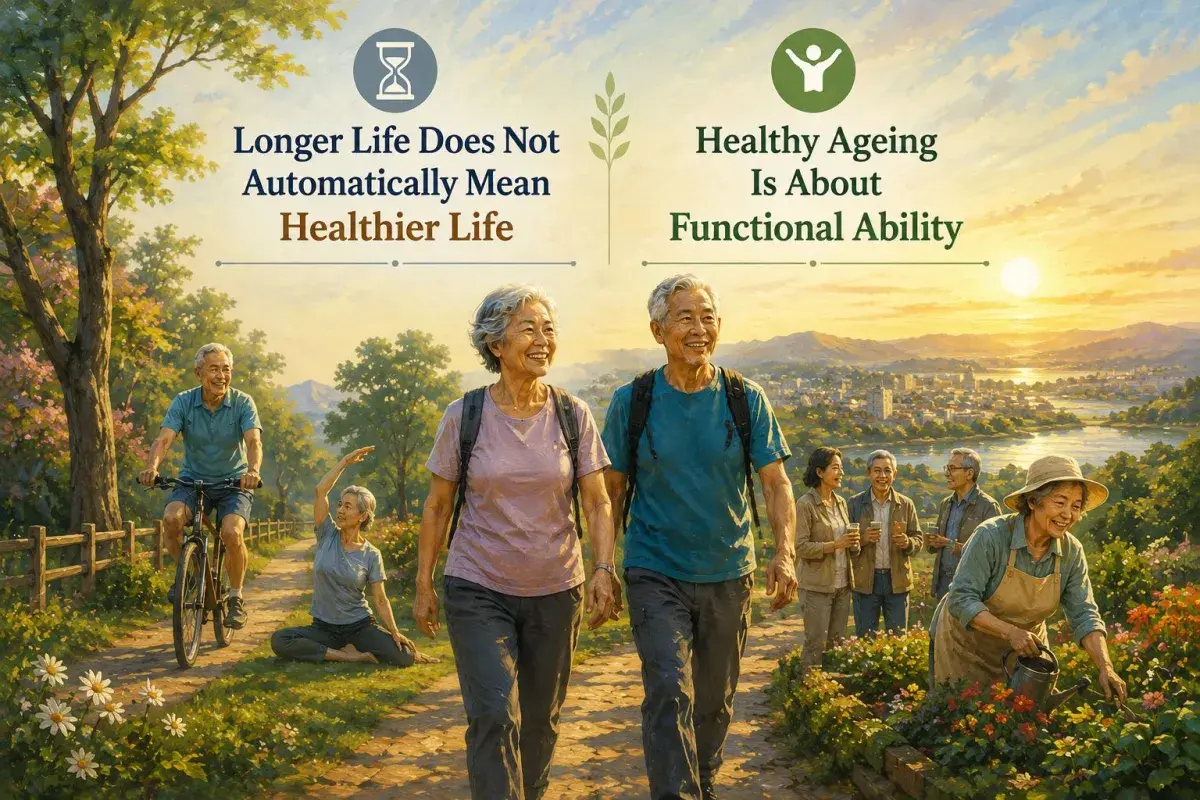
Longer Life Does Not Automatically Mean Healthier Life
Longer life and healthy life are related, but they are not synonymous. WHO reports that although people are living longer than ever before, there is little evidence that older people globally are in better health than previous generations. WHO also emphasizes that good health in older age is not equally distributed between or within generations. This creates a distinction between the achievement of longevity and the challenge of healthy ageing.
Longevity concerns the length of life. Healthy ageing concerns what happens to a person's health and functional ability during that life. WHO's current ageing framework therefore does not treat longer life as the endpoint. It emphasizes the need to close the gap between longer lives and healthier lives. This distinction becomes increasingly important as people move into later life, because ageing is accompanied by biological changes that can affect physical and mental capacity.
Ageing Is a Biological Process and It Is Not the Same for Everyone
WHO describes biological ageing as the result of the accumulation of a wide variety of molecular and cellular damage over time. These processes lead to a gradual decrease in physical and mental capacity, increasing the risk of disease and ultimately death. Importantly, WHO notes that these changes are neither linear nor consistent and are only loosely associated with chronological age.
This helps explain why chronological age does not fully describe an individual's physical condition.
There is considerable diversity among older adults. WHO noted that some people in their eighties can have levels of physical and mental capacity comparable with much younger adults, while others of the same age may require extensive assistance with basic activities such as dressing and eating. Ageing, therefore, does not produce one uniform outcome. The body changes over time, but the pattern and rate of change differ between individuals. That distinction is important because it moves the discussion away from the assumption that a particular chronological age automatically determines what a person can or cannot do.
Image
The Ageing Body Changes
Among the changes associated with ageing are changes in skeletal muscle.
A 2023 comprehensive review by Naruse, Trappe, and Trappe examined 47 cross-sectional studies involving 982 younger adults, with an average age of approximately 25 years, and 1,003 older adults, with an average age of approximately 75 years. Across nine muscle groups, the review found age-related reductions in muscle-specific size, although the degree of change varied considerably between muscles. For example, the review estimated approximately 27% lower quadriceps muscle size, 24% lower paraspinal muscle size, and 14% lower triceps surae muscle size in the older compared with younger groups represented in the studies.
The authors emphasized that age-related muscle atrophy is muscle-group specific, and that available research does not yet provide a complete picture of every muscle in the body. This is important because the ageing body cannot be adequately understood through a single measurement of muscle mass.
A separate 2023 systematic review examined the relationship between muscle mass, muscle strength and physical performance in older adults. Across 17 observational studies, the authors found that physical performance was significantly related to muscle strength, while the relationship between muscle mass and physical performance was weak or negligible.
The distinction is therefore significant. Muscle size tells us something about the body, but it does not tell the whole story. Muscle strength represents another dimension, while physical performance reflects how that capacity is expressed in movement and activity. These dimensions are related, but they are not interchangeable. This is why an ageing conversation focused primarily on appearance can overlook an important dimension of physical health: not simply how the body looks, but what the body is capable of doing.
Bone Health Adds Another Dimension
The musculoskeletal changes of ageing also involve the skeleton. WHO identifies older age as a non-modifiable risk factor for fragility fractures. Osteoporosis is characterized by low bone density and deterioration of bone tissue, which increase bone fragility and susceptibility to fracture. WHO also identifies falls and physical inactivity as modifiable risk factors associated with fragility fractures.
WHO reported that 178 million new fractures occurred globally in 2019, and that fractures accounted for 25.8 million years lived with disability that year. The organization noted that fractures are more common among older people and that most fractures in older people were associated with bone fragility and may result from forces equivalent to a fall from standing height or less.
The significance is not that ageing automatically results in fracture. Rather, ageing changes the physical context in which movement occurs. Changes in muscle capacity, bone vulnerability and physical performance can occur alongside one another, creating a different set of physical considerations as people grow older. Understanding how these factors interact becomes increasingly important when considering how the body can be prepared for the demands and vulnerabilities of later life.
Healthy Ageing Is About Functional Ability
The discussion of longevity eventually leads to a more important question: what does it mean to age well? A longer life, by itself, does not tell us whether a person will be able to continue living in ways that matter to them. Nor does the absence of a diagnosed disease fully describe how a person functions in everyday life.
This is reflected in the World Health Organization's definition of healthy ageing. WHO defines it as “the process of developing and maintaining the functional ability that enables well-being in older age.” The concept of functional ability broadens the discussion beyond disease and physical appearance. It refers to the capabilities that enable people to be and do what they have reason to value. WHO describes these capabilities as including the ability to meet basic needs, learn, grow and make decisions, remain mobile, build and maintain relationships, and contribute to society.
Seen this way, healthy ageing is not adequately described by chronological age or by how healthy a person may appear. The more meaningful question becomes what the person remains able to do and to be within the circumstances of their life. That includes physical capacity and mobility, but it extends beyond the body. The ability to make decisions, maintain relationships and contribute to society are also part of the functional ability that supports well-being in older age.
This distinction is important because it changes how preparation for longevity can be understood. The objective is not simply to preserve the appearance or characteristics of a younger body. It is to understand and, where possible, maintain the capacities that allow a person to continue functioning and participating in life as ageing progresses.
Healthy Ageing Happens Within an Environment
WHO's framework makes another important distinction between intrinsic capacity and functional ability. Intrinsic capacity refers to the physical and mental capacities an individual can draw upon, while functional ability reflects how those capacities interact with the environment in which the person lives. That environment extends beyond the home. It includes the built environment, community, relationships, social attitudes, policies, health and social-care systems, and other services and supports.
Consequently, two people with comparable physical capacities may experience very different levels of functional ability when their environments differ. A person's capacity matters, but so does whether the surrounding environment enables that capacity to be used. This principle is reflected in the UN Decade of Healthy Ageing 2021-2030, which identifies four areas for action: changing how societies think, feel and act toward age and ageing; creating age-friendly environments; delivering integrated and person-centred care; and ensuring access to long-term care for people who need it.
Healthy ageing, therefore, is shaped by more than individual behaviour. It emerges from the interaction of capacity, environment and the systems that support people as they age.
Where Does Exercise Enter the Picture?
Exercise is one component of this broader framework. The evidence does not support reducing exercise in older age to a single objective. A 2022 systematic review and meta-analysis of 29 randomized clinical trials involving community-dwelling older adults examined exercise effects on muscle mass, fat mass, bone mass, muscular strength and physical performance. The review found that resistance exercise performed two to three times per week increased total muscle mass by approximately 1.0 kg and appendicular muscle mass by approximately 0.4 kg in the interventions analyzed.
A 2021 systematic review and meta-analysis of 14 randomized controlled trials involving 561 older adults with sarcopenia found that resistance training improved handgrip strength, knee-extension strength, gait speed and Timed Up and Go performance, although the studies did not find significant effects on several measures of muscle mass.
These findings matter because they demonstrate that exercise research in older adults measures outcomes beyond appearance. The research examines whether exercise affects strength and physical performance. At the same time, this does not make aesthetic goals illegitimate, people may exercise because they want to change their appearance, maintain confidence, enjoy movement, participate in sport or improve physical performance. The evidence simply establishes that appearance and physical function are different outcomes. They can coexist.
Image
Preparing for the Years Ahead
The scientific evidence therefore points toward a broader understanding of physical preparation in later life. The objective is not to assume that ageing can be stopped, nor does the evidence support the idea that every age-related change can be prevented.
Instead, the evidence shows that ageing is accompanied by changes in physical and mental capacity, that these changes vary between individuals, and that some aspects of physical capacity can respond to health behaviours and interventions. WHO's healthy-ageing framework places the emphasis on developing and maintaining functional ability. The 2021 Baseline Report for the UN Decade of Healthy Ageing specifically identifies the optimization of functional ability as the goal of the Decade.
This provides a useful basis for thinking about longevity. The years themselves are an achievement; how well we can use those years depends, in part, on the capacities we bring into them. Some capacities can be developed or maintained, while others may decline, and these trajectories differ from person to person. The evidence therefore supports preparation not as a promise against vulnerability, but as an informed approach to healthy ageing.
From Longevity to Stewardship
The demographic evidence shows that human beings are living longer, while the biological evidence shows that ageing brings changes in physical and mental capacity. Research on the musculoskeletal system further shows that muscle size, strength and physical performance are related but distinct dimensions, while evidence on bone health highlights the increasing relevance of skeletal vulnerability with age. Within this broader picture, WHO places functional ability at the centre of healthy ageing the capacity to meet basic needs, make decisions, remain mobile, maintain relationships and contribute to society.
Altogether, these findings offer a broader way of thinking about longevity with the question on how we can understand the changes that accompany ageing and support the capacities that allow us to function, participate and live meaningfully during the years we have gained?
For this series, Pro-Aging is used as a campaign framework for that approach. It is not presented as a medical diagnosis or established clinical classification, but as an orientation toward ageing that emphasizes being prepared, informed, physically capable, adaptable and functionally engaged. There is no evidence-based reason to suggest that caring about appearance and caring about physical capability must be competing goals. A person may want to look good, feel good and remain physically capable at the same time. The broader message is simply to expand the goal of caring for the ageing body from how it looks to what it enables us to continue doing. Longevity gives us the years. Stewardship asks how we prepare to live them.
The Evidence at a Glance
| Ageing reality | What the evidence tells us | Why it matters | Key source |
| People are living longer | Global life expectancy reached 73.3 years in 2024, an increase of 8.4 years since 1995. | Longevity is a major demographic achievement. | WHO (2025) |
| The older population is expanding | The global population aged 60+ is projected to reach 2.1 billion by 2050; those aged 80+ are projected to reach 426 million. | More people will experience later life. | WHO (2025) |
| The Philippines is ageing | 11.42 million Filipinos aged 60+ represented 10.2%of the household population in 2024, up from 9.22 million or 8.5% in 2020. | Healthy ageing is already a national demographic reality. | Philippine Statistics Authority (2026) |
| Longer life does not automatically mean healthier life | WHO reports little evidence that older people globally are in better health than previous generations. | Longevity needs to be considered alongside health and function. | WHO (2025) |
| Muscle changes with age | A 2023 review found age-related reductions in muscle-specific size across nine muscle groups, with substantial differences between muscles. | Ageing affects the musculoskeletal system, but not uniformly. | Naruse et al. (2023) |
| Strength and muscle size are not the same | A 2023 systematic review found physical performance was significantly related to muscle strength, while the relationship with muscle mass was weak or negligible. | Physical capacity cannot be assessed through appearance or muscle size alone. | Riviati & Indra (2023) |
| Bone vulnerability matters | WHO identifies older age as a non-modifiable risk factor for fragility fractures and falls and physical inactivity as modifiable risk factors. | Musculoskeletal preparation needs to consider both muscle and skeletal vulnerability. | WHO (2024) |
| Resistance training can improve physical outcomes | A 2021 meta-analysis found improvements in handgrip strength, knee-extension strength, gait speed and Timed Up and Go among older adults with sarcopenia. | Exercise can influence functional measures as well as body composition. | Chen et al. (2021) |
| Healthy ageing is about functional ability | WHO defines healthy ageing as developing and maintaining functional ability that enables well-being in older age. | The focus extends from appearance and disease alone to what people can continue to be and do. |
What This Means for the Years Ahead
The evidence does not present ageing as a condition to be defeated. It describes a natural biological process marked by considerable individual variation, changing physical and mental capacities, and an ongoing interaction between people and the environments in which they live. At the same time, increasing longevity is reshaping societies by giving more people the opportunity to experience later life.
The question, then, is not simply how many years we may have, but how we will be able to live within them. Preparation cannot guarantee permanent health or independence, but it can begin with understanding the ageing body, recognizing changes in capacity, making informed decisions and supporting functional ability for as long as possible. To prepare for longevity is not to resist ageing; it is to meet it with knowledge, capacity and intention.
What happens when the functional ability we have worked to preserve is suddenly challenged by a misplaced step, a moment of lost balance - a fall?
Article 2 — The Fall (A Fall Takes a Second. Its Consequences Can Last a Lifetime.) will answer this question.
Image

Suggested Citation
Lendez, M.L.(2026). Preparing for the Years Ahead: Becoming a Good Steward of Longevity. Chikicha Longevity. (the author is the developer of the Ikigai-Bayanihan Framework for Purposeful Aging).
About the Author
Dr. Mariza Lendez is a researcher, social entrepreneur, and creator of the Ikigai-Bayanihan (Purpose + Collective Ethos) Retirement Model, an innovative framework that integrates purpose, community engagement, and sustainability to support meaningful aging and later-life well-being.
References
Chen, N., He, X., Feng, Y., Ainsworth, B. E., & Liu, Y. (2021). Effects of resistance training in healthy older people with sarcopenia: A systematic review and meta-analysis of randomized controlled trials. European Review of Aging and Physical Activity, 18, Article 23. https://doi.org/10.1186/s11556-021-00277-7
Naruse, M., Trappe, S., & Trappe, T. A. (2023). Human skeletal muscle-specific atrophy with aging: A comprehensive review. Journal of Applied Physiology, 134(4), 900–914. https://doi.org/10.1152/japplphysiol.00768.2022
Philippine Statistics Authority. (2026, July 17). Age and sex distribution in the Philippine population (2024 Census of Population). https://psa.gov.ph/statistics/population-and-housing
Riviati, N., & Indra, B. (2023). Relationship between muscle mass and muscle strength with physical performance in older adults: A systematic review. SAGE Open Medicine, 11, 1–10. https://doi.org/10.1177/20503121231214650
World Health Organization. (2021). Decade of healthy ageing: Baseline report.https://www.who.int/publications/i/item/9789240017900
World Health Organization. (2024, September 25). Fragility fractures. https://www.who.int/news-room/fact-sheets/detail/fragility-fractures
World Health Organization. (2025, February 21). Ageing: Global population. https://www.who.int/news-room/questions-and-answers/item/population-ageing
World Health Organization. (2025, October 1). Ageing and health. https://www.who.int/news-room/fact-sheets/detail/ageing-and-health