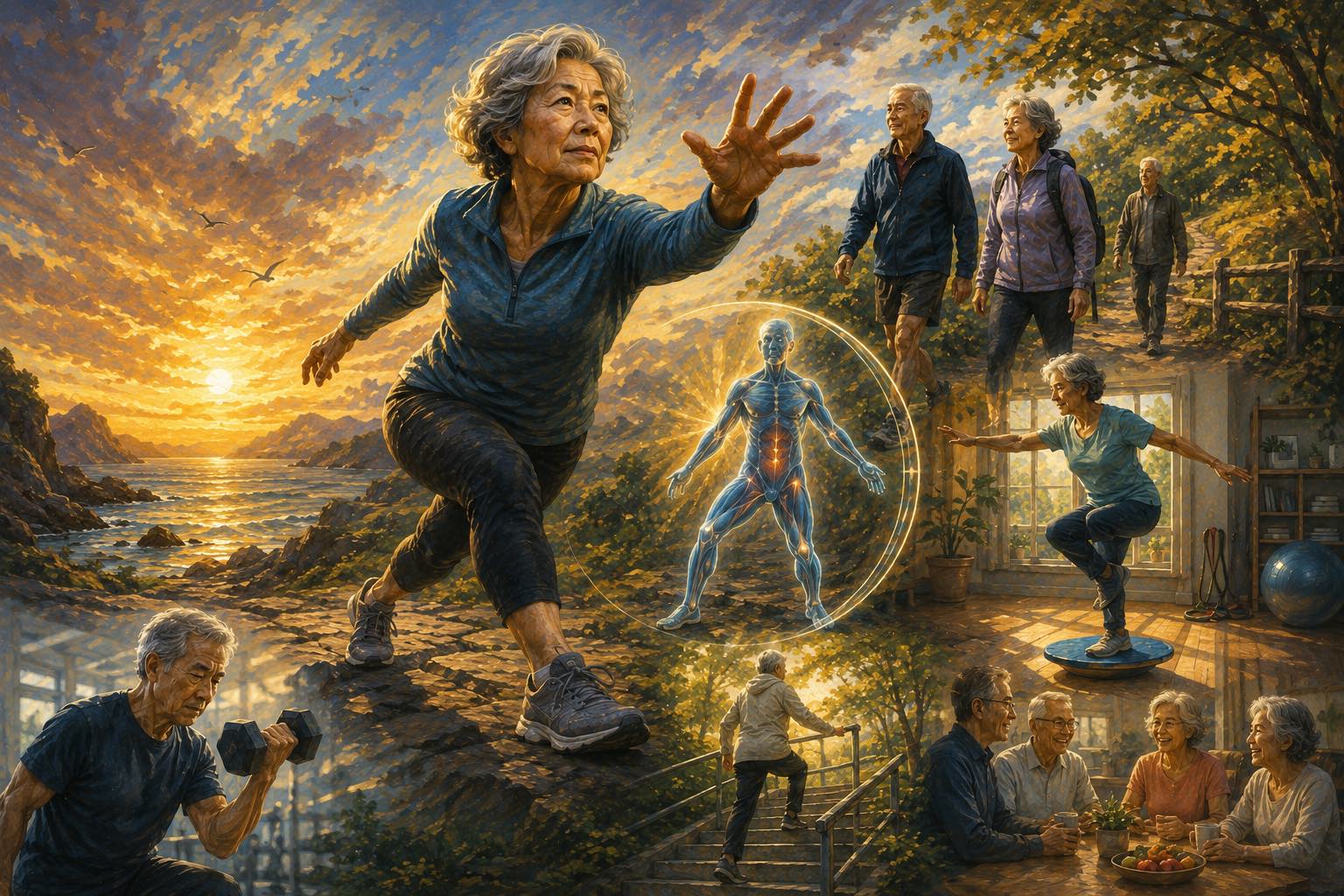
From the Fall to the Body
Article 2 ended with a question: if mobility is part of freedom, what physical capacities must we deliberately build and continue building as we grow older?
That question moves the discussion from the event of a fall to the physical capacity of the person who must respond when movement does not go according to plan. It also brings us beyond appearance and toward physical performance: what can the body actually do?
So what does the evidence tell us about physical capacity in later life?
One useful starting point is the relationship between muscle mass, muscle strength and physical performance. In a systematic review of 17 observational studies involving older adults, Riviati and Indra (2023) found that physical performance was significantly related to muscle strength, while the relationship between muscle mass and physical performance was weak or negligible. The authors also noted that the direction of these relationships could not be determined from the available evidence.
This distinction matters because having muscle and being able to use that muscle effectively are not necessarily the same thing. The evidence therefore moves the discussion beyond muscle size toward the capacity of the body to perform. From this point, the article follows the evidence from strength and power to the whole body, examining lower-body capacity, hip and gluteal function, calf and ankle function, breathing and trunk function, and grip and upper-body capacity.
The purpose is not to prescribe a particular exercise routine or identify a single muscle as the answer to ageing. It is to examine what the evidence tells us about the physical capacities associated with movement, balance and physical performance and why those capacities deserve attention as the body changes with age.
| Physical capacity | What the evidence establishes |
| Strength & Power | Strength and power are distinct dimensions of physical capacity. Power involves the ability to produce force rapidly and is relevant to physical performance in later life. |
| Lower-Body Power | Lower-extremity strength and power are associated with mobility, balance and physical performance. |
| Hip & Gluteal Capacity | Hip-muscle strength contributes to movement, balance and mobility. |
| Calf & Ankle Function | Calf and plantar-flexor function contribute to movement and balance, while the calf musculature also participates in the skeletal-muscle pump involved in venous return. |
| Breathing & Core | Respiratory-muscle capacity can be improved through training, while trunk musculature contributes to postural control and movement. |
| Grip & Upper-Body Capacity | Grip strength provides a practical measure of muscular function and is associated with measures such as mobility, balance and activities of daily living. |
| The Whole Body | Physical performance depends on the interaction of multiple systems rather than the strength or appearance of one isolated muscle. |
Strength Is Not the Same as Power
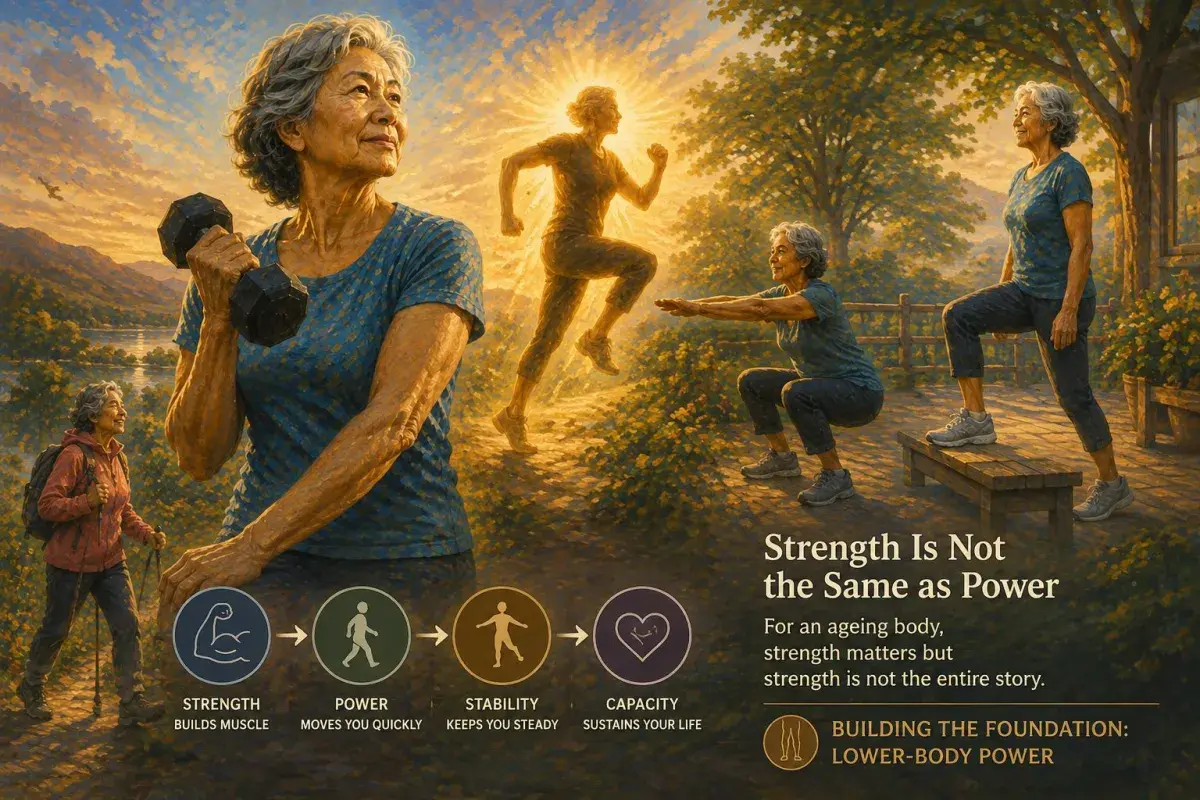
Strength and power are closely related, but they describe different dimensions of muscular performance. In their systematic review, el Hadouchi et al. (2022) described muscle strength as the ability to produce large muscular force and muscle power as the ability to produce large muscular force at high contraction velocity. This distinction becomes important when physical performance depends not only on producing force, but on producing it at speed.
Research in older adults has therefore examined power training separately from conventional strength training. In a systematic review and meta-analysis of 15 trials involving 583 participants, el Hadouchi et al. (2022) found statistically significant benefits of power training compared with strength training for muscle power, general activity-based tests and activity-based tests emphasizing movement speed. The authors concluded that power training offered greater potential for improving muscle power and performance on activity-based tests, while also identifying the need for further research on appropriate training parameters and standardized outcome measures.
A separate systematic review and meta-analysis by Balachandran et al. (2022) examined 20 randomized clinical trials involving 566 community-living older adults. The review found that power training was associated with a modest improvement in physical function compared with traditional strength training. However, the certainty of evidence for physical function was rated low, with the authors identifying risk of bias and imprecision and calling for larger, higher-quality trials before more definitive conclusions could be drawn.
Altogether, these findings do not establish that power training is universally superior to conventional strength training. Rather, they show why power deserves to be considered as a distinct component of physical capacity. The evidence indicates benefits in muscle power and certain activity-based measures, while the evidence concerning broader physical function remains more qualified. That distinction is important when considering how physical capacity may be maintained in later life.
For an ageing body, therefore, strength matters but strength is not the entire story.
Image

Building the Foundation: Lower-Body Power
Much of everyday movement depends on the coordinated action of the lower body. Standing, walking, changing position and moving through the environment require multiple muscles and joints to work together to generate, control and apply force. Lower-body capacity therefore extends beyond muscle mass to the ability to use that force effectively during movement and physical performance.
The power-training evidence gives this distinction practical significance. The findings of el Hadouchi et al. (2022) and Balachandran et al. (2022) suggest that power is a meaningful dimension of physical performance in older adults, while also showing that the evidence is not sufficient to declare power training universally superior to conventional strength training. The point is not that larger muscles automatically produce better function, but that physical capacity depends on how effectively the body can generate and use force when movement demands it.
This helps explain the idea of powerful legs differently from the way muscular appearance is often presented. Powerful legs are not necessarily large legs; they are legs capable of producing and controlling the force required to stand, walk, change direction, respond to movement demands and remain physically engaged with the environment. The value lies not in how the legs look, but in what they allow the person to do.
The Hip and Gluteal Region: Capacity for Movement
The hip musculature forms an important part of the lower-body system involved in balance and movement. Rather than considering the hips only in terms of muscle size or appearance, research has examined how hip-muscle strength, neuromuscular activation and muscle structure relate to the way people maintain balance and perform mobility tasks.
In a systematic review of 59 studies involving 2,144 participants across younger, middle-aged and older adults, Lanza et al. (2022) examined the associations between hip-abductor strength, neuromuscular activation, muscle structure, and measures of balance and mobility. The authors reported that hip-abductor strength was important for balance and mobility function, while neuromuscular activation also contributed to these functions and could vary according to the task. They further identified intramuscular fat as one structural characteristic associated with balance.
The findings do not mean that one muscle group can guarantee protection from falling, nor do they establish that strengthening the hips by itself will prevent falls. The review was designed to examine associations, and the authors noted that further research was needed to confirm the effects of these variables across age groups and to establish the effects of interventions.
What the evidence does establish is that the hip-abductor musculature has a meaningful relationship with the physical demands of balance and mobility. The review included tasks such as standing balance, stepping, walking, obstacle negotiation and stair-related movement, illustrating the range of activities in which hip-muscle function is involved.
This gives the gluteal region a different significance from its familiar presentation as an aesthetic target. Its relevance extends to what the musculature contributes to balance and movement. The evidence does not make the gluteal muscles a single solution to ageing or falling; it places hip-muscle capacity within the broader physical system through which movement is performed.
The Calf and Ankle: Movement and the Muscle Pump
The lower leg adds another dimension to physical capacity. The ankle plantar-flexor muscles contribute to movement, and their strength has been examined in relation to balance and walking performance in healthy adults. In a systematic review and meta-analysis of 34 studies, with older adults representing the main population of interest, Tavakkoli Oskouei et al. (2021) found that plantar-flexor strength in older adults had a weak positive association with static balance, moderate positive associations with dynamic reactive and proactive balance, and weak positive associations with preferred and maximum walking speed. The authors concluded that plantar-flexor strength may be important particularly for challenging dynamic balance tasks.
The calf also has a different physiological role through the calf-muscle pump. Houghton et al. (2021), in a population-based cohort study of 1,532 adults, described the calf-muscle pump as a major determinant of venous return from the legs. Their study found that reduced calf-muscle pump function was associated with venous thromboembolism risk, although the study was observational and therefore does not establish that reduced calf-muscle pump function causes venous thromboembolism.
These findings give the calf two distinct places in our discussion. Its plantar-flexor strength is associated with aspects of balance and walking, while its muscle-pump function contributes to venous return from the lower limbs (Houghton et al., 2021; Tavakkoli Oskouei et al., 2021).
This is also why the popular description of the calf as the body's “second heart” needs careful handling. The phrase is a metaphor, not a scientific classification. The evidence supports the more precise concept of the calf-muscle pump and its role in venous return, rather than suggesting that the calf performs the same function as the heart.
The evidence therefore gives us a more useful reason to pay attention to the lower leg: the calf is involved in both movement and circulation, but these are distinct physiological functions and should not be reduced to a single health claim.
Image
The Breath and the Core
Breathing introduces another dimension of physical capacity. As the body ages, respiratory-muscle strength can decline, and this can increase the work of breathing and contribute to breathlessness during activities of daily living. Manifield et al. (2021) examined whether inspiratory muscle training could improve respiratory-muscle strength and functional capacity in healthy adults over 60.
Their systematic review and meta-analysis included eight studies, with seven contributing data to the analysis of inspiratory-muscle strength and three providing data on functional capacity. The researchers found a significant improvement in maximal inspiratory pressure, the measure used to reflect inspiratory-muscle strength, following inspiratory muscle training. However, the improvement observed in functional capacity did not reach statistical significance (Manifield et al., 2021).
The distinction is important. The evidence supports the conclusion that inspiratory-muscle strength can be improved through specific training, but it does not establish that improving inspiratory-muscle strength automatically produces broader improvements in functional capacity. The authors noted that the evidence for functional capacity was limited by the small number of studies and substantial heterogeneity and called for further research in healthy older adults (Manifield et al., 2021).
That makes the respiratory system relevant to our discussion without turning it into a claim that the evidence has not established. The body can be trained in specific capacities, but an improvement in one measured capacity should not automatically be interpreted as an improvement in every aspect of physical function.
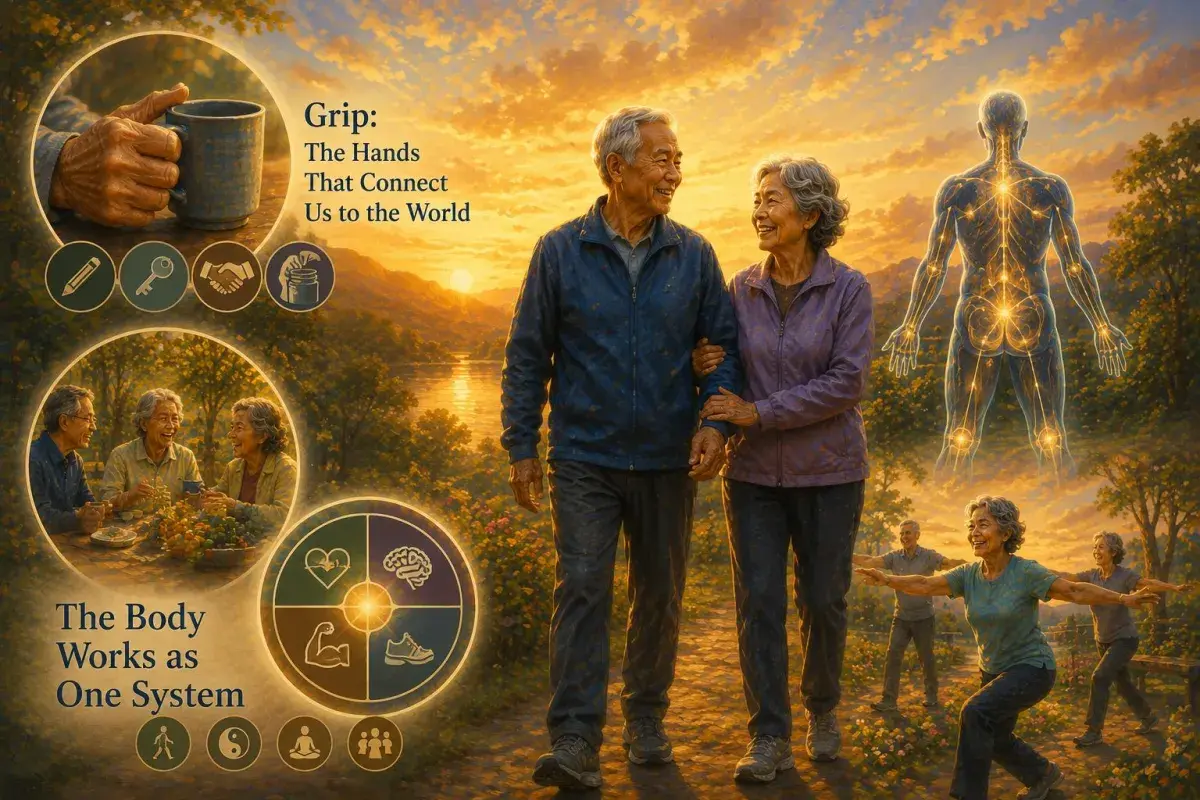
Grip: The Hands That Connect Us to the World
Physical capability is not confined to the legs. The hands are involved in many of the activities through which people interact with their physical surroundings, and handgrip strength provides one practical measure of upper-limb strength.
Bohannon (2019) reviewed the evidence on grip strength in older adults and described it as an important biomarker associated with a range of health and functional outcomes. The review discussed associations between grip strength and measures including overall strength, upper-limb function, mobility, activities of daily living and other indicators of health and physical performance. The author also noted that grip strength is relatively simple to measure and has therefore become widely used in clinical and research settings (Bohannon, 2019).
The distinction between measure and outcome is important. Grip strength does not, by itself, determine independence, longevity or overall health. Rather, it provides one measurable indicator of muscular capacity that has been associated with broader physical and functional outcomes (Bohannon, 2019).
This gives grip strength a useful place in an evidence-based discussion of ageing. The value of the measure is not simply that it tells us how firmly a person can squeeze a device. Its significance comes from the broader relationships observed between grip strength and aspects of physical function.
The hand therefore represents another dimension of physical capacity one that connects muscular strength to the ordinary actions through which people hold, carry, control and interact with the world around them.
Image
The Body Works as One System
The discussion has taken us from strength and power to the lower body, the hips, the calf and ankle, breathing, and grip. Each represents a different aspect of physical capacity, and the evidence examined them through different measures of strength, movement, balance and function. Taken together, they point away from the idea that healthy ageing can be reduced to maintaining one particular muscle.
The more useful perspective is the capacity of the body as a whole. Muscle strength is one dimension. Muscle power is another. Balance, mobility and physical performance reflect how those capacities are expressed through movement. The evidence we have examined does not treat muscle size as an adequate measure of physical performance; nor does it suggest that improving one isolated capacity automatically improves every other aspect of function (Riviati & Indra, 2023; el Hadouchi et al., 2022; Balachandran et al., 2022).
This is why the conversation about ageing needs to move beyond the mirror. A visible change in muscle may tell us something about the body, but it does not by itself tell us how effectively that body can perform. Conversely, physical capacity may improve without being fully captured by appearance.
The more meaningful questions are therefore functional:
-
Can the body produce the force required for movement?
-
Can it produce that force with the speed required by the task?
-
Can it maintain the balance and physical performance needed to move through everyday activities?
-
And can different physical capacities contribute to the demands placed on the body?
These are not questions about how old the body looks. They are questions about what the body remains capable of doing. And that is the central lesson emerging from the evidence in THE POWER: physical capacity is not one characteristic, and it cannot be judged by one measurement or one muscle.
It is a collection of capacities that can be examined, supported and within the limits established by the evidence trained.
Training for Capacity, Not Appearance
This does not mean that exercising for appearance is wrong. It means that appearance is not the only reason to remain physically active as we grow older.
The World Health Organization (WHO) recommends that adults aged 65 years and older undertake muscle-strengthening activities involving all major muscle groups on two or more days per week. For older adults, WHO also recommends varied multicomponent physical activity that emphasizes functional balance and strength on three or more days per week as part of physical activity designed to enhance functional capacity and help prevent falls (World Health Organization [WHO], 2020).
These recommendations place physical activity in a broader context. They include aerobic activity, muscle strengthening, and, for older adults, activities that incorporate functional balance and strength rather than reducing exercise to a single form of training (WHO, 2020).
The significance for this discussion is that physical activity in later life is not framed solely around appearance or body composition. Muscle strength, balance and functional capacity are explicitly part of the physical-activity recommendations for older adults (WHO, 2020).
This article is not intended to turn those population-level recommendations into an individualized exercise prescription. The appropriate type, intensity, frequency and progression of physical activity depend on the individual and the circumstances in which the activity is undertaken. WHO's guidelines provide population-level recommendations; they do not replace individual assessment when specific health or physical limitations need to be considered.
The distinction brings us back to the central idea of this article: training can be considered not only as a way of changing how the body looks, but also as a way of supporting the physical capacities through which the body functions.
From Power to Freedom
The evidence examined in this article brings us to a broader understanding of physical capacity. Strength concerns the ability to produce force; power adds the ability to produce that force rapidly. Lower-body, hip and ankle capacity have been examined in relation to movement and balance, while grip strength provides another measurable indicator of muscular capacity. Research on inspiratory-muscle training demonstrates that specific respiratory capacity can also be improved, although broader functional effects remain less certain (Bohannon, 2019; Lanza et al., 2022; Manifield et al., 2021; Tavakkoli Oskouei et al., 2021).
Collectively, these findings shift the conversation away from the appearance of the ageing body and toward what the body is capable of doing. The evidence does not identify one muscle as the key to ageing well, nor does it suggest that improving one physical capacity guarantees independence. Rather, it shows that physical capacity has several dimensions, and that strength, power, balance, mobility and physical performance are related aspects of how the body functions.
This is why the value of physical capacity extends beyond what can be seen in a mirror.
It matters when a person needs to stand, walk, climb, reach, carry, turn, respond and participate in everyday life. The body is therefore not being prepared simply to look strong. It is being prepared to remain capable. That does not require abandoning aesthetic goals. Wanting to look good, feel good and care for one's appearance remains entirely compatible with caring for physical function. The distinction is that appearance does not have to be the only measure of success.
Aesthetics may be the visible result. Function gives physical capacity its purpose. And this brings the series to its next question: If strength and power are valuable because they support our ability to move and function, what happens when we use that capacity in the life we actually want to live?
Because the ultimate value of physical capacity is not the muscle itself. It is the possibility of movement, participation and continued engagement in life.
Article 4 — FUNCTION Mobility Is Freedom: What Does It Mean to Remain Capable?
Image

Suggested Citation
Lendez, M.L. (2026). THE POWER Beyond Strength: Building Physical Capacity for Later Life. Chikicha Longevity. (the author is the developr of the Ikigai-Bayanihan Framework for Purposeful Aging).
About the Author
Dr. Mariza Lendez is a researcher, social entrepreneur, and creator of the Ikigai-Bayanihan (Purpose + Collective Ethos) Retirement Model, an innovative framework that integrates purpose, community engagement, and sustainability to support meaningful aging and later-life well-being.
Medical & Exercise Disclaimer
This article is intended for general educational and informational purposes and is based on published scientific literature and guidance from recognized health authorities. It does not constitute medical advice, diagnosis or an individualized exercise prescription. Physical capacity, health status and exercise tolerance vary between individuals. Older adults particularly those with chronic health conditions, significant mobility limitations, recent injuries, symptoms, or concerns about exercise safety should consult an appropriately qualified physician, physical therapist, exercise physiologist, or certified exercise professional before beginning or substantially modifying an exercise program.
References
Balachandran, A. T., Steele, J., Angielczyk, D., Belio, M., Schoenfeld, B. J., Quiles, N., Askin, N., & Abou-Setta, A. M. (2022). Comparison of power training vs traditional strength training on physical function in older adults: A systematic review and meta-analysis. JAMA Network Open, 5(5), e2211623. https://doi.org/10.1001/jamanetworkopen.2022.11623
Bohannon, R. W. (2019). Grip strength: An indispensable biomarker for older adults. Clinical Interventions in Aging, 14, 1681–1691. https://doi.org/10.2147/CIA.S194543
el Hadouchi, M., Kiers, H., de Vries, R., Veenhof, C., & van Dieën, J. (2022). Effectiveness of power training compared to strength training in older adults: A systematic review and meta-analysis. European Review of Aging and Physical Activity, 19, 18. https://doi.org/10.1186/s11556-022-00297-x
Houghton, D. E., Ashrani, A., Liedl, D., Mehta, R. A., Hodge, D. O., Rooke, T. W., Wennberg, P. W., Wysokinski, W. E., & McBane, R. D. (2021). Reduced calf muscle pump function is a risk factor for venous thromboembolism: A population-based cohort study. Blood, 137(23), 3284–3290. https://doi.org/10.1182/blood.2020010231
Lanza, M. B., Arbuco, B., Ryan, A. S., Shipper, A. G., Gray, V. L., & Addison, O. (2022). Systematic review of the importance of hip muscle strength, activation, and structure in balance and mobility tasks. Archives of Physical Medicine and Rehabilitation, 103(8), 1651–1662. https://doi.org/10.1016/j.apmr.2021.12.008
Manifield, J., Winnard, A., Hume, E., Armstrong, M., Baker, K., Adams, N., Vogiatzis, I., & Barry, G. (2021). Inspiratory muscle training for improving inspiratory muscle strength and functional capacity in older adults: A systematic review and meta-analysis. Age and Ageing, 50(3), 716–724. https://doi.org/10.1093/ageing/afaa221
Riviati, N., & Indra, B. (2023). Relationship between muscle mass and muscle strength with physical performance in older adults: A systematic review. SAGE Open Medicine, 11, 20503121231214650. https://doi.org/10.1177/20503121231214650
Tavakkoli Oskouei, S., Malliaras, P., Jansons, P., Hill, K., Soh, S.-E., Jaberzadeh, S., & Perraton, L. (2021). Is ankle plantar flexor strength associated with balance and walking speed in healthy people? A systematic review and meta-analysis. Physical Therapy, 101(4), pzab018. https://doi.org/10.1093/ptj/pzab018
World Health Organization. (2020). WHO guidelines on physical activity and sedentary behaviour. World Health Organization. https://www.who.int/publications/i/item/9789240015128?