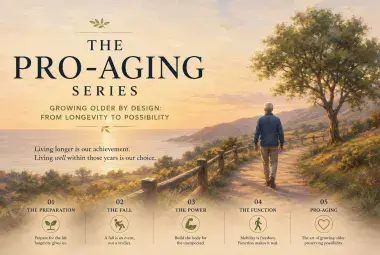
An Investment in Functional Freedom Across the Life Course
Long before old age is reached, the conditions that will define it are already being formed.
A persistent misconception in contemporary health behavior is the tendency to approach the body through a project-based lens. Health is often treated as a task to be initiated, optimized, and completed, structured around short-term goals, measurable outputs, and episodic effort. Within this framework, inconsistency is frequently attributed to a lack of discipline.
However, the issue may be less about discipline and more about a misalignment between the nature of the body and the model through which it is managed.
A project is finite. It has a defined endpoint, can be paused or resumed, and exists externally to the individual. The body does not conform to these conditions. It is continuous, adaptive, and responsive to patterns of care over time. Physiological outcomes are not determined by isolated efforts, but by repeated behaviors that accumulate across days, months, and years.
From this perspective, health is more accurately understood as a relationship rather than a project.
Relationships are not sustained through intensity, but through continuity. They are shaped by consistent, often unremarkable actions: regular movement, adequate rest, appropriate nourishment, and attentiveness to early physiological signals. These actions rarely produce immediate, dramatic results, yet they exert a compounding effect on long-term function.
This distinction becomes particularly salient in midlife.
As biological resilience gradually declines, the body’s tolerance for neglect, overexertion, and delayed recovery diminishes. Practices that were once sustainable, such as pushing through fatigue or postponing rest, begin to yield diminishing returns. This transition is frequently misinterpreted as dysfunction or decline, when in fact it reflects a predictable shift in physiological requirements.
The body is not failing; it is recalibrating its expectations of care.
Consequently, the operative question must evolve. Rather than asking, “What program should be followed?” a more adaptive inquiry is: “What does the body require under present conditions?” This shift prioritizes responsiveness over prescription, allowing behavior to align more closely with fluctuating biological needs.
Sustained responsiveness fosters cooperation between individual and body. Over time, this is reflected in more stable energy levels, improved recovery, and greater functional capacity. What is often attributed to favorable genetics may, in many cases, be the outcome of prolonged behavioral consistency and physiological attunement.
Conversely, when the body is treated primarily as an instrument of productivity subjected to repeated override of fatigue, discomfort, or early warning signals - it adapts accordingly. Functional decline emerges not as an abrupt failure, but as a gradual accumulation of unresolved strain. Mobility becomes restricted, recovery slows, and minor conditions persist.
Image

The implications of this pattern extend beyond health metrics to quality of life.
Physical capacity underpins autonomy. The ability to move comfortably, maintain balance, perform daily tasks, and engage in social and environmental contexts constitutes a form of functional freedom. This freedom is not established in later life, but is built progressively through long-term behavioral patterns.
Seemingly minor decisions like a brief walk, or a balanced meal, and adequate rest serve as incremental investments in this capacity. While individually insignificant, their cumulative effect is substantial. Over time, consistent care supports resilience, whereas sustained neglect contributes to limitation.
This understanding reframes health behavior from a corrective endeavor to a continuous process of maintenance. Importantly, this reframing is not intended to induce retrospective judgment. Rather, it invites a shift in orientation. Key reflective questions emerge:
Is the body being managed episodically or supported consistently?
Is engagement with health contingent on motivation, or anchored in routine care?
When disruption occurs, is the response corrective or simply restorative?
Such questions are not evaluative, but directional. They facilitate a transition from outcome-driven behavior to process-oriented engagement. Within this framework, aging is not solely a biological process, but a relational outcome, shaped by the degree of alignment between individual behavior and physiological need.
Health, therefore, is more appropriately conceptualized as stewardship. Each individual assumes primary responsibility for the long-term condition of the body they inhabit. This condition is not determined by isolated interventions, but by cumulative patterns of care sustained over time.
Accordingly, the central behavioral question shifts from “How can health be optimized?” to “How can continuity of care be maintained?”
Continuity does not depend on ideal conditions. It accommodates variability, interruption, and imperfection. It is sustained through modest, repeatable actions that preserve the relationship between individual and body, even in the absence of motivation or structure.
Ultimately, the body reflects patterns rather than intentions. And while past patterns shape present condition, the capacity to influence future outcomes remains intact. The relationship with the body is not fixed; it is continuously renegotiated through ongoing behavior.
Image

Conclusion
A critical realization that emerges with age is that the body retains a cumulative record of care. In earlier life stages, high physiological resilience often obscures the consequences of neglect, reinforcing the assumption that health can be deferred and later restored.
However, longitudinal experience suggests otherwise. The functional state of the body in later life is not the result of late-stage intervention, but of sustained interaction across the life course. Each behavioral choice contributes incrementally to this trajectory. This perspective does not necessitate perfection, but it does require presence.
Effective health management is less dependent on intensity than on consistency; less on correction than on continuity. In this sense, health is best understood not as an outcome to be achieved, but as a condition to be maintained through an ongoing relationship with the body.
The implications are both practical and existential. Physical freedom in later life, the capacity to move, engage, and participate without undue limitation is not incidental. It is constructed through daily acts of care that, while individually modest, collectively determine long-term function.
Thus, the most relevant question is neither whether one is adhering to an optimal regimen nor achieving ideal metrics, but rather: Is the body being cared for in a manner that supports the life one intends to live in later years?
Because the future condition of the body is not deferred. It is being formed continuously through the choices enacted in the present.
Image

Closing Reflection of the Author
Mobility is not merely a fitness objective. It is freedom. The ability to walk comfortably, to travel, to bend, to carry, to breathe deeply, to move without apprehension, these are not minor conveniences. They are the architecture of a life well-lived.
And that freedom is not constructed in later life. It is accumulated, incrementally, across decades built, day by day, through a relationship that we continue to tend. So the most honest question we can ask ourselves today is not whether we are doing health perfectly, but simply this:
“Am I caring for the body that will one day carry me into my older years?”
Because the future version of ourselves is already taking shape in the choices we make today. And the relationship we build with our body now will eventually become the life we are able to live later. Because aging well requires a shift in posture. Not intensity but consistency.
Projects reward speed. Relationships reward patience. And in the later chapters of life, patience becomes protective.
To push excessively is to invite injury.
To ignore fatigue is to invite resistance.
To override the body repeatedly is to erode trust.
But to listen, to respond, to adjust, and to respect, this is what builds cooperation. And when the body begins to trust you, something subtle yet profound occurs: it stops resisting. Movement becomes less effortful. Energy stabilizes. Recovery becomes more predictable. Not because the body has reversed time, but because it is no longer being asked to endure constant negotiation.
From this vantage point, health is no longer a pursuit. It is stewardship. And stewardship carries an enduring truth: each of us is the primary caretaker of the body we will one day grow old in.
Image

This reflection draws inspiration from contemplative frameworks such as the “Tree of Contemplative Practices” developed by The Center for Contemplative Mind in Society.
Suggested Citation: Lendez, M. (2026). Health is not a project. It’s a relationship: The investment that determines our freedom in later life.Developed within the IKIGAI-Bayanihan Purpose-Driven Framework on Aging.
About the Author
Written by Dr. Mariza Lendez, the developer of the Ikigai-Bayanihan Purpose-Driven Retirement Framework, a model that redefines aging through purpose, dignity, and community-centered living.