The Silent Loss No One Is Measuring
As society continuously chases the future, it often overlooks a profound and quiet erosion happening in the present: the steady, unheralded departure of its most seasoned minds.
While the loss of an individual is often treated as a private milestone, the accumulation of these farewells represents a staggering systemic deficit. The true wealth of a civilization is measured not just in its data repositories or institutional policies, but in the living libraries of human experience walking among us. When a master practitioner steps away, what vanishes is not merely labor, but the nuanced intuition, the unspoken resilience, and the irreplaceable art of practice that can only be forged through a lifetime of doing.
In an era increasingly enamored with artificial intelligence and digitized knowledge, we risk mistaking information for wisdom failing to realize that the most vital human insights cannot be queried, downloaded, or replicated
In Part 1 of this series, we proposed that ageing populations may represent repositories of wisdom capital, tacit knowledge, mentorship capacity, and intergenerational assets. If that proposition is true, a new question emerges: “What happens when these assets disappear faster than they are transferred?”
The answer may point to a challenge that remains largely absent from contemporary ageing discourse, not a labor nor a pension crisis, but a wisdom crisis.
The Silent Disappearance of Human Experience
Retirement is often discussed as a workforce transition, an economic event, or a personal milestone. Governments monitor labor force participation, retirement trends, and workforce replacement strategies. Organizations develop succession plans to ensure operational continuity. Yet considerably less attention is devoted to what may leave alongside the worker.
Michael Polanyi (1966) famously argued that people often “know more than they can tell,” describing forms of tacit knowledge that are difficult to articulate yet essential to effective action. Building upon this foundation, Nonaka and Takeuchi (1995) demonstrated that some of the most valuable forms of organizational knowledge originate from experience and are not easily captured through manuals, procedures, or databases.
An organizations can replace positions, but replacing decades of accumulated judgment is considerably more difficult.
Contemporary research further suggests that older workers often possess valuable experiential knowledge, institutional memory, contextual understanding, and mentorship capacity that may be difficult to transfer without intentional knowledge-sharing processes (Fasbender & Gerpott, 2021). As populations age and retirement transitions accelerate globally, societies may face not only workforce shortages but also the gradual erosion of experience-based knowledge that supports effective decision-making, leadership, and continuity.
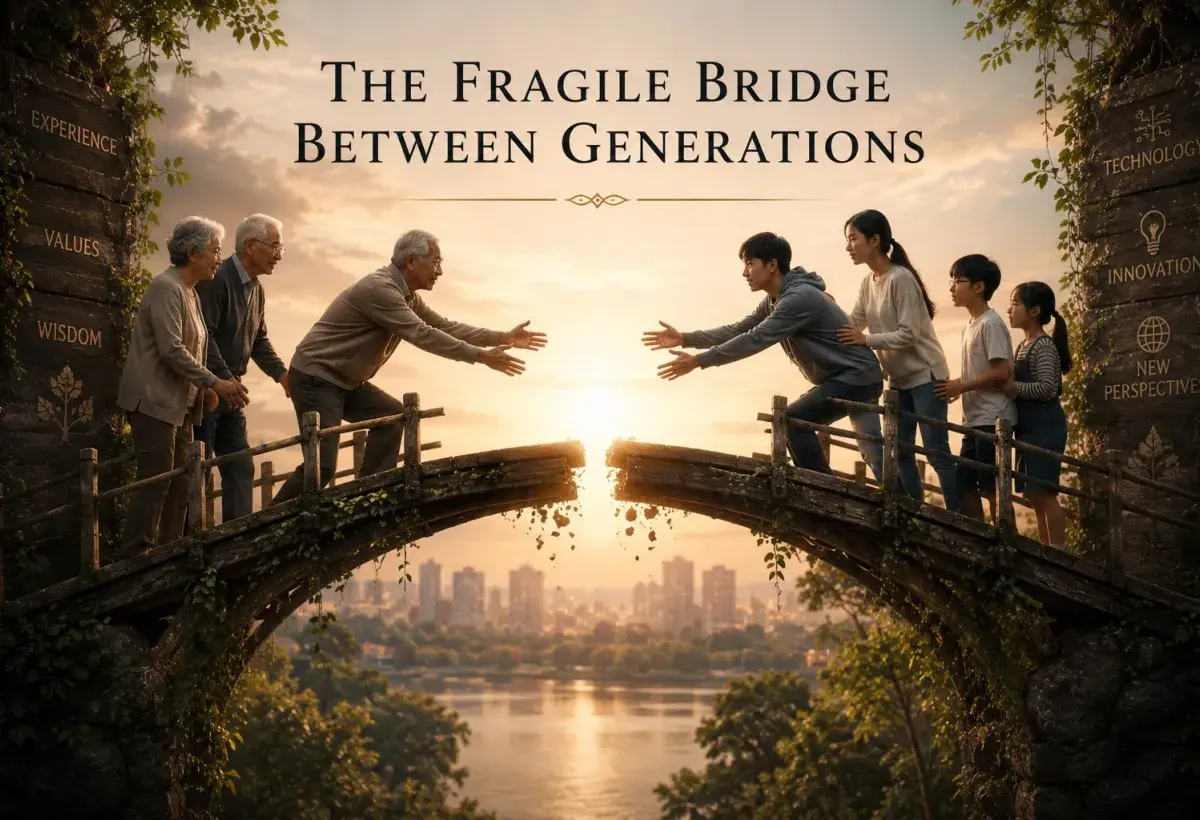
The Fragile Bridge Between Generations
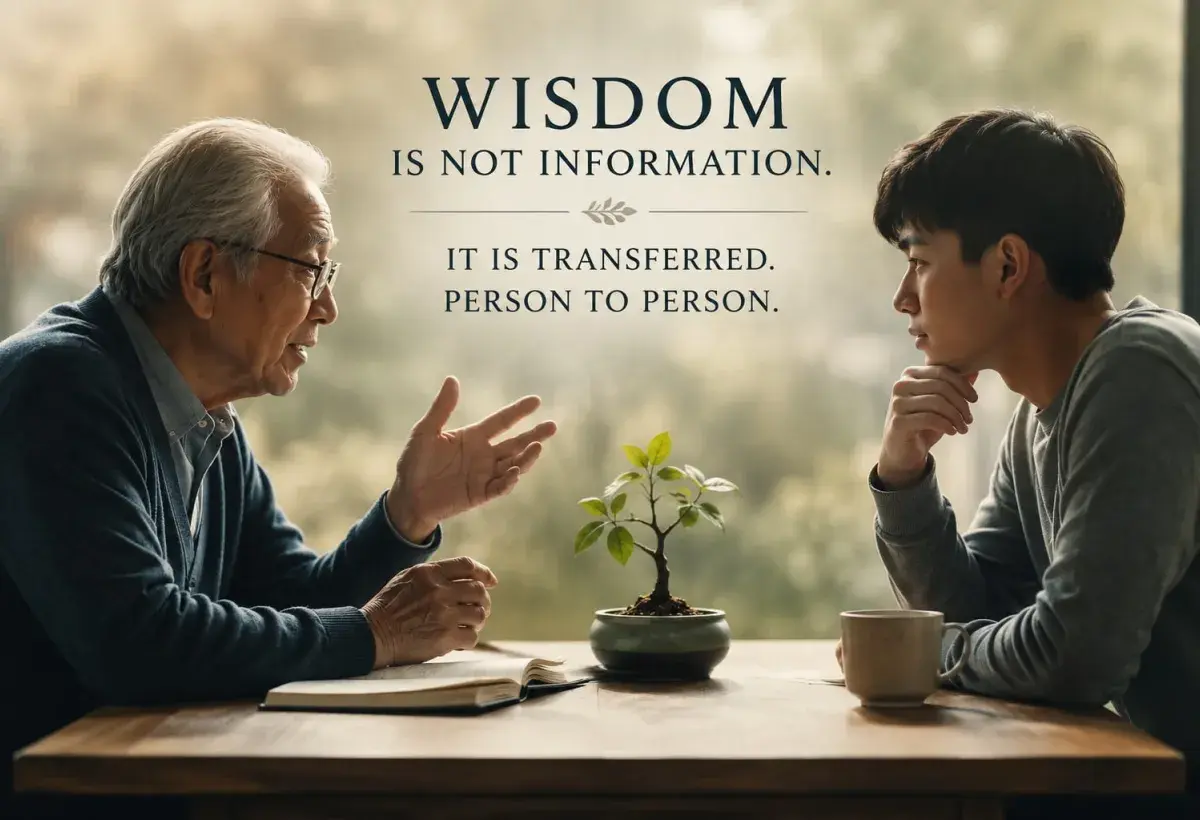
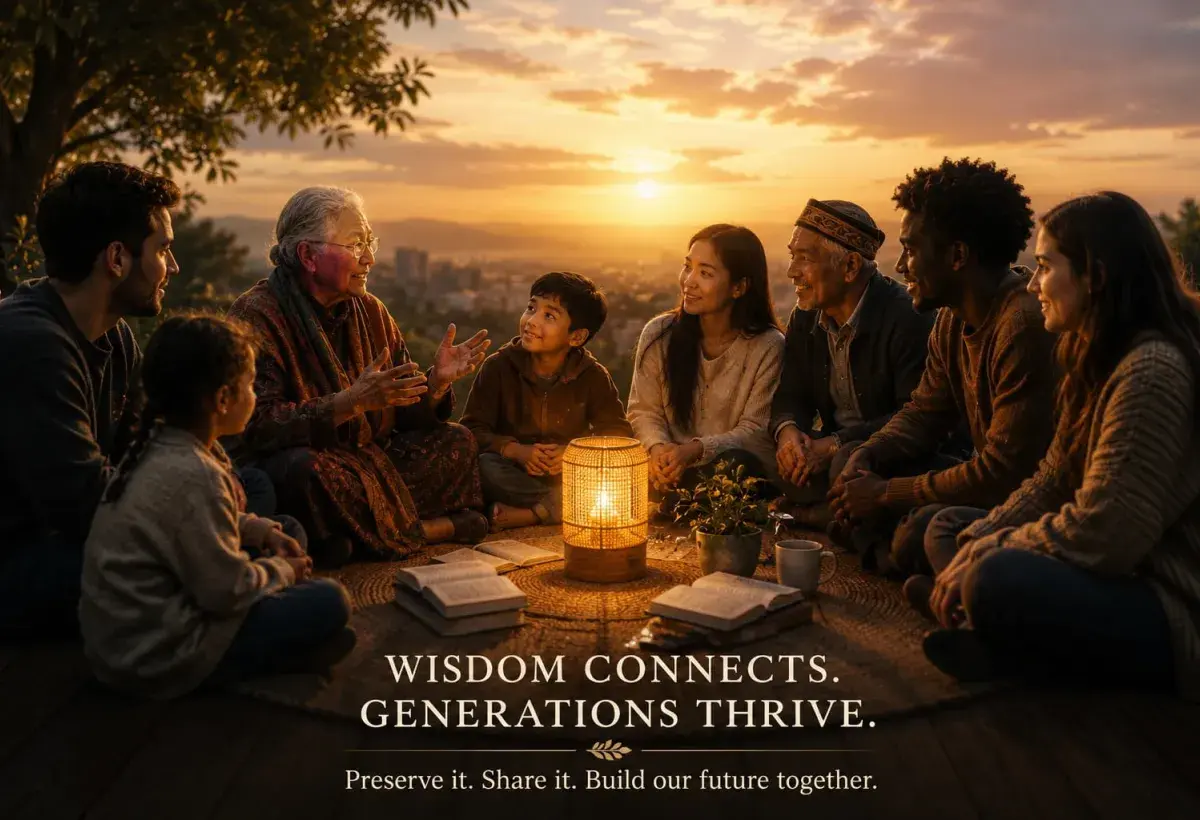
The transfer of wisdom does not occur automatically. Unlike information, wisdom cannot simply be archived, downloaded, or transmitted through instruction alone. It often requires relationships, trust, observation, dialogue, and shared experience.
Erikson's (1982) theory of generativity suggests that later adulthood is often characterized by a desire to guide, support, and contribute to future generations. Contemporary healthy ageing frameworks similarly emphasize meaningful participation, social connection, and engagement as essential components of wellbeing in later life (WHO, 2024).
Reflecting this perspective, the United Nations Decade of Healthy Ageing (2021-2030) calls for communities and institutions that foster the abilities of older people and support their continued participation and contribution to society (UN DESA, 2025).
Together, these perspectives suggest that the transfer of experience, mentorship, and wisdom is not merely a personal choice but a societal process that depends upon opportunities for meaningful intergenerational engagement. The true challenge is not whether older adults possess wisdom, but whether societies has built the pathways to share it.
Image
The Loneliness Paradox
Humanity is living longer than at any point in history, yet many older adults are spending more of those years in relative social isolation.
The World Health Organization increasingly recognizes social isolation and loneliness as major public health concerns affecting people across the life course (WHO, 2025). Empirical research has similarly demonstrated that loneliness and social isolation are associated with adverse health outcomes among older adults, including increased mortality risk (Steptoe et al., 2013).
More recent longitudinal evidence further suggests that changes in social isolation over time may significantly influence long-term health and wellbeing outcomes in later life (Lyu et al., 2024). These findings are often discussed in terms of individual wellbeing. However, the implications may extend beyond the individual.
When older adults become disconnected from families, communities, workplaces, and civic life, societies may also lose opportunities for mentorship, storytelling, cultural transmission, community leadership, and intergenerational learning. The issue is therefore not only one of social isolation but also one of societal disconnection. Wisdom that was once shared through conversations, relationships, observation, and lived experience becomes increasingly isolated from the individuals and communities that could benefit from it.
In this sense, loneliness may represent more than a public health challenge. It may also signal the growing isolation of wisdom itself. As opportunities for meaningful intergenerational engagement diminish, societies risk losing not only social connection but also access to the experience, perspective, and guidance accumulated across entire lifetimes.
The Rise of the Knowledge-Rich, Wisdom-Poor Society
Modern societies possess unprecedented access to information. Digital technologies, artificial intelligence, online education, and global communication networks have dramatically expanded humanity's ability to store, retrieve, and distribute knowledge. The OECD (2025) and World Economic Forum (2025) both identify knowledge, skills, adaptability, and continuous learning as essential assets in rapidly changing economies. Never before have individuals possessed such immediate access to information across virtually every domain of human activity.
By many measures, humanity has never been more informed.
Yet contemporary wisdom research continues to distinguish wisdom from the mere accumulation of information or knowledge. A synthesis of three decades of psychological wisdom research concluded that wisdom represents an integrated form of human functioning that extends beyond intelligence, factual knowledge, or cognitive ability alone (Dong et al., 2023). Similarly, Zhang et al. (2022) describe wisdom as a multidimensional quality that integrates knowledge, experience, reflection, and virtue in ways that support sound judgment in complex situations.
These findings reinforce earlier conceptualizations by Baltes and Staudinger (2000), who viewed wisdom as expertise in the fundamental pragmatics of life, and Ardelt (2003), who emphasized the cognitive, reflective, and compassionate dimensions of wisdom. Collectively, this body of scholarship suggests that wisdom is distinguished not by how much information a person possesses, but by how effectively knowledge, experience, reflection, and ethical judgment are integrated when confronting uncertainty, complexity, and change.
This distinction may become increasingly important as societies navigate technological disruption, demographic transformation, geopolitical uncertainty, and accelerating social change. Information can help us understand what is happening. Knowledge can help us understand how systems function. Wisdom, however, helps individuals and societies determine what ought to be done.
The challenge confronting modern societies may therefore not be a shortage of information, but a shortage of perspective. As access to information expands exponentially, opportunities for acquiring lived experience, intergenerational mentorship, historical perspective, and reflective judgment may not be expanding at the same pace. The result is a paradox of modernity: societies may become increasingly knowledge-rich while simultaneously becoming wisdom-poor.
This possibility becomes particularly significant in an era increasingly influenced by artificial intelligence. AI systems can process information, identify patterns, and generate responses at unprecedented speed. Yet wisdom involves capacities that extend beyond computation - ethical discernment, contextual understanding, moral judgment, empathy, and the ability to navigate competing human values. As technological capabilities continue to advance, the societal importance of wisdom may not diminish; it may become even more essential.
The question facing modern societies is therefore whether humanity is preserving the human capacities required to interpret, apply, and ethically navigate that information.
Image
Are We Approaching a Wisdom Deficit?
Governments around the world are preparing for labor shortages, pension pressures, healthcare demands, and demographic ageing. International organizations increasingly emphasize healthy ageing, workforce adaptation, social participation, and lifelong learning. These priorities are both necessary and urgent.
Yet a less visible question remains largely absent from public discourse.
Are societies also facing deficits in mentorship capacity, institutional memory, intergenerational learning, and accumulated wisdom?
Unlike workforce participation rates, healthcare expenditures, or economic productivity indicators, wisdom-related assets are difficult to quantify. They rarely appear in national statistics, policy dashboards, or economic forecasts. Nevertheless, they may play a critical role in societal resilience, continuity, and adaptive capacity.
The concern is not that wisdom is disappearing entirely. Human beings will continue to learn, reflect, and develop insight. Rather, the concern is that many of the social structures that historically facilitated wisdom transfer, multigenerational households, long-term community relationships, apprenticeship models, mentorship traditions, and sustained intergenerational interaction are becoming less prominent in many societies.
At the same time, ageing populations are growing larger than at any point in human history. This creates a paradoxical situation. Never before have societies possessed such vast reservoirs of accumulated experience, and yet never before has there been greater uncertainty regarding how that experience will be preserved, shared, and mobilized.
If wisdom, tacit knowledge, mentorship, and lived experience represent forms of societal capital, then their erosion should concern us no less than the depletion of financial, human, or natural capital. The challenge therefore, is not simply demographic. It is civilizational.
The Wisdom Crisis Framework
Building upon scholarship on wisdom, tacit knowledge, healthy ageing, generativity, social connection, and intergenerational learning, this article proposes the Wisdom Crisis Framework.
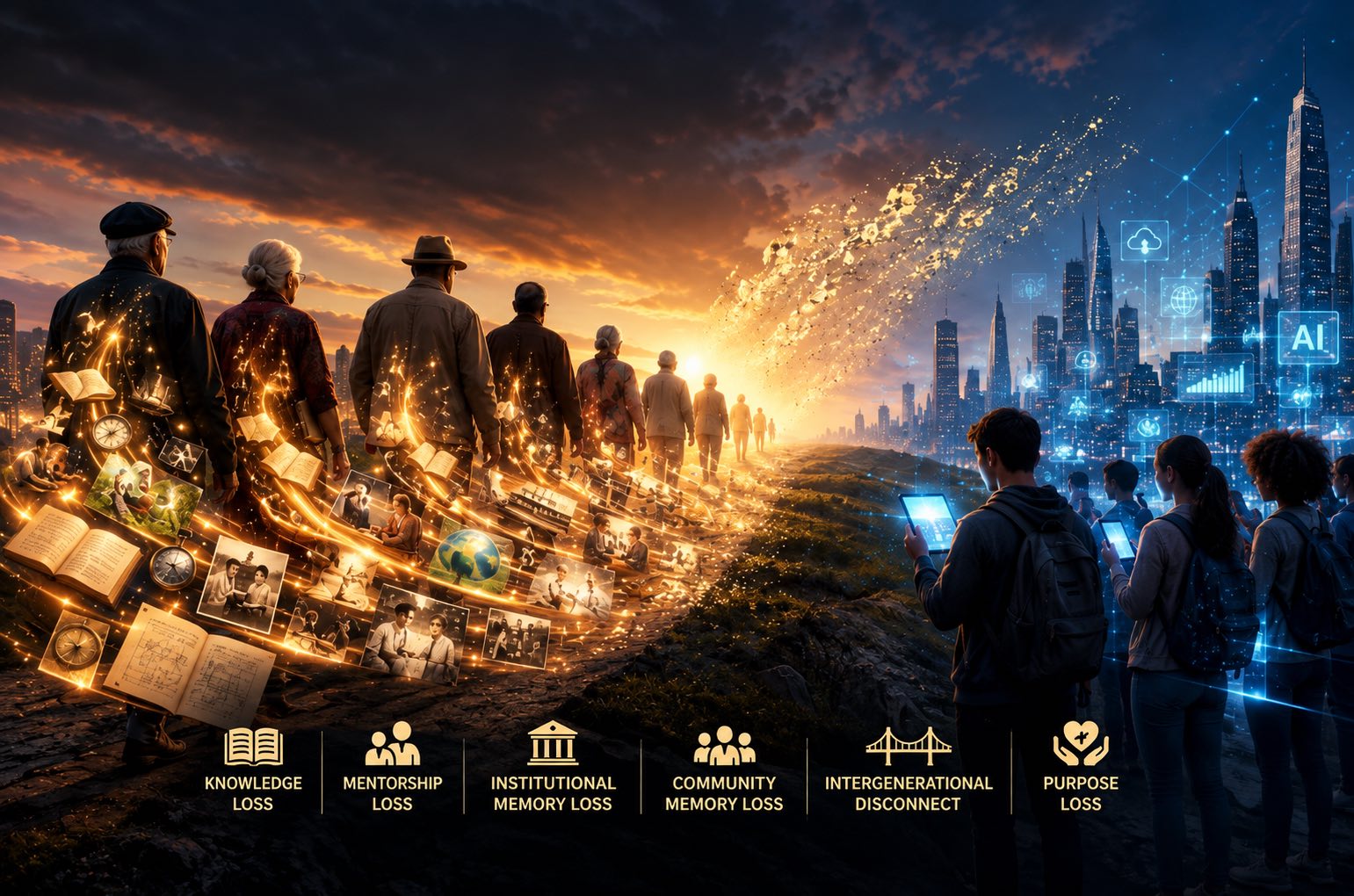
The framework suggests that societies may face six interconnected risks when accumulated wisdom is insufficiently preserved, transferred, and utilized.
- Knowledge Loss: The gradual disappearance of expertise developed through decades of lived experience, professional practice, caregiving, leadership, and community participation.
- Mentorship Loss: The reduction of opportunities for younger generations to learn from experienced individuals through guidance, observation, and relationship-based learning.
- Institutional Memory Loss: The erosion of contextual understanding, historical perspective, and organizational learning that often reside within long-serving individuals rather than formal records.
- Community Memory Loss: The weakening of local knowledge, cultural continuity, collective identity, and social cohesion as intergenerational relationships become less common.
- Intergenerational Disconnect: The breakdown of social bridges that facilitate the transfer of values, experience, perspective, and practical wisdom across generations.
- Purpose Loss: The underutilization of older adults' capacity to continue contributing meaningfully to families, communities, organizations, and society.
Viewed individually, each of these risks may appear manageable, but viewed collectively, however, they reveal a broader challenge. The issue is not merely that populations are ageing, it is whether societies possess the structures necessary to preserve and mobilize the wisdom embedded within increasingly long-lived populations.
The Wisdom Economy proposed in Part 1 viewed ageing populations as repositories of societal assets. The Wisdom Crisis Framework introduced here highlights what may be lost when those assets are overlooked. Ultimately, the question now is whether ageing societies can afford to lose what older adults know.
A Question Civilization Must Confront
Humanity has invested heavily in preserving information. We have built libraries, archives, databases, cloud storage systems, and artificial intelligence capable of processing extraordinary amounts of knowledge. Yet knowledge alone does not guarantee wisdom. As populations age and societies transform, a more pressing question emerges.
If wisdom is accumulated across a lifetime but rarely preserved beyond it, are we witnessing the gradual depletion of one of civilization's most valuable and least understood forms of capital?
The answer may depend not on how long people live, but on whether societies learn how to preserve, share, and mobilize the wisdom that longer lives make possible. If ageing populations represent reservoirs of accumulated knowledge, experience, judgment, and mentorship, then the challenge before humanity extends beyond healthcare, pensions, and longevity itself. It becomes a question of infrastructure.
Not a digital networks, roads or bridges but - a wisdom infrastructure.
The defining challenge of ageing societies in the twenty-first century is not simply extending human longevity, but transforming longevity into a societal asset by ensuring that the wisdom accumulated across longer lives is preserved, shared, and transferred to future generations.
Read 👉️ The Wisdom Economy - Part 1: The Greatest Wealth We Never Measured https://www.chikicha.com/wisdom-economy-part-1-greatest-wealth-we-never-measured
Read 👉️ The Wisdom Economy – Part 3: Reservoirs of Wisdom https://www.chikicha.com/wisdom-economy-part-3-reservoirs-wisdom
Image
Suggested Citation:
Lendez, M. (2026). The Wisdom Economy Part 2: The Comming Wisdom Crisis. Chikicha. (the author is the developer of Ikigai-Bayanihan Framework).
About the Author: Dr. Mariza Lendez is a researcher, social entrepreneur, and creator of the Ikigai-Bayanihan (Purpose + Collective Ethos) Retirement Model, an innovative framework that integrates purpose, community engagement, and sustainability to support meaningful aging and later-life well-being
References
Erikson, E. H. (1982). The life cycle completed. W. W. Norton & Company - https://wwnorton.com/books/The-Life-Cycle-Completed/
Dong, M., Grossmann, I., & colleagues. (2023). Thirty years of psychological wisdom research: What we know about the correlates of an ancient concept. Psychological Science in the Public Interest, 24(1), 3–54. https://doi.org/10.1177/17456916221114096
Fasbender, U., & Gerpott, F. H. (2021). To share or not to share: A social-cognitive internalization model to explain how age discrimination impairs older employees' knowledge sharing with younger colleagues. European Journal of Work and Organizational Psychology, 30(1), 125–142.
Lyu, J., Lee, H., Kim, K., et al. (2024). Social isolation changes and long-term outcomes among older adults. JAMA Network Open, 7(7), e2424519. https://doi.org/10.1001/jamanetworkopen.2024.24519
Nonaka, I., & Takeuchi, H. (1995). The knowledge-creating company: How Japanese companies create the dynamics of innovation. Oxford University Press. - https://www.hbs.edu/faculty/Pages/item.aspx?num=38411&utm
Organisation for Economic Co-operation and Development. (2025). OECD skills outlook 2025: Building the skills of the 21st century for all. - https://www.oecd.org/en/publications/2025/12/oecd-skills-outlook-2025_ac37c7d4.html?
Polanyi, M. (1966). The tacit dimension. University of Chicago Press - https://press.uchicago.edu/ucp/books/book/chicago/T/bo6035368.html?
Steptoe, A., Shankar, A., Demakakos, P., & Wardle, J. (2013). Social isolation, loneliness, and all-cause mortality in older men and women. Proceedings of the National Academy of Sciences, 110(15), 5797–5801. https://doi.org/10.1073/pnas.1219686110
United Nations Department of Economic and Social Affairs. (2025). United Nations Decade of Healthy Ageing (2021–2030). United Nations. Retrieved from: https://social.desa.un.org/sdn/decade-of-healthy-ageing-2021-2030?
United Nations General Assembly. (2020). United Nations Decade of Healthy Ageing (2021–2030) (A/RES/75/131). United Nations. Retrieved from: https://digitallibrary.un.org/record/3895802?v=pdf
World Economic Forum. (2025). The future of jobs report 2025. World Economic Forum. https://reports.weforum.org/docs/WEF_Future_of_Jobs_Report_2025.pdf? / https://www.weforum.org/publications/series/future-of-jobs/?
World Health Organization. (2024). Ageing and health. World Health Organization. Retrieved from: https://www.who.int/news-room/fact-sheets/detail/ageing-and-health?
World Health Organization. (2025). UN Decade of Healthy Ageing (2021–2030). World Health Organization. Retrieved from: https://www.who.int/initiatives/decade-of-healthy-ageing?
World Health Organization. (2025). Social isolation and loneliness. World Health Organization. Retrieved from https://www.who.int/teams/social-determinants-of-health/demographic-change-and-healthy-ageing/social-isolation-and-loneliness
Zhang, K., Shi, J., Wang, F., & Ferrari, M. (2022). Wisdom: Meaning, structure, types, arguments, and future concerns. Current Psychology, 42, 15030–15051. https://doi.org/10.1007/s12144-022-02816-6 / https://pmc.ncbi.nlm.nih.gov/articles/PMC8817649/?