⚠️ A Note Before We Begin
This article is for public education, not medical advice, diagnosis, or treatment. We do not sell, endorse, or recommend any product, procedure, or remedy. We examine credible research and authoritative evidence to understand what has been studied, what researchers found, where evidence remains limited, and what the findings allow us to say.
Natural does not automatically mean safe or effective. Persistent, severe, painful, or changing skin concerns warrant professional dermatological assessment.
After Understanding, We Investigate
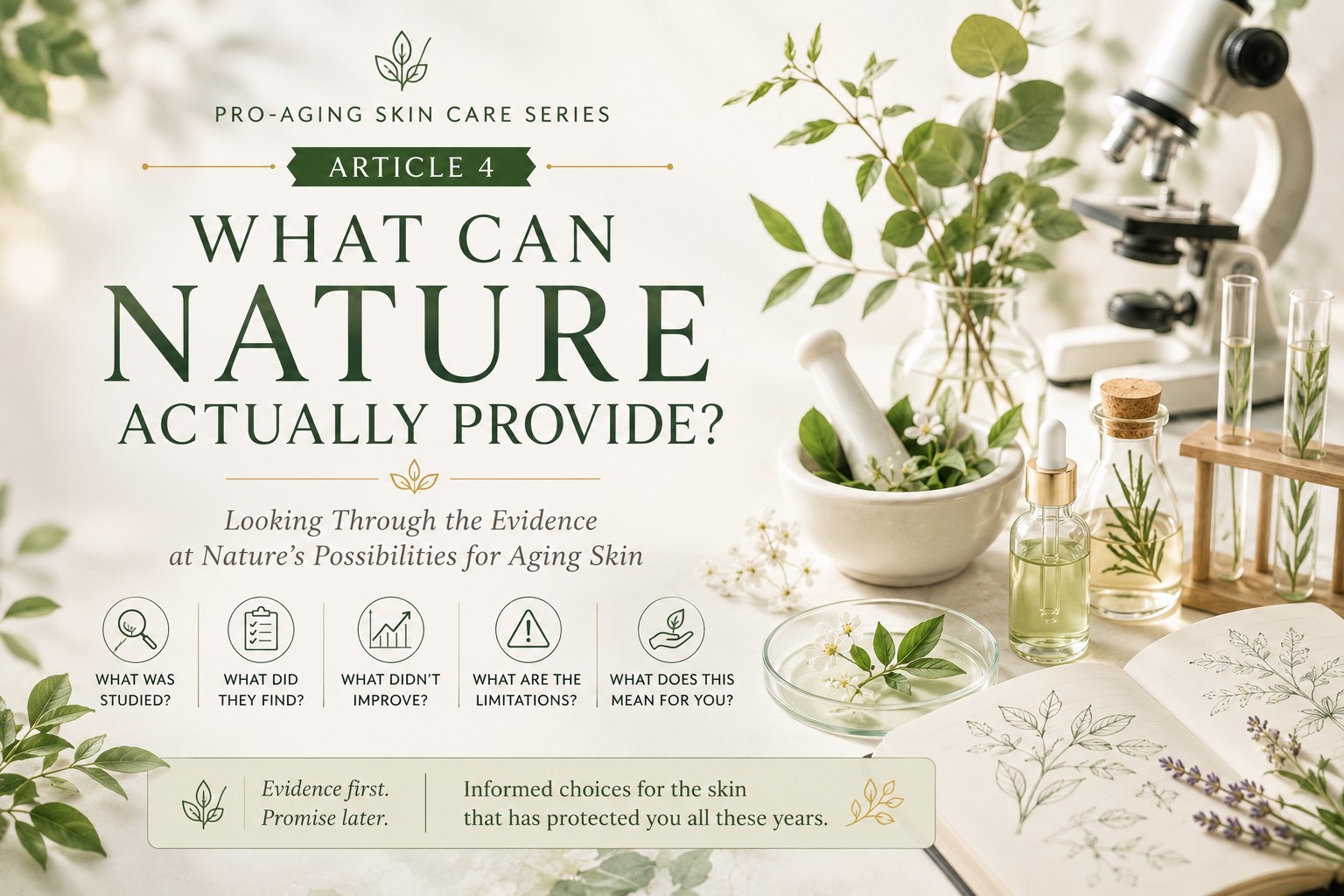
The first three articles established the foundation. Aging changes the skin; observation helps us recognize those changes; and the skin we have today reflects both biological aging and the environment in which it has lived. Article 4 moves from understanding to investigation: what can nature actually provide for aging skin?
Natural materials have been investigated for hydration, barrier function, elasticity, pigmentation, inflammation, wound healing and photoaging. Reviews of plant extracts and other natural products have identified biological activities of interest, while also emphasizing unresolved questions concerning active compounds, mechanisms, safety and translation into effective skin applications (Fernandes et al., 2023; Michalak, 2023).
The question is not whether a natural ingredient sounds promising, but what scientific investigation has actually demonstrated about its effects on the skin.
Natural Is Not a Scientific Result
The word natural generally refers to something existing in or produced by nature rather than being artificial (Merriam-Webster, n.d.). That describes origin; it does not establish that a substance is safe, effective, gentle, or beneficial to aging skin.
The regulatory position is equally important. The U.S. Food and Drug Administration (FDA, n.d.) has not established a regulatory definition of “natural” for cosmetic labeling. FDA also states that the same safety and labeling requirements apply to cosmetics regardless of their source and that choosing ingredients considered natural or organic does not guarantee safety. The distinction is therefore straightforward:
Natural describes where something comes from. Evidence determines what we can responsibly say it does.
Where Does the Evidence Begin?
Natural skin care has a long history. Fruits, herbs, oils, seeds, flowers, minerals, clays and marine materials have been used by different populations for generations, creating a large body of traditional knowledge.
Scientific research approaches that history differently. Researchers can identify compounds, isolate constituents, prepare extracts, formulate products and test defined preparations under controlled conditions. The research question then becomes measurable: Does this preparation produce a measurable change in the outcome being studied? That distinction allows traditional knowledge to remain valuable without treating it as clinical proof.
Traditional use can give researchers a question. The study has to provide the answer.
The Material Being Studied Matters
The phrase natural ingredient can conceal major differences in preparation. Researchers may investigate a whole plant, a juice, an oil, an infusion, a standardized extract, a purified compound or a finished formulation. These preparations can differ in composition, concentration, stability and biological activity.
Michalak (2023) reviewed plant-derived materials investigated for moisturizing, antioxidant, anti-inflammatory, regenerative, wound-healing, photoprotective and anti-aging applications. The breadth of these investigations demonstrated the scientific interest in plant materials, but it did not establish that every preparation produces every claimed effect. Therefore, before accepting a claim, the reader needs to know exactly what was tested.
What Does “Improvement” Actually Mean?
A natural ingredient cannot be evaluated meaningfully until the outcome is defined. Skin-aging research can measure different outcomes, including hydration, transepidermal water loss (TEWL), elasticity, pigmentation, erythema, wrinkles and other characteristics. These measurements describe different aspects of skin condition and cannot automatically be substituted for one another.
For example, a preparation that increases hydration has demonstrated an effect on hydration. A preparation that reduces TEWL has demonstrated an effect on water loss through the skin barrier. Neither finding automatically establishes improvement in every other aspect of aging skin. This distinction becomes especially important when a narrow research finding is expanded into a broad marketing claim.increased hydration and reduced transepidermal water loss are related to skin water balance but represent different measurements. Likewise, improved skin feel or appearance is not automatically evidence that the biological barrier has been repaired. The evidence therefore has to follow the measurement.
We report what researchers measured - not what a later advertisement claims the measurement means.
Image

What Recent Human Evidence Found
Cheng et al. (2025) conducted a systematic review and meta-analysis of randomized controlled trials investigating topical plant-based products for skin aging. Their search covered four databases from January 2000 through December 2024, and eight randomized controlled trials met their inclusion criteria.
The meta-analysis found statistically significant improvements in skin hydration and overall skin elasticity, as well as reductions in melanin and erythema. However, it found no statistically significant reduction in TEWL and no significant improvement in the specific elasticity measures R5 and R7. A subgroup analysis found a significant improvement in overall elasticity measured by R2 in treatments lasting eight weeks or less, but not in treatments lasting longer than eight weeks (Cheng et al., 2025).
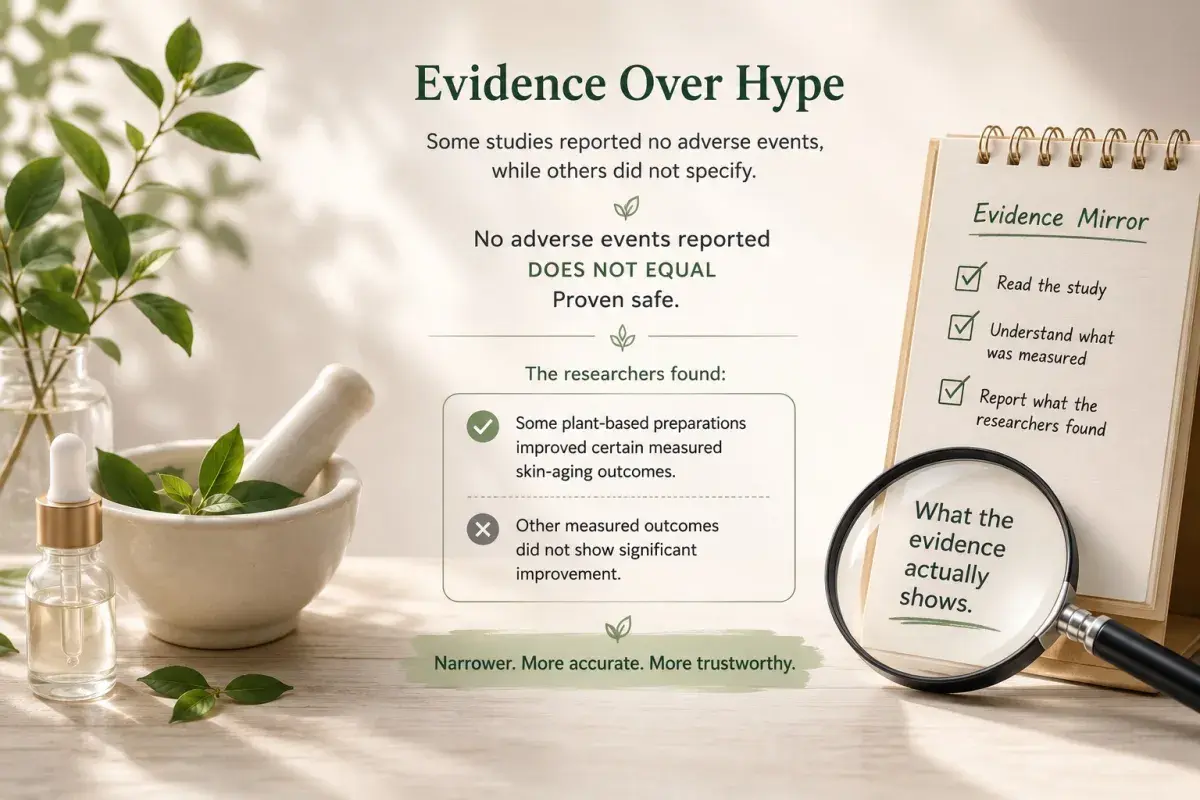
The findings therefore support specific effects under the conditions studied, rather than a universal claim about aging skin. The safety findings also require precision. Six studies reported no adverse events, while two did not specify whether adverse events occurred (Cheng et al., 2025). The absence of reported adverse events cannot therefore be interpreted as proof of universal safety. The appropriate conclusion is narrower as what the evidence demonstrated.
Some topical plant-based preparations improved particular measured skin-aging outcomes in the randomized trials included in the meta-analysis, while other measured outcomes did not show significant improvement.
What Changed From the Earlier Evidence?
Hunt et al. (2010) provided an earlier systematic assessment of botanical extracts for skin aging and wrinkling. Of the 11 eligible controlled clinical trials, significant reductions in wrinkling were reported for several botanical preparations, including date-kernel, cork, soy, Rosaceae and peony extracts. However, no significant reduction was found for green tea, Vitaphenol®, or maca root. The authors judged all included trials to be of poor methodological quality, noted that adverse effects were frequently not reported, and concluded that the evidence was weak and that there was no evidence that observed effects were enduring. They recommended larger samples, longer treatment periods, more rigorous designs and independent replication (Hunt et al., 2010).
More recent evidence has not simply overturned that conclusion. Cheng et al. (2025) found statistically significant effects for some measured outcomes while finding no significant effects for others. The evidence has become more precise, not simply more positive.
This progression is important because it shows how evidence develops. An earlier review can identify weak evidence and methodological problems; subsequent research can add newer trials and provide stronger estimates for particular outcomes without eliminating uncertainty in other areas.
If the study found no significant effect, we keep that finding too.
A non-significant result does not prove that an ingredient can never have an effect. It means that the study did not demonstrate the expected effect under the conditions investigated. That boundary prevents us from presenting an unsupported outcome as an established benefit.
The Skin Barrier: A Different Question
Barrier function provides another example of why the specific research question matters. Lei et al. (2024) reviewed topical natural ingredients investigated for epidermal permeability-barrier function. Their review found evidence that some natural ingredients could accelerate barrier recovery after acute disruption and lower TEWL in intact skin. The authors discussed mechanisms involving keratinocyte differentiation, lipid production, antioxidant activity, hyaluronic-acid production, aquaporin 3 and sodium-hydrogen exchanger 1.
These findings support investigation of natural ingredients for barrier-related outcomes. They do not establish that every natural ingredient improves barrier function, nor that a preparation used outside the studied conditions will produce the same result. The distinction is particularly important because some of the reviewed evidence concerned acute barrier disruption, while aging skin represents a broader biological process. The appropriate conclusion remains specific:
Some natural ingredients have demonstrated barrier-related effects under particular studied conditions.
From Photoaging to Plant-Derived Compounds
Environmental exposure is part of the biological history of aging skin. Tanveer et al. (2023) reviewed the molecular basis of photoaging and the research examining plant-derived natural products in relation to UV-induced processes. Their review addressed oxidative stress, inflammation and changes to the extracellular matrix associated with photoaging and summarized plant-derived compounds investigated against these mechanisms.
This evidence establishes a scientific basis for investigating plant-derived compounds in photoaging. It does not establish that applying the corresponding raw plant to human skin will prevent or reverse photoaging. Evidence of a biological mechanism remains evidence of a mechanism until human research demonstrates the corresponding outcome.
When Food Becomes a Skin-Care Ingredient
Food-derived materials present the same evidence question.
Jin et al. (2024) reviewed food-derived ingredients investigated for skin aging, including plant-derived foods, animal-derived foods and traditional herbs. Their review discussed mechanisms associated with UV-induced skin aging, including oxidative stress, collagen loss and melanogenesis, and examined delivery systems intended to facilitate the use of food-derived ingredients in skin care.
The evidence therefore concerns food-derived ingredients studied in particular forms and applications. It does not establish that applying the raw food itself will reproduce the effect observed with a purified compound, extract or formulated preparation.
Containing a studied compound does not make every preparation containing that compound equivalent to the preparation studied.
Image

Herbal Research: More Human Evidence, Continuing Gaps
Goh et al. (2025) reviewed topical herbal compounds for skin aging and synthesized evidence from 51 clinical trials conducted during the preceding decade. The review identified findings involving wrinkles, elasticity, hydration and pigmentation and reported potential benefits across several skin-aging parameters.
At the same time, the authors identified important gaps. Human trials remained limited compared with the volume of preclinical research, and further studies were needed to identify the specific compounds responsible for observed effects and to clarify their mechanisms. They recommended larger clinical trials, investigation of ingredient combinations and improved delivery systems (Goh et al., 2025).
The evidence therefore supports continued investigation and not a blanket conclusion that herbal skin care is established across all ingredients and outcomes.
When the Preparation Changes, the Question Changes
The preparation is part of the intervention. A researcher may study a standardized extract at a defined concentration under controlled conditions. A person at home may use the raw plant, squeeze its juice, blend it into a paste, infuse it in water, combine it with oil or mix it with another ingredient. These are different preparations and cannot automatically be treated as the same intervention.
Research may control concentration, extraction method, purity, pH, stability, preservation, dosage, application frequency and duration. A homemade preparation may vary across these characteristics. Michalak (2023) demonstrated why this matters by noting that plant-extract composition and properties depend on factors including cultivation, harvesting, processing and extraction methods. Therefore:
A study of an ingredient is not automatically a study of every way that ingredient can be prepared or used.
When the Claim Is Bigger Than the Study
A study may demonstrate increased hydration after applying a defined preparation. A laboratory experiment may demonstrate antioxidant activity in cells. A review may identify a biological pathway affected by a plant-derived compound.
None of these findings automatically establishes that the material reverses aging, repairs all aspects of the skin barrier, or works for every aging person.
Fernandes et al. (2023) reviewed natural products investigated for inflammation, wound healing and photoaging and identified evidence of antioxidant and anti-inflammatory activities. At the same time, the authors emphasized unresolved questions concerning safety, biological activity, precise mechanisms and characterization of the active compounds responsible for observed effects. The conclusion must therefore remain proportional to the evidence:
The size of the conclusion must not exceed the size of the study.
Safety Belongs Beside Efficacy
An ingredient cannot be evaluated responsibly by asking only whether it produces a desirable effect. Safety depends on the substance, concentration, preparation, route and conditions of use. FDA states that natural or organic sourcing does not guarantee cosmetic safety and that manufacturers remain responsible for ensuring product safety under labeled or customary conditions of use.
The recent plant-based meta-analysis illustrates the importance of complete reporting: six studies reported no adverse events, while two did not specify whether adverse events occurred (Cheng et al., 2025). Therefore, two separate questions must remain visible as they belong in the evidence.
-
Did the preparation produce the intended effect?
-
Was its safety adequately evaluated and reported?
The Evidence Ladder
Evidence answers different questions at different levels. The closer the research comes to the actual human intervention and outcome being considered, the more directly it informs that question.
Image
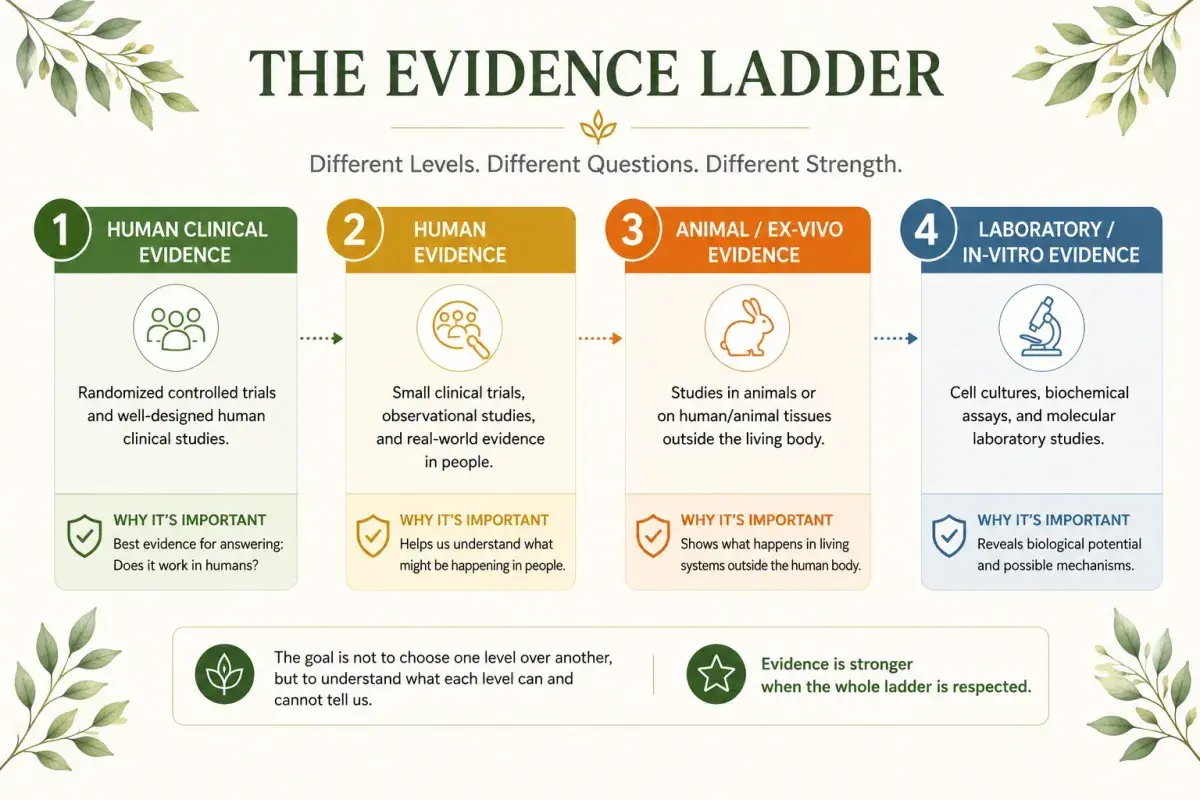
The ladder is not a judgment that lower-level evidence has no scientific value. Laboratory and experimental studies can identify mechanisms and generate hypotheses; human research can determine whether a defined intervention produces a measurable outcome in people.
The boundary is simple: A laboratory finding remains a laboratory finding until human research demonstrates the corresponding human outcome.
The Evidence Mirror
When a natural-skin-care claim appears, the reader can examine it through the same questions used to evaluate the research:
| Evidence Mirror | Question for the reader | Why it matters |
| Title & Authors | Who conducted the research, and where was it published? | Identifies the original scientific source. |
| Research Question | What problem were the researchers actually investigating? | Establishes what the study was designed to answer. |
| Natural Material | What ingredient, plant, fruit, vegetable, herb, mineral or marine substance was studied? | “Natural” is too broad to describe the intervention. |
| Preparation | Was it raw, processed, extracted, purified, standardized or formulated? | Determines whether the study applies to another preparation. |
| Why Was It Studied? | What biological rationale or previous evidence led researchers to investigate it? | Shows why the research question was considered worth testing. |
| Who / What Was Studied? | Humans, animals, cells, reconstructed skin or another model? | Different models answer different questions. |
| What Skin? | Healthy, mature, dry, sensitive, photoaged or affected by a specific condition? | Results cannot automatically be transferred to every type of aging skin. |
| How Was It Used? | Concentration, frequency, application site and duration? | Defines the conditions under which the finding occurred. |
| What Was Measured? | Hydration, TEWL, barrier function, elasticity, wrinkles, pigmentation or another outcome? | Identifies what “improvement” actually meant. |
| What Was the Comparison? | Baseline, placebo, vehicle, untreated skin or another preparation? | Gives the result context. |
| What Happened? | What actually changed? | This is the research finding. |
| Was It Statistically Significant? | Was the observed difference statistically significant? | Helps distinguish a statistically supported difference from random variation. |
| How Large Was the Effect? | Was the change small, moderate or substantial? | Statistical significance alone does not establish practical importance. |
| What Did Not Improve? | Were any outcomes unchanged or unsupported? | Prevents one positive finding from becoming a broader claim. |
| What Were the Gaps? | Sample size, duration, preparation, controls, follow-up or other limitations? | Shows how far the findings can be generalized. |
| Was Safety Evaluated? | Were adverse effects assessed and reported? | Benefit cannot be separated from safety. |
| What Did the Authors Conclude? | What did the researchers themselves say? | Keeps interpretation anchored to the study. |
| What Did They Recommend? | Further research, refinement or application? | Shows how far the authors believed the evidence could be taken. |
| What Evidence Level? | Human, observational, animal/ex-vivo, laboratory or traditional? | Prevents a lower level of evidence from being presented as clinical proof. |
| Can It Be Verified? | Can the original study or authoritative record be accessed? | Allows the reader to examine the evidence directly. |
This is the difference between reading a claim and investigating a claim. This is the practical value of the Evidence Mirror. It does not tell the reader which ingredient to choose. It gives the reader a method for deciding how much confidence a claim deserves.
Image
From Evidence to Personal Choice
The research can tell us what was studied, what happened, what did not happen, how strong the evidence was, and where the gaps remain. It cannot determine what an individual should value in the appearance, care or aging of their own skin.
One person may prioritize maintaining a youthful appearance and choose aesthetic or dermatological interventions. Another may prioritize comfort, barrier protection and simplicity. Another may choose a combination of approaches. These are personal decisions.
Our responsibility is not to tell readers what they should put on their skin. It is to make the evidence visible, distinguish findings from claims, and preserve the limitations alongside the results.
We provide the evidence. The individual evaluates it. The individual decides.
That distinction matters in a marketplace where a biological finding can become a product promise, where “natural” can become synonymous with “safe,” and where improvement in one measured outcome can become a claim about reversing aging. The reader now has a different way to approach those claims:
-
What was studied?
-
How was it prepared?
-
What skin was studied?
-
What was measured?
-
What improved?
-
What did not?
-
What were the limitations?
-
What did the researchers actually conclude? and most importantly:
-
Is the claim being made today the same claim the researchers actually investigated?
The Magnifying Glass Comes Down
For four articles, we have followed the skin through a progression of understanding: from recognizing that it changes with age, to learning to observe the skin we have today, to understanding the environmental history it carries, and finally to examining what science has actually found in the search for ways to care for it. Each step has brought us closer to the same point, not to determine how aging skin should look, but to understand what it is, what it has experienced, and what the evidence can responsibly tell us about caring for it.
The research does not produce one universal answer. Some preparations have demonstrated improvements in particular measured outcomes; others have not shown significant effects; some findings remain limited by study design, preparation, duration, sample size, or incomplete safety reporting; and some evidence remains at the laboratory or experimental level rather than in humans. These differences are not obstacles to the evidence as they are the evidence.
That is why a promising finding must remain a promising finding until stronger research establishes more. A natural origin does not make an ingredient safe; a biological mechanism does not establish a human outcome; and a statistically significant result in one measure does not establish improvement in every aspect of aging skin.
When the research does not demonstrate an effect, that finding remains visible; when it demonstrates an effect, we report it within the boundaries in which it was studied.
The result is a more honest way of looking at skin care. Instead of asking which ingredient is the winner, the reader can ask what was studied, how it was prepared, what type of skin was investigated, what was measured, what changed, what did not, how strong the evidence was, what limitations remained, and what the researchers themselves concluded or recommended. The claim can then be considered against the evidence rather than the evidence being reshaped to fit the claim.
And that distinction matters because evidence informs a decision; it does not make the decision.
After four articles, the reader has been given the opportunity to see aging skin differently - as living tissue that has changed through time and exposure, adapted to its environment, and continued to perform its protective role. The evidence can tell us what has been demonstrated, what remains uncertain, and where further research is needed; it cannot determine what each person should value when deciding how to care for their own skin.
That choice belongs to the individual. One person may choose to pursue a youthful appearance through cosmetic or dermatological interventions. Another may prioritize maintaining comfort, hydration, barrier function and protection while accepting the visible signs of age. Another may choose both.
Our responsibility is not to rank those choices, but to make sure that whatever choice is made is informed by evidence rather than by an exaggerated claim, an incomplete finding, or the assumption that natural automatically means better.
The magnifying glass can therefore come down because we have reached the boundary between what science can tell us and what only the individual can decide. We have examined how skin changes with age. We have learned to observe it rather than assume what it needs. We have considered the environment that has shaped its history. And we have looked at what nature has actually demonstrated when its possibilities were subjected to scientific investigation.
Now there is no ingredient for us to declare the winner. There is no single definition of what aging skin should look like. There is only the evidence—and the person who must decide what to do with it.
Knowing what you know now, what matters most to you as you grow older, and how do you want to care for the skin that has protected you all these years?
Science can inform that decision but it cannot make it for you. Responsible skin care begins with trustworthy information, critical evaluation, and an informed choice not with being told what to choose.
The evidence is ours to examine.
The decision is yours to make.
And with that, we move from knowing, to understanding, to caring, to protecting, and finally to choosing how we want to move forward with the skin that has carried us through life in Article 5 — Caring Forward (Choosing How We Want to Age With the Skin That Has Carried Us)
Image

Suggested Citation
Lendez, M.L. (2026). PRO-AGING SKIN CARE: What Can NAture Actually Provide?. Chikicha.com (the author is the developer of the ikigai-Bayanihan Framework for Purposeful Aging).
About the Author
Dr. Mariza Lendez is a researcher, social entrepreneur, and creator of the Ikigai-Bayanihan (Purpose + Collective Ethos) Retirement Model, an innovative framework that integrates purpose, community engagement, and sustainability to support meaningful aging and later-life well-being.
References
Cheng, F., Feng, J., Cao, Z., Duan, Q., & Li, H. (2025). Efficacy and safety of topical application of plant-based products on skin aging in healthy individuals: A systematic review and meta-analysis of randomized controlled trials. Journal of Cosmetic Dermatology, 24(2), e16710. https://doi.org/10.1111/jocd.16710
Fernandes, A., Rodrigues, P. M., Pintado, M., & Tavaria, F. K. (2023). A systematic review of natural products for skin applications: Targeting inflammation, wound healing, and photo-aging. Phytomedicine, 115, 154824. https://doi.org/10.1016/j.phymed.2023.154824
Goh, A. P.-T., Goh, S.-M., Tow, W.-K., Toh, K.-M., Palanisamy, U. D., & Sundralingam, U. (2025). Exploring the role of herbal compounds in skin aging: A systematic review of topical approaches. Phytotherapy Research, 39(1), 315–363. https://doi.org/10.1002/ptr.8375
Hunt, K. J., Hung, S. K., & Ernst, E. (2010). Botanical extracts as anti-aging preparations for the skin: A systematic review. Drugs & Aging, 27(12), 973–985. https://doi.org/10.2165/11584420-000000000-00000
Jin, Z., Zhang, P., Huang, H., Liu, J., Jiang, C., Zhang, H., Ren, L., Sun, B., Chang, X., Gao, T., & Sun, W. (2024). Food-derived skin-care ingredient as a promising strategy for skin aging: Current knowledge and future perspectives. Colloids and Surfaces B: Biointerfaces, 244, 114170. https://doi.org/10.1016/j.colsurfb.2024.114170
Lei, D., Liu, D., Zhang, J., Zhang, L., & Man, M.-Q. (2024). Benefits of topical natural ingredients in epidermal permeability barrier. Frontiers in Physiology, 14, 1275506. https://doi.org/10.3389/fphys.2023.1275506
Michalak, M. (2023). Plant extracts as skin care and therapeutic agents. International Journal of Molecular Sciences, 24(21), 15478. https://www.mdpi.com/1422-0067/24/20/15444
Tanveer, M. A., Rashid, H., & Tasduq, S. A. (2023). Molecular basis of skin photoaging and therapeutic interventions by plant-derived natural product ingredients: A comprehensive review. Heliyon, 9(3), e13580. https://doi.org/10.1016/j.heliyon.2023.e13580
U.S. Food and Drug Administration. (n.d.). Small businesses & homemade cosmetics: Fact sheet. U.S. Department of Health and Human Services. Retrieved September 1, 2026, from https://www.fda.gov/cosmetics/industry/small-businesses-homemade-cosmetics-fact-sheet