⚠️ A Note Before We Begin
This article is for public education, not medical advice, diagnosis, or treatment. We do not sell, endorse, or recommend any product, procedure, or remedy. We simply examine what credible scientific research, peer-reviewed literature, dermatological organizations, and health authorities have reported and distinguish established evidence from emerging findings, uncertainty, and opinion.
“Natural” does not automatically mean safe or effective. When skin changes are persistent, severe, painful, or concerning, professional dermatological assessment is appropriate.
We do not tell the evidence what to say. We listen to what the evidence says.
Your Skin Has Changed: Understanding the Skin We Grow Into
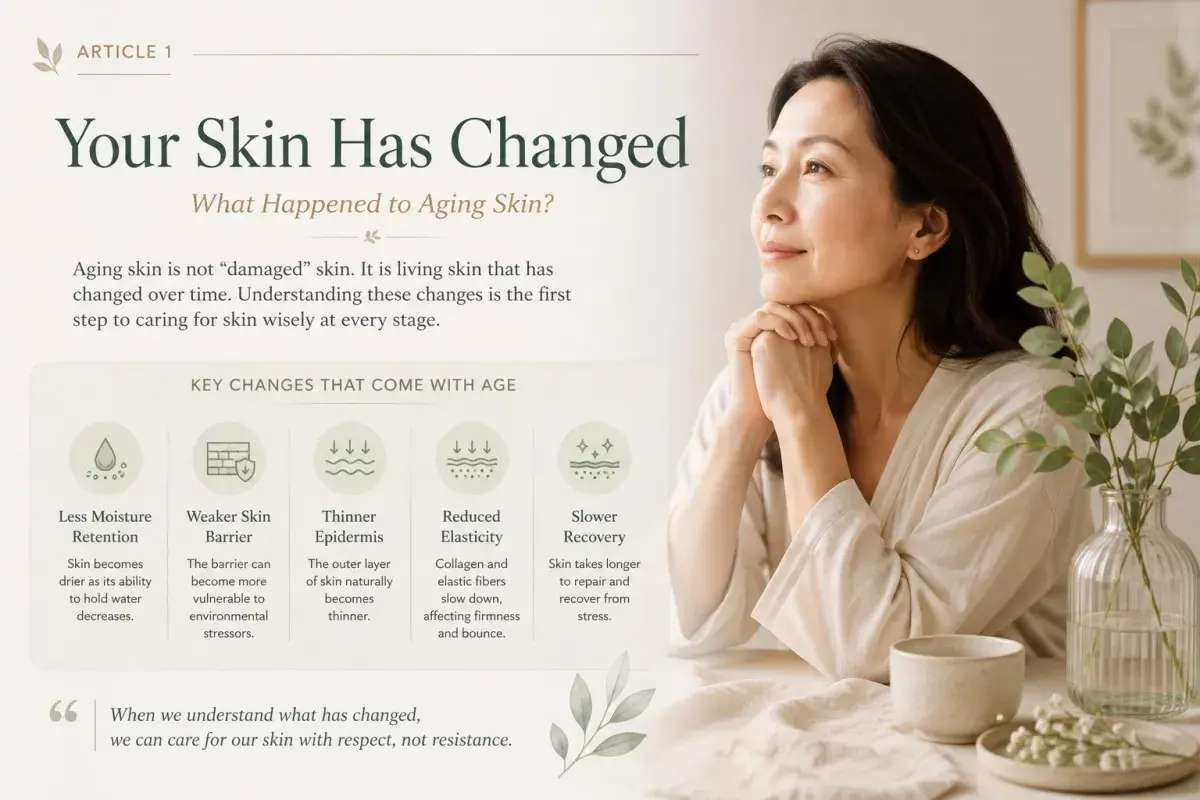
For most of our lives, we experience our skin from the outside. We notice a new line around the eyes, a rougher texture, increased tightness after cleansing, or a moisturizer that no longer seems to provide the same comfort it once did. These changes can easily be interpreted as signs that something has gone wrong, but aging skin is not failed young skin; it is living skin that has changed.
That distinction is important because skin undergoes biological changes throughout the life course. Recent dermatological literature has described aging as being associated with significant structural, molecular and functional changes in the skin, including changes that affect its barrier function (Wahhab et al., 2025). Understanding those changes gives us a more appropriate starting point than assuming that every visible sign of age represents damage that must be corrected.
Pro-Aging skin care begins with a question "What has changed, and what does my skin need now?”
The skin is an organ, not simply a surface
The skin is the body's largest organ and forms an interface between the body and its external environment. It provides protection, contributes to sensation and temperature regulation, participates in immune defense, and helps regulate the movement of water between the body and the environment (Kanitakis, 2002; Jiao et al., 2024). Its functions therefore extend far beyond the appearance we see in a mirror.
The outermost layer of the epidermis, the stratum corneum, has a particularly important role in maintaining that boundary. Fluhr et al. (2024) described it as the principal permeability and protective barrier of the skin and explained that its function depended on the coordinated activity of corneocytes, natural moisturizing factors, enzymes, antimicrobial components and lipids. Together, these components helped limit water loss and protect the body from infection and potentially harmful external factors (Fluhr et al., 2024).
This makes the skin's barrier function central to understanding aging skin. The skin does not simply hold water; it must regulate water movement while maintaining its structural and protective functions. When that system becomes altered, dryness, flaking, sensitivity and other changes can emerge, although the mechanisms underlying these conditions are not completely understood (Fluhr et al., 2024).
The skin protects us, but it is not an impenetrable wall
Because the skin acts as a barrier, it would be easy to assume that substances placed on its surface remain entirely outside the body. That would be too broad a conclusion, because certain substances can penetrate the skin, while the degree of penetration depends on the substance, its formulation, the exposure and characteristics of the skin.
The U.S. Food and Drug Administration distinguishes several routes of administration and defines topical administration as application to a particular location on the outer surface of the body. It separately defines transdermal administration as delivery through the dermal layer of the skin into the systemic circulation by diffusion (U.S. Food and Drug Administration [FDA], n.d.). This distinction is important because transdermal medicines are specifically designed to use the skin as a route for systemic drug delivery; it does not mean that every cream, oil or cosmetic applied to the skin enters the bloodstream.
The appropriate scientific question therefore is what substances can cross the skin barrier, under what conditions, in what amounts, and with what consequences. That question will become important later in this series when we examine topical products, botanical ingredients and natural preparations, but Article 1 begins simply by recognizing that the skin is a biological interface rather than an inert surface.
Image

The barrier itself changes with age
The skin barrier is not biologically identical throughout life. Contemporary research has described age-related changes in skin structure and function, including alterations involving the epidermis, dermis and mechanisms responsible for maintaining barrier integrity and hydration (Wahhab et al., 2025). These changes help explain why the skin of an older adult may respond differently to environmental exposure, cleansing and topical products than it did earlier in life.
The stratum corneum is particularly relevant because its barrier function depends on several interconnected processes rather than a single component. Fluhr et al. (2024) reported that healthy barrier function involved lipids, natural moisturizing factors, corneocyte maturation and desquamation, enzymatic activity, immune mechanisms, antimicrobial peptides and lipids, epidermal nerve fibres and the skin microbiome. The authors also emphasized that the underlying biology of dry and sensitive skin remained incompletely understood and called for additional research to clarify these mechanisms and support more individualized treatment (Fluhr et al., 2024).
This is important because it prevents us from reducing aging skin to one simple explanation. There is no single switch that turns “young skin” into “old skin”; rather, multiple biological processes change over time, and those changes can interact with one another.
Why does aging skin become dry?
Dryness is one of the most familiar experiences associated with aging skin, but it is not caused by age alone. The American Academy of Dermatology has explained that skin becomes drier with age because older skin becomes thinner and loses water more easily, while medications and medical conditions can also contribute to excessive dryness (American Academy of Dermatology [AAD], n.d.-a).
Research on epidermal barrier function has likewise linked dry skin with alterations in the stratum corneum and its components, while emphasizing that the complete pathophysiology of dry skin is still not fully understood (Fluhr et al., 2024). This means that when an older person experiences tightness, roughness or flaking, chronological age may be part of the explanation without necessarily being the whole explanation.
The distinction matters because dry skin is a condition or symptom, whereas aging is a biological process. Environmental conditions, cleansing practices, medications, medical conditions, hormonal changes and individual differences can all enter the picture, so the appearance of dryness should prompt observation rather than an automatic assumption about its cause.
Young skin is not perfect, and older skin is not automatically damaged
It is tempting to use younger skin as the standard against which all older skin should be judged. Yet younger skin can also be dry, sensitive, inflamed or affected by disease, while older skin can remain healthy, comfortable and resilient. The scientific discussion of skin aging is therefore more useful when it describes biological change rather than treating chronological age itself as a disease.
Recent dermatological literature has emphasized that aging produces significant changes in skin structure and function and that understanding these changes can help clinicians guide appropriate maintenance and proactive care (Wahhab et al., 2025). The objective is therefore not to assume that older skin must be restored to a younger state, but to understand the characteristics and needs of skin at its present stage of life.
This is the distinction at the heart of Pro-Aging skin care: we respect the aging process while protecting the functions that can still be supported.
Not all skin aging comes from the same source
Skin aging reflects both intrinsic biological processes and external influences. Intrinsic aging occurs as part of the passage of time, while extrinsic influences can accelerate visible and functional changes; among these external influences, ultraviolet radiation has a particularly well-established relationship with premature skin aging (AAD, n.d.-b).
The American Academy of Dermatology has identified sun protection as a foundation of skin care because ultraviolet exposure contributes to premature skin aging. It has also emphasized that realistic skin-care goals are important because no single product can address every manifestation of aging (AAD, n.d.-b). The distinction between intrinsic and extrinsic aging therefore gives us a more realistic understanding of what can and cannot be influenced.
We cannot stop chronological aging. We can, however, recognize that some environmental exposures are modifiable and that protecting the skin from avoidable damage is different from trying to erase the fact that the skin is aging.
Hormonal change can become part of the story
For women, the menopausal transition can introduce another biological influence on the skin. The American Academy of Dermatology has reported that declining estrogen levels during menopause can contribute to thinner, drier skin and reduced ability to retain moisture, and it has recommended gentle cleansing and regular moisturization as part of caring for menopausal dry skin (AAD, n.d.-c).
That information should nevertheless be interpreted carefully. Menopause does not explain every change that occurs in aging skin, just as chronological age does not explain every episode of dryness. Hormonal changes are one part of a larger interaction among biological aging, environmental exposure, skin-barrier function and individual characteristics.
Image
Why the routine that worked before may no longer be enough
Many people discover aging skin not through a scientific paper but through an ordinary experience: the routine that worked for years suddenly does not feel right anymore. A cleanser may leave the skin tighter than before, a lightweight moisturizer may no longer provide sufficient comfort, or products that were previously tolerated may begin to cause irritation.
The AAD has noted that skin holds less moisture with age and that moisturizer selection should take account of skin type and the severity of dryness rather than assuming that one formulation will work for everyone (AAD, n.d.-d). The implication is not that earlier skincare was wrong, but that the biological condition of the skin may have changed enough to justify reassessment.
A skincare routine is therefore not a lifetime contract. When the skin changes, it is reasonable to examine the routine again.
But more is not necessarily better
When an established routine stops working, adding more products can seem like the logical response. Yet the AAD has advised introducing anti-aging products carefully, focusing on one concern at a time and recognizing that using several products too quickly can irritate the skin (AAD, n.d.-e). Irritation itself can make some visible signs of aging more noticeable, which means that aggressive experimentation can work against the goal of caring for the skin.
This is another reason why Pro-Aging care should begin with understanding rather than accumulation. The question is not how many products can be placed on aging skin, but whether the care being provided is appropriate for the skin's present condition.
When dryness may be more than ordinary aging
Dryness should also not automatically be dismissed as an inevitable consequence of getting older. The AAD has explained that persistent or excessive dryness may be associated with medical conditions, medications or other causes and may require professional assessment, particularly when symptoms are severe or accompanied by cracking, bleeding, pain, significant irritation or other concerning changes (AAD, n.d.-f).
This is an important boundary for public education. Understanding aging skin should help people recognize when ordinary skin-care adjustments may be reasonable and when a persistent problem deserves professional evaluation. Pro-Aging does not mean avoiding dermatological care. It means knowing enough about aging skin to recognize when dermatological care is appropriate.
The first act of Pro-Aging care: know before you change
The evidence gives us a more complete picture of aging skin. Skin is a living organ and a protective barrier; its structure and function change throughout life, dryness has multiple possible contributors, environmental exposure can influence premature aging, hormonal changes can affect skin physiology, and the products or practices that were once tolerated may not always remain appropriate. None of this means that aging skin has failed. It means that aging skin deserves to be understood on its own terms.
Therefore, the most appropriate first question of Pro-Aging skin care is “What has changed, what is my skin experiencing now, and what does the evidence tell me about caring for it?”
That is where our investigation begins. Before we change the skin, we first need to learn how to read it.
…. Next in the series - Article 2 — THE KNOWING: Before You Change Your Skin Care, Know the Skin You Have Today
Image
Suggested Citation
Lendez, M. L. (2026). Pro-Aging Skin Care: TheChange. Chikicha.com. (the author is the developer of the Ikigai-Bayanihan Framework for Purposeful Aging).
About the Author
Dr. Mariza Lendez is a researcher, social entrepreneur, and creator of the Ikigai-Bayanihan (Purpose + Collective Ethos) Retirement Model, an innovative framework that integrates purpose, community engagement, and sustainability to support meaningful aging and later-life well-being.
References
American Academy of Dermatology. (n.d.-a). How to care for your skin in your 60s and 70s. https://www.aad.org/public/everyday-care/skin-care-basics/care/skin-care-in-your-60s-and-70s
American Academy of Dermatology. (n.d.-b). Skin care in your 40s and 50s. https://www.aad.org/public/everyday-care/skin-care-basics/care/skin-care-in-your-40s-and-50s
American Academy of Dermatology. (n.d.-c). Skin care during menopause. https://www.aad.org/public/everyday-care/skin-care-secrets/anti-aging/skin-care-during-menopause
American Academy of Dermatology. (n.d.-d). How to pick the right moisturizer for your skin. https://www.aad.org/public/everyday-care/skin-care-basics/dry/pick-moisturizer
American Academy of Dermatology. (n.d.-e). How to select anti-aging skin care products. https://www.aad.org/public/everyday-care/skin-care-secrets/anti-aging/selecting-anti-aging-products
American Academy of Dermatology. (n.d.-f). Dry skin: Diagnosis and treatment. https://www.aad.org/public/diseases/a-z/dry-skin-treatment
Fluhr, J. W., Moore, D. J., Lane, M. E., Lachmann, N., & Rawlings, A. V. (2024). Epidermal barrier function in dry, flaky and sensitive skin: A narrative review. Journal of the European Academy of Dermatology and Venereology, 38(5), 812–820. https://doi.org/10.1111/jdv.19745
Jiao, Y., et al. (2024). [Locked source from the Article 1 evidence bank].
Kanitakis, J. (2002). Anatomy, histology and immunohistochemistry of normal human skin. European Journal of Dermatology, 12(4), 390–401. PubMed record
U.S. Food and Drug Administration. (n.d.). Route of administration. https://www.fda.gov/drugs/data-standards-manual-monographs/route-administration
Wahhab, R., Sanders, M., Kokikian, N., Ni, C., & Vandiver, A. R. (2025). Clinical consequences of age-related skin barrier dysfunction—Part I: Structural, molecular, and physiologic changes with cutaneous aging. Journal of the American Academy of Dermatology, 93(4), 905–914. https://doi.org/10.1016/j.jaad.2024.08.044