I. Introduction: The Emerging Economic Frontier
The Philippines is entering a demographic transition that is often framed as a fiscal challenge, yet it also presents a significant economic opportunity. By 2030, more than 8.5 million Filipinos are projected to be aged 60 and above (Philippine Statistics Authority, 2023). At the same time, the Asian Development Bank (2023) estimated that the country’s silver economy could reach approximately ₱1.2 trillion, driven by consumption, services, and extended participation.
Despite this scale, structural gaps remain evident. The Bangko Sentral ng Pilipinas (2024) reported that a significant proportion of Filipino adults, particularly among older segments, remain outside formal financial systems. This gap reflects not a lack of potential, but a mismatch between system design and user realities. Economic opportunity exists, but participation remains constrained.
Reframing the silver economy requires a shift from welfare-oriented thinking toward inclusion-driven strategy. Older adults must be understood not only as beneficiaries of support systems but as contributors to economic activity. Unlocking this potential depends on how effectively institutions align access, design, and participation.
II. Financial Inclusion: Designing for Real Users
Financial exclusion among older Filipinos is rooted not only in access but in usability. Many financial technologies assume literacy, digital familiarity, and confidence navigating complex interfaces. However, global evidence from the World Health Organization (2021) highlighted that aging populations often experience cognitive, visual, and functional changes that affect digital interaction.
This creates a structural disconnect between innovation and accessibility. Systems designed for efficiency can unintentionally exclude those who require simplicity and clarity. As a result, older adults may remain hesitant to adopt digital tools, even when such tools could improve their financial security.
Inclusive design offers a practical solution. Voice-assisted transactions, simplified interfaces, and USSD-based services can bridge usability gaps. Evidence from the Reserve Bank of India (2022) demonstrated that low-tech, user-centered financial systems significantly improved adoption among underserved populations. In the Philippine context, similar approaches could expand both access and trust.
Image

III. Agricultural Knowledge as Economic Capital
The agricultural sector provides a clear example of untapped value within aging populations. Older farmers possess decades of experiential knowledge related to climate patterns, soil management, and crop resilience. Yet much of this knowledge remains informal and at risk of being lost. The Department of Science and Technology - PCAARRD (2023) noted that many aging farmers lack structured succession plans.
This gap represents both a vulnerability and an opportunity. As younger generations move away from agriculture, knowledge continuity weakens, increasing dependence on external inputs and reducing resilience. The loss is not only cultural but economic.
Digital and community-based platforms provide pathways for preservation and monetization. By transforming tacit knowledge into structured learning or advisory services, older farmers can participate in new economic models. In doing so, agriculture evolves from a labor-driven sector into a knowledge-driven ecosystem.
IV. Financial Vulnerability and the Rise of Protection Economies
Older adults face increasing exposure to financial risk, particularly in digital environments. Studies from the Organisation for Economic Co-operation and Development (2020) found that older individuals are more susceptible to fraud due to trust-based decision-making patterns and lower digital familiarity. This vulnerability is often compounded by underreporting.
Traditional awareness campaigns have shown limited effectiveness when they rely solely on passive information dissemination. Behavioral and community-based approaches have demonstrated stronger outcomes. Prevention, rather than reaction, becomes the more effective strategy.
For example, initiatives by the Singapore Police Force (2023) reported measurable reductions in scam incidents through structured, community-led education programs. In the Philippine setting, similar localized approaches could enhance protection while creating new service opportunities within the silver economy.
V. Intergenerational Workspaces and Shared Productivity
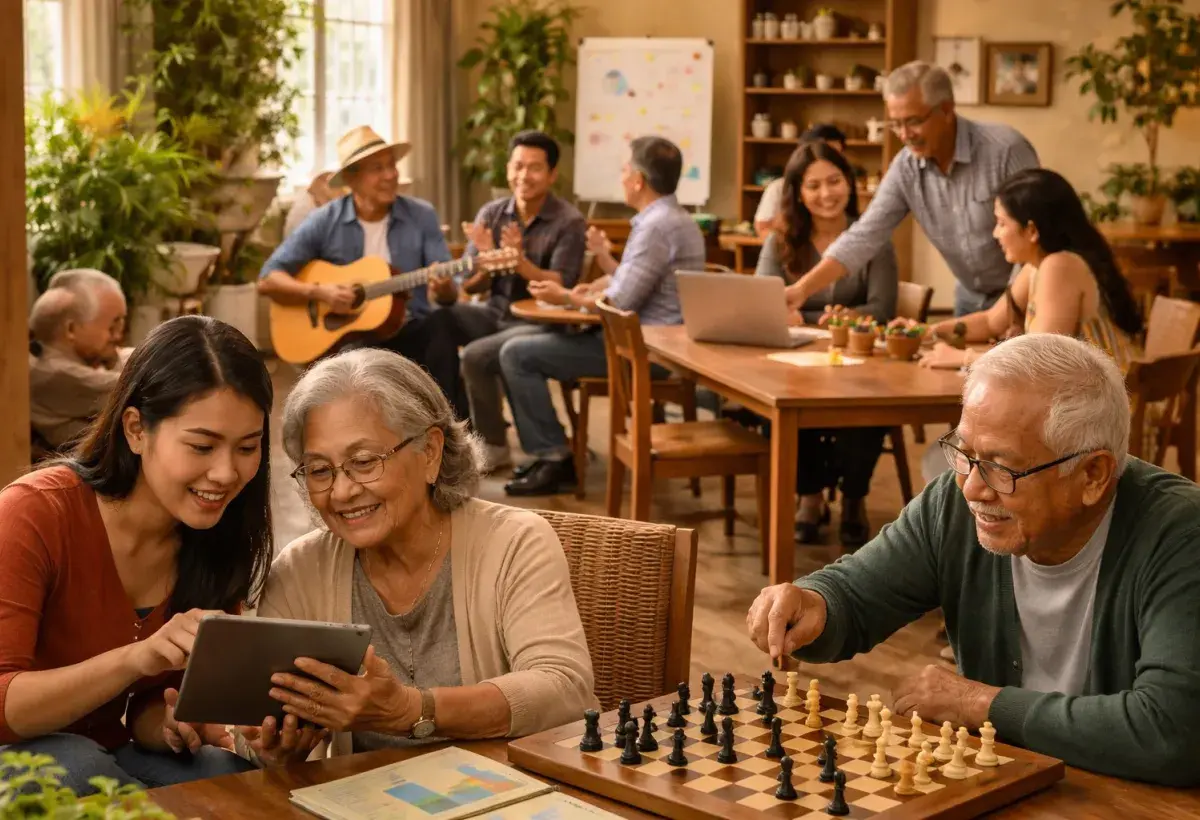
Aging populations and youth unemployment are often treated as separate issues, yet they exist within the same economic ecosystem. Integrating these groups offers a pathway toward shared productivity. Older adults contribute experience and contextual understanding, while younger individuals bring digital skills and adaptability.
Research from the World Health Organization (2021) indicated that sustained social engagement plays a critical role in maintaining cognitive and emotional well-being among older adults. At the same time, intergenerational collaboration enhances learning outcomes for younger participants.
Co-working hubs and shared community spaces can facilitate this exchange. These environments enable knowledge transfer, mentorship, and collaborative work. More importantly, they redefine productivity as a collective process, rather than an individual metric.
Image
VI. Toward a Philippine Model of the Silver Economy
The Philippine silver economy illustrates a broader principle: demographic change alone does not generate value but systems do. Financial inclusion, knowledge preservation, protection mechanisms, and intergenerational integration must function together to enable participation. Without alignment, potential remains unrealized.
The convergence of these elements points toward a uniquely Philippine model of aging, one that integrates economic opportunity with social cohesion. Cultural values such as family, community, and shared responsibility provide a strong foundation for this model. When supported by policy and innovation, these values can translate into measurable economic outcomes.
The transition requires intentional design. Policies must promote accessibility, institutions must support participation, and systems must adapt to real user conditions. Only then can the silver economy move from projection to reality.
VII. Conclusion: From Untapped to Unlocked
The ₱1.2 trillion silver economy is not a distant possibility,it is an emerging reality shaped by demographic change and institutional response. The Philippines stands at a critical juncture where aging can either deepen structural gaps or unlock new pathways for growth.
The difference lies in perspective and execution. When older adults are viewed as assets rather than dependents, new opportunities emerge across sectors. When systems are designed for inclusion, participation follows.
Ultimately, the silver economy is not about aging alone. It is about how societies recognize, value, and activate human potential across the lifespan. In doing so, the Philippines can transform a demographic
Image

Suggested Citation:
Lendez, M. (2026). Unlocking the ₱1.2 trillion silver economy: Untapped opportunities in an aging Philippines. Developed within the IKIGAI-Bayanihan Purpose-Driven Retirement Framework.
About the Author
Written by Dr. Mariza Lendez, the developer of the Ikigai-Bayanihan Purpose-Driven Retirement Framework, a model that redefines aging through purpose, dignity, and community-centered living.
References
Philippine Statistics Authority. (2023). 2020 census of population and housing: Age and sex distribution in the Philippines. https://psa.gov.ph
Bangko Sentral ng Pilipinas. (2024). Financial inclusion survey 2023. https://www.bsp.gov.ph
Economic Framing
Asian Development Bank. (2023). Asia’s aging population and the silver economy: Opportunities and challenges. https://www.adb.org
Sector-Specific
Department of Science and Technology - PCAARRD. (2023). Aging farmers and agricultural succession in the Philippines. https://www.pcaarrd.dost.gov.ph
Aging + System Design
World Health Organization. (2021). Decade of healthy ageing: Baseline report. https://www.who.int
Risk / Fraud / Vulnerability
Organisation for Economic Co-operation and Development. (2020). Consumer policy and vulnerability in the digital age. https://www.oecd.org
Comparative / Supporting Models
Reserve Bank of India. (2022). Financial inclusion initiatives and digital banking accessibility. https://www.rbi.org.in
Singapore Police Force. (2023). Annual scam statistics and prevention initiatives. https://www.police.gov.sg