
Disclaimer
The author is not a licensed medical doctor, psychiatrist, or healthcare professional. This article is intended solely for educational and public awareness purposes and is based on scientific literature, peer-reviewed research, and information from recognized international health authorities. It is not intended to replace professional medical advice, diagnosis, treatment, or individualized healthcare guidance. The author and Chikicha do not sell, endorse, or promote any products, supplements, treatments, or medical interventions discussed in relation to this topic. Readers with concerns about muscle health, physical function, or any health condition should consult an appropriately qualified healthcare professional for individualized assessment and advice.
The Aging Destination We Can Slow Down
Aging changes skeletal muscle gradually.
Muscle does not simply become smaller as we grow older. Its ability to produce force, generate power, maintain quality, and support physical function also changes. This is why sarcopenia has become an important subject in aging research, because changes in muscle can affect mobility, independence, health, and quality of life.
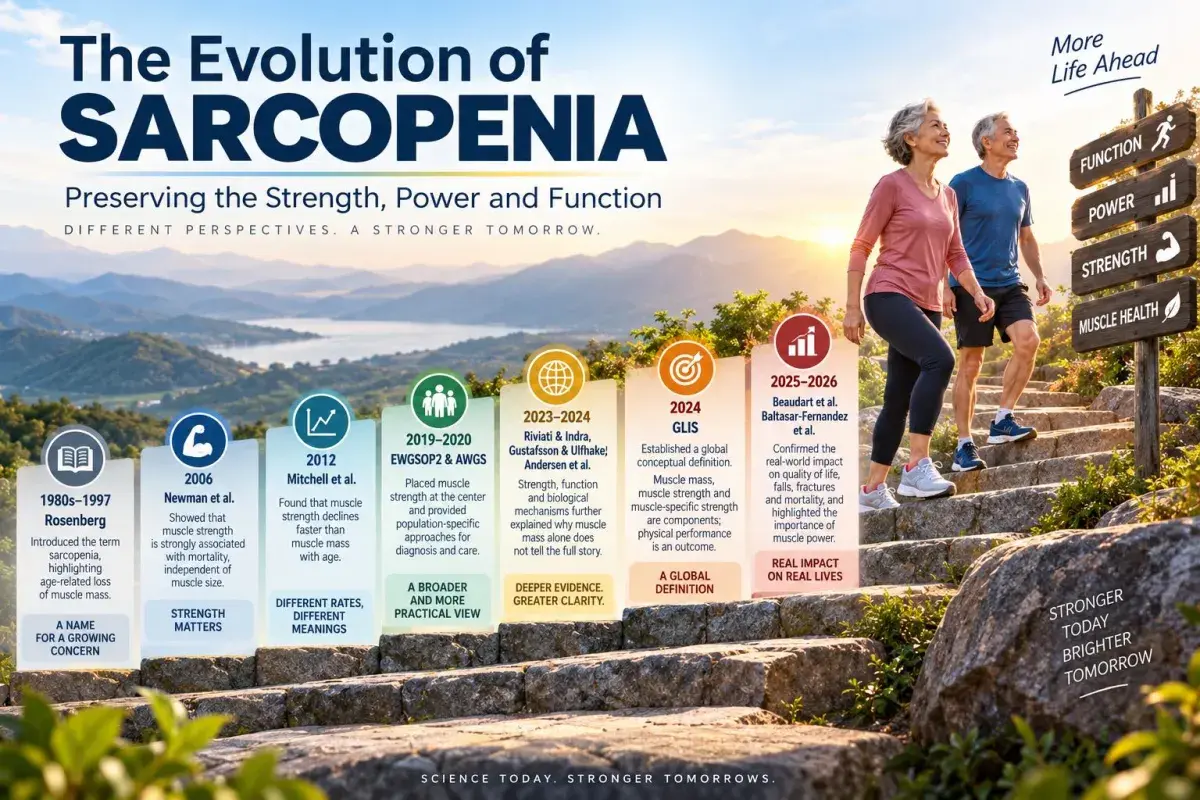
Yet sarcopenia has not always been understood this way. The scientific definition has evolved considerably over the past several decades. What began as a term describing age-related loss of muscle has developed into a much more precise understanding involving muscle mass, muscle strength, muscle-specific strength, and physical function. Understanding that evolution gives us a better starting point for understanding aging itself.
From “loss of flesh” to sarcopenia
The word sarcopenia comes from the Greek “sarx”, meaning flesh, and “penia”, meaning loss.
Irwin Rosenberg introduced the term in the late 1980s to describe the important changes in body composition and related functions associated with aging. His work helped establish a name for a phenomenon that researchers were beginning to recognize as more significant than ordinary changes in body composition (Rosenberg, 1997). At that time, the emphasis was largely on the loss of muscle tissue.
Research that followed gradually demonstrated that muscle size alone could not tell the whole story.
When muscle mass was no longer enough
One of the important developments in sarcopenia research was the recognition that muscle mass and muscle strength do not decline at the same rate.
Mitchell et al. (2012) conducted a quantitative review of changes in human skeletal muscle size and strength with advancing age. In studies of people around age 75, muscle mass was reported to decline at approximately 0.64-0.70% per year in women and 0.80-0.98% per year in men. Strength declined substantially faster approximately 2.5-3% per year in women and 3-4% per year in men.
In studies that measured both, strength declined approximately two to five times faster than muscle mass (Mitchell et al., 2012). This finding was important because it showed that an older person could lose relatively little muscle size while experiencing a much larger decline in what that muscle could actually do. Mitchell and colleagues therefore emphasized the importance of muscle quality - the force-generating capacity of muscle relative to its size.
The distinction was also evident in the Health, Aging and Body Composition Study. Newman et al. (2006) followed 2,292 adults aged 70-79 for an average of 4.9 years. During the follow-up period, 286 participants died. The researchers found strong associations between quadriceps and grip strength and mortality, while muscle size measured by CT and DXA was not strongly associated with mortality in that cohort.
Their conclusion was not that muscle mass had no value. Rather, their findings indicated that muscle size alone did not explain the relationship between strength and mortality. Strength appeared to provide important information about muscle quality and health risk beyond muscle quantity (Newman et al., 2006), and this distinction remains important today.
The newer evidence strengthens the older evidence
Later research has continued to examine whether muscle mass and muscle strength tell the same story. They do not. Muscle mass tells us how much muscle remains; muscle strength tells us what that muscle can do.
Riviati and Indra (2023) conducted a systematic review of 17 observational studies examining the relationship between muscle mass, muscle strength, and physical performance in older adults. Their review found that declining muscle mass was not necessarily accompanied by declining muscle strength.
More importantly, physical performance showed a stronger and more consistent relationship with muscle strength than with muscle mass alone. Their findings support an increasingly important principle in sarcopenia research that having muscle and being able to use that muscle effectively are related, but they are not identical measures.
Gustafsson and Ulfhake (2024) provided further biological context. Their review of aging skeletal muscle described changes involving muscle fibers, motor units, neuromuscular function, and other biological processes that contribute to age-related loss of strength and muscle mass. Their work helps explain why strength can deteriorate differently from muscle size. Aging affects not only the amount of muscle tissue but also the systems responsible for activating and using that tissue. The evidence has also been extended into the oldest-old population.
Andersen et al. (2024) examined the association between muscle strength and mortality among 1,890 adults aged 90 years and older from 27 European countries and Israel. Over an average follow-up of 4.2 years, 971 participants died. Lower muscle strength was associated with higher mortality, while higher strength was associated with lower mortality. The relationship was gradual rather than defined by one specific strength threshold (Andersen et al., 2024).
Together, these studies strengthen the earlier work of Newman and Mitchell. They also add an important qualification, that muscle mass still matters. But muscle mass alone does not describe the functional capacity of aging muscle.
The Asian perspective
The evolution of sarcopenia research is particularly relevant to Asia. The Asian Working Group for Sarcopenia updated its consensus in 2019, with the recommendations published by Chen et al. (2020). The AWGS retained the importance of age-related muscle loss while incorporating muscle strength and physical performance into the identification of sarcopenia.
The group also introduced the practical concept of possible sarcopenia, which can be identified through low muscle strength or low physical performance alone. This approach was intended to facilitate earlier identification, particularly in primary healthcare and community settings, where more comprehensive diagnostic equipment may not always be available.
The AWGS framework also established assessment approaches and cutoffs specifically relevant to Asian populations (Chen et al., 2020), this was an important development. A global aging problem cannot necessarily be assessed using one population's measurements and assumptions. Differences in body size, ethnicity, health patterns, and population characteristics make population-specific approaches important in clinical and community assessment.
EWGSOP2 changes the question
In 2019, the European Working Group on Sarcopenia in Older People published its revised consensus, known as EWGSOP2. Cruz-Jentoft and colleagues made a decisive shift in the way sarcopenia should be approached.
Rather than placing muscle mass at the center, EWGSOP2 placed low muscle strength as the key characteristic of sarcopenia. Low muscle quantity or quality was used to confirm the condition, while poor physical performance indicated severe sarcopenia. The group described sarcopenia as a muscle disease, or muscle failure, resulting from adverse changes in skeletal muscle that accumulate across the lifetime. It also made another important point: Sarcopenia does not necessarily begin at a particular age.
Although it is common in older adults, it can occur earlier in life. The measurable condition seen in later life may therefore represent the accumulated result of a much longer process (Cruz-Jentoft et al., 2019), and this changes how we think about prevention. If muscle aging is a process, then the opportunity to influence that process also exists before the condition becomes severe.
Image
The Global Definition Becomes Clearer
The understanding of sarcopenia took another important step forward with the Global Leadership Initiative in Sarcopenia (GLIS). In 2024, Kirk et al. brought together 107 experts from 29 countries across seven continents or regions through a Delphi consensus process to establish a global conceptual definition of sarcopenia. Their work brought together decades of research and clarified how the different dimensions of aging muscle should be understood.
The GLIS consensus identified muscle mass, muscle strength, and muscle-specific strength as components of sarcopenia. At the same time, it made an important distinction: impaired physical performance is an outcome of sarcopenia, rather than a component of the condition itself (Kirk et al., 2024). This distinction helps us understand what each measure tells us.
Muscle mass tells us how much skeletal muscle is present. Muscle strength tells us how much force that muscle can produce. Muscle-specific strength considers the force-producing capacity of the muscle in relation to its size, providing an important way of understanding what has traditionally been described as muscle quality.
Physical performance is different, it reflects how muscular capacity is ultimately expressed through movement and function whether a person can walk, rise from a chair, climb stairs, maintain balance, or perform other physical tasks. These abilities depend on muscle, but they are also influenced by the nervous system, balance, coordination, cardiovascular capacity, joints, and other physiological systems. The GLIS framework therefore moves us beyond the idea that sarcopenia can be captured by a single measurement.
How much muscle we have, how much force it can produce, how efficiently it can generate that force, and how that capacity translates into physical function are related dimensions, but they are not interchangeable. Together, they provide a more complete understanding of how skeletal muscle changes with age (Kirk et al., 2024).
And Then There Is Muscle Power
There is another dimension of aging muscle that becomes especially important when we move from measurement to everyday life: muscle power. Strength refers to the ability of a muscle to produce force; power adds another element - the ability to produce that force quickly.
This informations matters because many everyday movements do not simply require enough strength; they require the body to generate force within a limited amount of time. Rising from a chair, climbing stairs, recovering from a stumble, or responding to a sudden loss of balance all depend, in part, on how quickly the muscles can produce force. In this sense, power brings us closer to understanding how aging muscle performs in the real world.
Getting up from a chair is not simply about whether the legs can produce enough force. Recovering from a stumble, climbing stairs, crossing a street safely, or responding to a sudden loss of balance also requires the ability to generate force rapidly.
Recent longitudinal evidence shows why power deserves attention. Baltasar-Fernandez et al. (2026) followed 565 adults aged 65 and older for eight years and examined changes in relative sit-to-stand power. Relative power declined in both men and women, with greater declines among adults aged 75 and older. Their analysis estimated that approximately 95% of the average decline in relative sit-to-stand power was attributable to reduced specific sit-to-stand power, while approximately 5% was attributable to loss of leg muscle mass.
The finding does not mean that muscle mass is unimportant, however, it demonstrates something more precise, that the ability of muscle to produce useful force and power can deteriorate substantially beyond the amount of muscle tissue that has been lost. This is one reason why looking only at muscle size can underestimate the functional consequences of aging muscle.
Sarcopenia Is a Trajectory, Not a Birthday
The evidence gives us a clearer way to think about when sarcopenia begins. It does not begin simply because a person reaches a particular birthday. There is no single age-60, 65, or 70 - at which sarcopenia suddenly appears.
EWGSOP2 describes sarcopenia as the result of adverse changes in skeletal muscle that accumulate across the lifetime (Cruz-Jentoft et al., 2019). What becomes apparent in later life may therefore reflect a process that has been developing gradually, with the rate and extent of change differing from one person to another.
This trajectory is also not defined by a single measure - muscle mass, strength, muscle-specific strength, and power can change at different rates, which means that two people of the same chronological age may have very different levels of muscular capacity and physical function. Their difference is not simply their age; it is also the result of the biological and physical experiences accumulated over time.
Why Sarcopenia Matters
Understanding sarcopenia as a trajectory also changes the significance of the condition. The concern is not simply that muscle mass or strength decline with age, but that progressive changes in skeletal muscle can eventually compromise the physical reserve required to maintain mobility, independence, and resilience.
The Global Leadership Initiative in Sarcopenia's 2025 outcome consensus, led by Beaudart and colleagues, synthesized evidence from systematic reviews, meta-analyses, and cohort studies and found strong evidence linking sarcopenia with important adverse outcomes, including reduced quality of life, falls, fractures, and mortality (Beaudart et al., 2025). These outcomes place sarcopenia beyond the boundaries of a body-composition problem.
They position muscle health within the broader capacity of an individual to withstand physical stress, recover from illness or injury, remain independent, and continue participating in everyday life.
Seen in this context, the evolution of sarcopenia research becomes more coherent. Rosenberg (1997) gave the phenomenon its name and drew attention to age-related loss of muscle. Mitchell et al. (2012) demonstrated that strength declines substantially faster than muscle mass, while Newman et al. (2006) showed that strength was strongly associated with mortality in older adults even after accounting for muscle size.
The AWGS consensus extended assessment into Asian populations, while Riviati and Indra (2023) demonstrated that physical performance is more consistently related to muscle strength than to muscle mass alone. EWGSOP2 subsequently placed low muscle strength at the center of clinical assessment, and Gustafsson and Ulfhake (2024) further described the neuromuscular and cellular complexity underlying age-related changes in muscle. Andersen et al. (2024) extended the strength mortality evidence into adults aged 90 and older.
The GLIS consensus then brought these strands into a global conceptual framework, distinguishing muscle mass, muscle strength, and muscle-specific strength as components of sarcopenia, while recognizing impaired physical performance as an important outcome (Kirk et al., 2024). More recent longitudinal evidence on muscle power adds another dimension, showing that declines in functional power can substantially exceed what would be expected from muscle-mass loss alone (Baltasar-Fernandez et al., 2026).
The progression of the evidence therefore tells a consistent story: the aging of muscle is not adequately described by how much muscle remains. It must also be understood through what that muscle can produce, how efficiently it can respond, and how that capacity translates into physical function.
Sarcopenia is no longer adequately described as simply “losing muscle because we are getting older.” And that brings us to the biological question at the center of the next article: What is happening inside the aging muscle that drives these changes?
The Muscle of Longevity: Why Does Sarcopenia Happen?
The Biology Behind the Decline
Image

Suggested Citation
Lendez, M.L. (2026). What is Sarcopenia?. Chikicha.com (the author is the developer of the Ikigai-Bayanihan Framework for Purposeful Aging).
About the Author
Dr. Mariza Lendez is a researcher, social entrepreneur, and creator of the Ikigai-Bayanihan (Purpose + Collective Ethos) Retirement Model, an innovative framework that integrates purpose, community engagement, and sustainability to support meaningful aging and later-life well-being
References
Andersen, L. L., López-Bueno, R., Núñez-Cortés, R., Lusa Cadore, E., Polo-López, A., Calatayud, J., Andersen, L. L., López-Bueno, R., Núñez-Cortés, R., Lusa Cadore, E., Polo-López, A., & Calatayud, J. (2024). Association of muscle strength with all-cause mortality in the oldest old: Prospective cohort study from 28 countries. Journal of Cachexia, Sarcopenia and Muscle, 15(6), 2756–2764. https://doi.org/10.1002/jcsm.13619
Baltasar-Fernandez, I., Alcazar, J., Gómez-Cabello, A., Moradell, A., Pedrero Chamizo, R., Alegre, L. M., Villa-Vicente, J. G., Gusi, N., González-Gross, M., Casajús, J. A., Vicente-Rodríguez, G., & Ara, I. (2026). Changes and major determinants of relative muscle power loss in older adults: Results from an 8-year longitudinal study. European Journal of Applied Physiology, 126(3), 1737–1750. https://doi.org/10.1007/s00421-025-05947-3
Beaudart, C., Alcazar, J., Aprahamian, I., Batsis, J. A., Yamada, Y., Prado, C. M., Reginster, J.-Y., Sanchez-Rodriguez, D., Lim, W. S., Sim, M., von Haehling, S., Woo, J., Duque, G., & Global Leadership Initiative in Sarcopenia (GLIS) group. (2025). Health outcomes of sarcopenia: A consensus report by the outcome working group of the Global Leadership Initiative in Sarcopenia (GLIS). Aging Clinical and Experimental Research, 37, 100. https://doi.org/10.1007/s40520-025-02995-9
Chen, L.-K., Woo, J., Assantachai, P., Auyeung, T.-W., Chou, M.-Y., Iijima, K., Jang, H. C., Kang, L., Kim, M., Kim, S., Kojima, T., Kuzuya, M., Lee, J. S. W., Lee, S. Y., Lee, W.-J., Lee, Y., Liang, C.-K., Lim, J.-Y., Lim, W.-S., ... Arai, H. (2020). Asian Working Group for Sarcopenia: 2019 consensus update on sarcopenia diagnosis and treatment. Journal of the American Medical Directors Association, 21(3), 300–307.e2. https://doi.org/10.1016/j.jamda.2019.12.012
Cruz-Jentoft, A. J., Bahat, G., Bauer, J., Boirie, Y., Bruyère, O., Cederholm, T., Cooper, C., Landi, F., Rolland, Y., Sayer, A. A., Schneider, S. M., Sieber, C. C., Topinková, E., Vandewoude, M., Visser, M., & Zamboni, M. (2019). Sarcopenia: Revised European consensus on definition and diagnosis. Age and Ageing, 48(1), 16–31. https://doi.org/10.1093/ageing/afy169
Gustafsson, T., & Ulfhake, B. (2024). Aging skeletal muscles: What are the mechanisms of age-related loss of strength and muscle mass, and can we impede its development and progression? International Journal of Molecular Sciences, 25(20), 10932. https://doi.org/10.3390/ijms252010932
Kirk, B., Cawthon, P. M., Arai, H., Ávila-Funes, J. A., Barazzoni, R., Bhasin, S., Binder, E. F., Bruyere, O., Cederholm, T., Chen, L.-K., Cooper, C., Duque, G., Fielding, R. A., Guralnik, J., Kiel, D. P., Landi, F., Reginster, J.-Y., Sayer, A. A., Visser, M., von Haehling, S., Woo, J., Cruz-Jentoft, A. J., & Global Leadership Initiative in Sarcopenia (GLIS) group. (2024). The conceptual definition of sarcopenia: Delphi consensus from the Global Leadership Initiative in Sarcopenia (GLIS). Age and Ageing, 53(3), afae052. https://doi.org/10.1093/ageing/afae052
Mitchell, W. K., Williams, J., Atherton, P., Larvin, M., Lund, J., & Narici, M. (2012). Sarcopenia, dynapenia, and the impact of advancing age on human skeletal muscle size and strength: A quantitative review. Frontiers in Physiology, 3, 260. https://doi.org/10.3389/fphys.2012.00260
Newman, A. B., Kupelian, V., Visser, M., Simonsick, E. M., Goodpaster, B. H., Kritchevsky, S. B., Tylavsky, F. A., Rubin, S. M., & Harris, T. B. (2006). Strength, but not muscle mass, is associated with mortality in the Health, Aging and Body Composition Study cohort. The Journals of Gerontology: Series A, 61(1), 72–77. https://doi.org/10.1093/gerona/61.1.72
Riviati, N., & Indra, B. (2023). Relationship between muscle mass and muscle strength with physical performance in older adults: A systematic review. SAGE Open Medicine, 11, 20503121231214650. https://doi.org/10.1177/20503121231214650
Rosenberg, I. H. (1997). Sarcopenia: Origins and clinical relevance. The Journal of Nutrition, 127(5 Suppl), 990S–991S. https://doi.org/10.1093/jn/127.5.990S