An Opening Manifesto
“Where should I grow old and why does it matter more than ever?”
For those approaching retirement, this is no longer a distant question. It is immediate, practical, and consequential. The answer will shape not only how long we live, but how well we live in the years that follow.
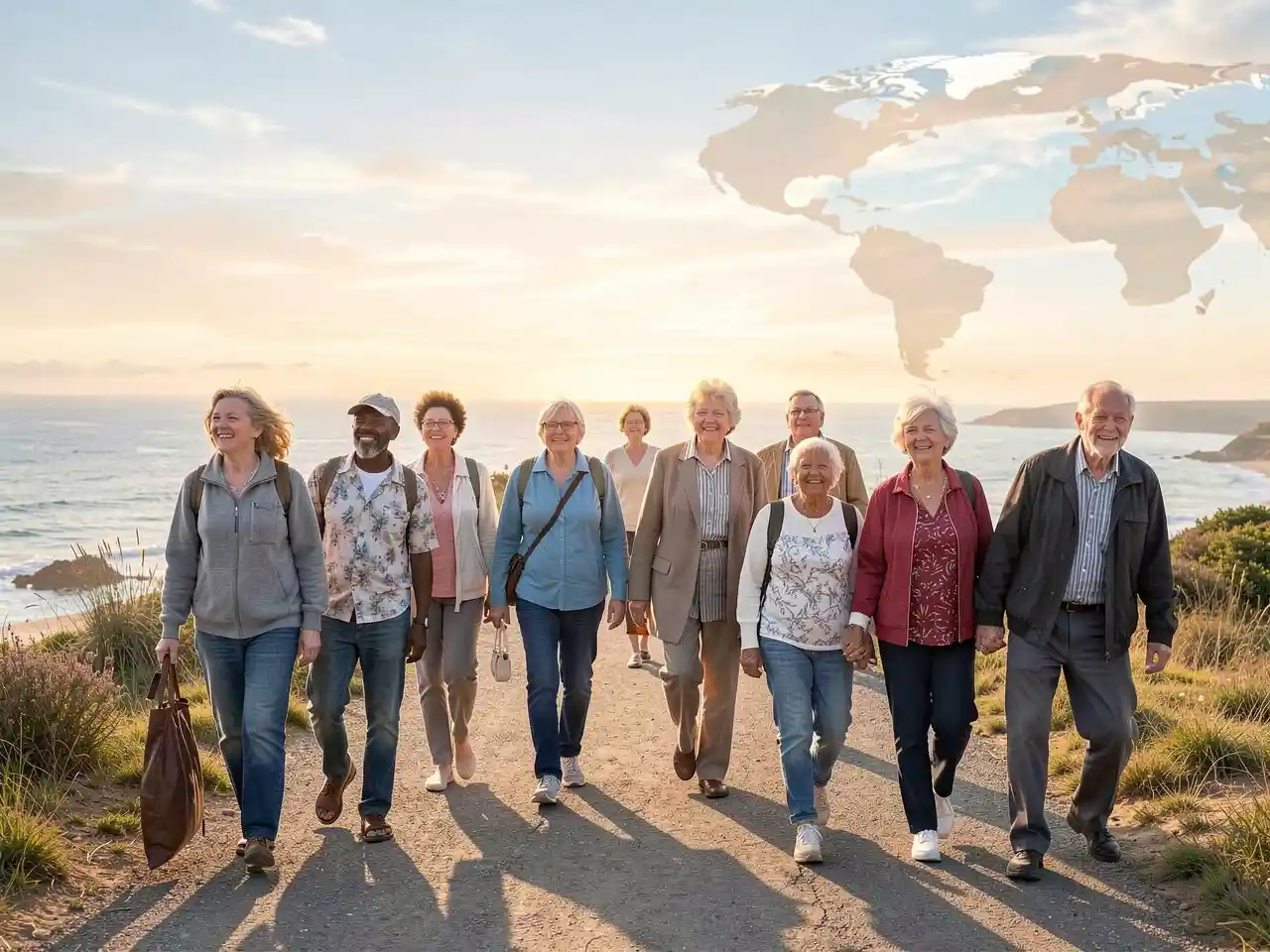
The world is aging quietly, steadily, and faster than most realize. By 2050, the global population aged 60 and above is projected to reach 2.1 billion, more than double the number recorded in 2015 (United Nations Department of Economic and Social Affairs [UN DESA], 2023). For the first time in history, older adults will outnumber children under the age of 15. This shift is not theoretical. It is already reshaping economies, healthcare systems, labor markets, and family structures.
Yet while the numbers are clear, readiness is not.
Behind every statistic is a human life. A retired public-school teacher in Manila. A former factory worker in Berlin. A grandmother in Nairobi supporting both grandchildren and herself. Each carries the same expectation that later life will provide stability, dignity, and continuity. Whether that expectation is met depends increasingly on where one grows old.
Some countries have invested in systems that support aging through pensions, healthcare, housing, and long-term care. Others rely heavily on families, often without financial, institutional, or technical support. The result is a widening gap in how aging is experienced across nations.
This imbalance reflects policy decisions, economic priorities, and societal values. The Silver Migration Series exists to examine these differences with clarity and discipline.
Image

Our Purpose
This series was created to bring structure to a global conversation often shaped by assumptions, marketing, or incomplete information.
We do not promote migration.
We do not market destinations.
We do not speculate about lifestyle.
We document reality.
Using verified data, public records, and internationally recognized frameworks, this series examines how countries prepare or fail to prepare for aging populations. Where evidence is strong, it is cited. Where systems are incomplete, it is stated directly. Where data is limited, the gap is acknowledged.
Aging is not treated as a burden. It is treated as a shared condition that requires system-level response.
What This Series Examines
Each article focuses on how aging systems function in practice.
We examine:
When and why formal aging policies were introduced
The strength of pension systems, healthcare access, and long-term care
Protections for caregivers, older workers, and vulnerable populations
The role of housing, technology, and urban design
Measured outcomes, not stated intentions
Structural gaps and reform pressures
Practical considerations for individuals and families
The series also evaluates countries with limited or fragmented systems and reviews global initiatives such as the UN Decade of Healthy Ageing (2021–2030), which provides guidance for policy development and international coordination (World Health Organization [WHO], 2021).
Image
Who This Series Is For
This work is written for individuals and institutions making long-term decisions.
Older adults seeking clarity grounded in data
Families planning for care and continuity
Policymakers benchmarking systems and reforms
Investors assessing demographic and structural risk
Advocates working to improve aging conditions
It is intended for those who evaluate aging not as an abstract issue, but as a real condition requiring informed choices.
What We Stand For
The series is guided by three principles.
Truth over comfort
Systems are presented as they are, not as they are intended to be.
Evidence over opinion
All claims are grounded in data, research, or verified records.
Dignity over productivity
Human value is not defined by economic output alone.
Aging is not only a healthcare or financial issue. It is a structural question about how societies allocate care, opportunity, and inclusion across the lifespan.
The Global Context
The right to age with dignity is recognized within international frameworks on health, housing, and social protection (United Nations, 2020; WHO, 2021). Implementation, however, remains uneven. Across regions, outcomes differ significantly based on policy design, funding, and execution.
This series documents those differences. It identifies where systems are effective, where they are under strain, and where they are absent. The goal is not comparison for its own sake, but clarity on what works and what does not.
The Series Overview
👉️ Part 1: The Silver Migration Series – An Opening Manifesto
This opening manifesto establishes the foundation of the Silver Migration Series, framing population aging as a structural global reality rather than a personal or lifestyle concern. It defines the purpose of the series, which is to examine how countries prepare or fail to prepare for aging, using evidence, policy analysis, and real-world outcomes.
👉️ Read here - Part 2: Global Retirement Checklist
This article provides a structured framework for evaluating where to grow old based on measurable factors such as healthcare access, cost of living, long-term care systems, safety, and legal protections. It translates complex national systems into practical criteria that individuals and families can use to make informed, long-term decisions.
👉️ Read here - Part 3: Silver at a Cost: Aging in the Land of Independence (United States)
A detailed analysis of the United States as a system of advanced medical capability and strong institutional foundations, yet marked by fragmentation, high costs, and unequal access. It evaluates how aging is experienced within a structure that provides both protection and exposure.
👉️ Read here - Part 4: ASIAN Rising: Retirement Haven or Policy Mirage?
An assessment of Southeast Asia’s position as a global retirement destination, examining both its advantages and structural limitations. It analyzes whether affordability and accessibility are supported by long-term care systems and policy readiness.
👉️ Read here - Part 5: The Countries Left Behind: Who Is Failing to Protect Their Aging Citizens?
A global review of nations with limited or absent aging frameworks, focusing on the consequences of prolonged policy neglect. It highlights structural care gaps and the resulting impact on families, economies, and vulnerable populations.
👉️ Read here - Part 6: The Silver Blueprint: Redesigning Systems with the Strength of Age
A forward-looking analysis that reframes aging as a design opportunity. It explores how systems can be restructured to integrate older populations as contributors to economic, social, and institutional resilience.
Image

What Comes Next
Each article in the Silver Migration Series stands independently, but together they form a structured map of how societies are responding to longevity. They examine both progress and gaps, providing a comprehensive view of global aging systems.
The objective is not to direct decisions, but to inform them.
Conclusion
The question is no longer whether the world is aging. The question is whether societies are prepared.
Growing old with dignity should not depend on geography. It should not be determined by access to private resources alone. It should not be unevenly distributed across populations.
It is a standard that reflects how societies organize care, allocate resources, and define responsibility across generations. The Silver Migration Series exists to make these realities visible, to support informed decision-making, and to contribute to a more structured global conversation on aging.
Image

About the Author
Written by Dr. Mariza Lendez, the developer of Ikigai-Bayanihan purpose-driven retirement framework, a model that redefines aging through purpose, dignity, and community-centered living.
Silver Migration Series
👉 Part 1: The Silver Migration Series – An Opening Manifesto
👉 Part 2: Global Retirement Checklist
👉 Part 3: Silver at a Cost: Aging in the Land of Independence
👉 Part 4: ASIAN Rising: Retirement Haven or Policy Mirage?
👉 Part 5: The Countries Left Behind: Who Is Failing to Protect Their Aging Citizens?
👉 Part 6: The Silver Blueprint: Redesigning Systems with the Strength of Age
References
-
United Nations Department of Economic and Social Affairs. (2023). World Population Ageing 2023.
-
World Health Organization. (2021). UN Decade of Healthy Ageing 2021–2030: Baseline Report.
-
United Nations. (2020). Policy Brief: The Impact of COVID-19 on Older Persons.